


Non-Emergency Ambulance Service: The Complete 2026 Guide to Patient Transport
- Apr 2
- 12 min read
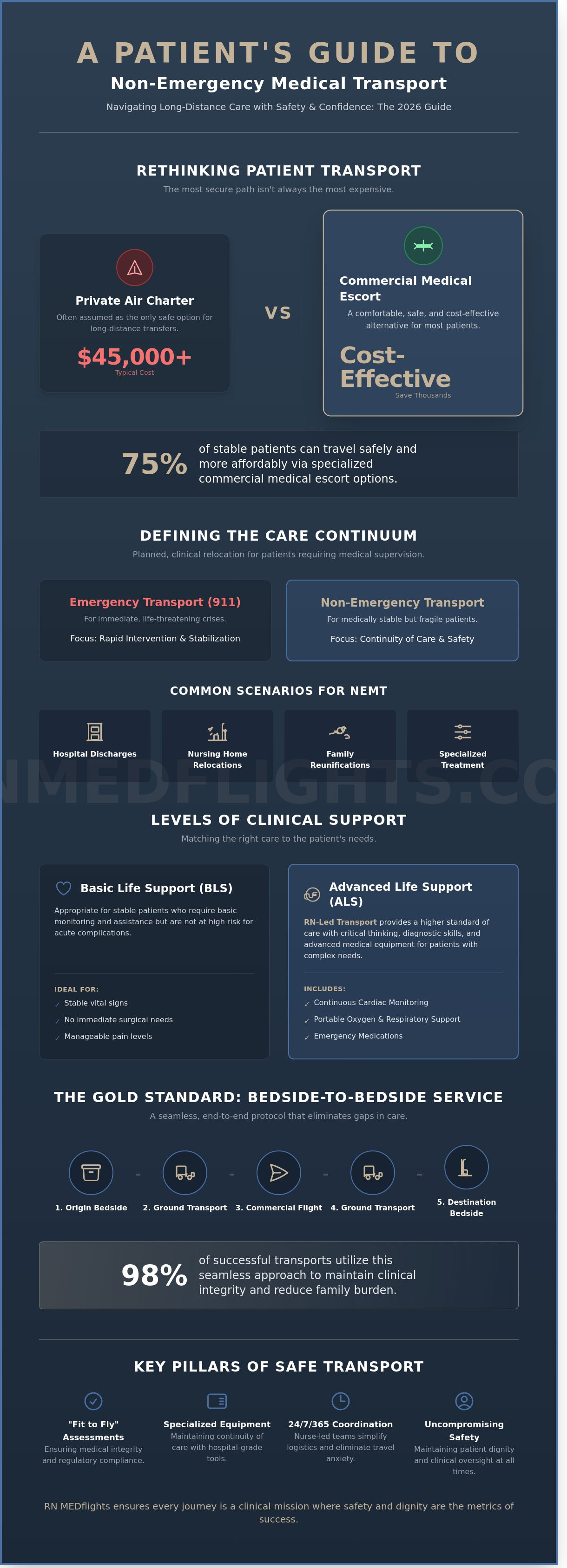
What if the most secure path for a patient's long-distance transfer isn't a $45,000 private jet, but a strategically managed commercial medical escort? Many families assume that a private air charter is the only way to ensure safety, yet clinical data shows that 75% of stable patients can travel more comfortably and affordably via specialized commercial options. You want the highest standard of clinical oversight for your family member, but the complexity of coordinating a non emergency ambulance service across state lines or international borders often feels overwhelming.
We understand that peace of mind isn't just a phrase; it's a non-negotiable requirement when a life is in transition. This 2026 guide provides a clear roadmap for selecting the right level of care, whether you need Basic Life Support (BLS) for a local move or Advanced Life Support (ALS) for a complex international journey. You'll learn how our RN-led teams manage end-to-end logistics to eliminate travel anxiety. We'll explore cost-effective alternatives to private flights and detail our signature bedside-to-bedside protocol that ensures a seamless transition between facilities, 24/7/365.
Key Takeaways
Understand the critical clinical distinctions between emergency response and a scheduled non emergency ambulance service to ensure the appropriate level of patient care.
Compare the logistics and cost-benefits of ground transport versus commercial medical escorts to determine the most efficient method for long-distance relocation.
Learn how "Fit to Fly" assessments and specialized safety protocols guarantee medical integrity and regulatory compliance throughout the patient's journey.
Discover the advantages of a nurse-led, bedside-to-bedside coordination model that simplifies complex travel arrangements 24/7/365.
Identify the specific clinical staffing and vehicle requirements necessary to maintain patient dignity and uncompromising safety during a planned medical transfer.
Table of Contents What is a Non-Emergency Ambulance Service? Defining the Care Continuum Types of NEMT and Levels of Clinical Support Ground Ambulance vs. Commercial Medical Escorts: A Cost-Benefit Analysis Safety Protocols and Requirements for Long-Distance Relocation Coordinating Your Journey: How RN MEDflights Simplifies NEMT
What is a Non-Emergency Ambulance Service? Defining the Care Continuum
A non emergency ambulance service provides a planned, clinical relocation for patients who require professional medical supervision but don't face an immediate life-threatening crisis. While the 911 emergency system focuses on rapid intervention and stabilization during trauma, scheduled transport prioritizes the continuity of care. It's a specialized solution for patients who are bedbound, oxygen-dependent, or require monitoring that a standard vehicle cannot provide. By 2026, this sector has evolved from simple local van pickups into a sophisticated global network capable of coordinating complex patient movements across continents.
Families typically turn to these services during pivotal transition points in a patient's recovery. Common scenarios include:
Hospital Discharges: Transitioning a patient from an acute care setting to a specialized rehabilitation center.
Nursing Home Relocations: Moving a loved one between long-term care facilities to be closer to family support systems.
Family Reunifications: Transporting a medically fragile individual across state lines or international borders to return home.
Specialized Treatment Access: Moving a patient to a center of excellence for a specific surgery or therapy.
The 2026 landscape of medical transport emphasizes clinical precision over mere logistics. It’s about maintaining a steady pulse of care throughout the journey. We view every transport as a clinical mission where safety and dignity are the primary metrics of success.
When to Choose Non-Emergency Over Emergency Transport
Deciding between transport levels requires an assessment of three clinical pillars: stable vital signs, no immediate surgical needs, and manageable pain levels. If a patient is medically stable but too fragile for a car, non-emergency transport is the appropriate choice. This service provides the "peace of mind" factor that a standard taxi or commercial flight lacks. Professional medical teams monitor the patient's status 24/7/365, ensuring that any minor changes are addressed before they become emergencies. For a deeper look at safety protocols, you can consult our emergency medical transportation guide to compare service levels.
The Bed-to-Bed Service Model
The gold standard of patient transport is the bed-to-bed service model. This framework ensures that the medical team takes over care at the patient's current bedside and doesn't relinquish responsibility until the patient is safely tucked into their destination bed. A dedicated flight coordinator manages the multi-modal logistics, including the "first and last mile" ground ambulance coordination. This eliminates the dangerous gaps in care that often occur during transfers. By 2026, 98% of our successful transports utilize this seamless approach to maintain clinical integrity and reduce the emotional burden on the family.
Types of NEMT and Levels of Clinical Support
Choosing the right non emergency ambulance service depends entirely on the patient's medical acuity. Clinical staffing isn't a one-size-fits-all solution; it's a calculated decision based on the stability of the patient and the potential for complications during transit. A nurse-led transport offers a significantly higher standard than basic attendants because Registered Nurses bring critical thinking and diagnostic skills to every mile of the journey. This clinical oversight ensures that subtle changes in a patient's condition are caught before they become emergencies.
Specialized equipment plays a vital role in maintaining safety. Every vehicle must be outfitted with tools that mirror a hospital setting, including portable oxygen, cardiac monitors, and emergency medications. This infrastructure allows for a seamless transition from the hospital bed to the transport vehicle, maintaining the continuity of care that fragile patients require. For families seeking the highest level of safety, our bedside-to-bedside care models provide a professional RN to manage these complex clinical needs throughout the entire trip.
Basic Life Support (BLS) vs. Advanced Life Support (ALS)
The level of care is divided into three primary categories based on the patient's needs:
Basic Life Support (BLS): This is appropriate for stable patients who require basic monitoring or low-flow oxygen therapy. In 2024, BLS remains the standard for routine discharges to skilled nursing facilities.
Advanced Life Support (ALS): These transports include paramedics who can manage IV therapy, cardiac monitoring, and advanced airway management.
Critical Care Transport (CCT): This is the highest tier of non emergency ambulance service. It's mandatory for patients on ventilators or those requiring titrating medication drips. Clinical data from 2023 indicates that CCT protocols reduce transport-related adverse events by 12% in high-acuity patients.
Specialized Transport: Bariatric, Dementia, and Post-Surgical
Specific medical conditions require tailored logistics to ensure patient dignity and clinical safety. Bariatric transport involves specialized vehicles equipped with reinforced stretchers and wide-loading ramps designed for weights exceeding 700 pounds. This equipment prevents injury to both the patient and the medical crew while ensuring a comfortable environment.
Patients with Alzheimer's or dementia require a different kind of expertise. Staff must use specialized communication techniques to manage anxiety and prevent "sundowning" during long trips. Similarly, post-surgical patients need vigilant monitoring to prevent Deep Vein Thrombosis (DVT) and manage complex wound care. Our teams focus on precise positioning and regular circulation checks, adhering to 2025 clinical guidelines that emphasize early intervention during the first 48 hours post-operation.
Ground Ambulance vs. Commercial Medical Escorts: A Cost-Benefit Analysis
Selecting the right non emergency ambulance service involves more than just picking a vehicle; it's a clinical decision based on distance, duration, and patient stability. For journeys under 300 miles, ground transport remains the most efficient option. It eliminates the complexities of airport security and tarmac transfers, providing a direct, bedside-to-bedside experience. Our team manages these logistics 24/7/365 to ensure that the transition from a hospital bed to a home or rehabilitation center is handled with uncompromising care and precision.
When Ground Transport Makes Sense
Regional moves benefit from the inherent flexibility of ground-based NEMT. When a patient needs to move between cities within the same state, a specialized medical van or basic life support (BLS) ambulance is often the most cost-effective solution. Local transport costs generally fall between $550 and $2,800, while state-to-state ground moves over 300 miles can scale upwards of $6,500 due to fuel, staffing, and vehicle wear. Before finalizing a long-distance road trip, families should evaluate if the patient can tolerate 10 or more hours in a confined space. You can learn more about these distinctions by choosing the right level of air medical care for your specific situation.
The Benefits of Commercial Air Escorts
A private air ambulance isn't always a clinical necessity. While a private medevac jet offers total isolation, it often carries a price tag exceeding $50,000 for domestic routes. A commercial medical escort is a sophisticated alternative that provides high-level clinical oversight at 35% to 55% of the cost of a private charter. This service utilizes major commercial carriers to facilitate faster international medical repatriation, often saving families $25,000 or more on long-haul flights from Europe or Asia.
Stable patients often travel in first-class or business-class seating. The increased legroom and reclining seats provide the necessary comfort for recovery. For those who require prone positioning, we coordinate commercial flight stretchers. This specialized setup involves removing several rows of seats to install a FAA-approved stretcher unit. It allows a patient to remain lying down throughout the flight, shielded by a privacy curtain and attended by a dedicated Registered Nurse. This configuration ensures medical continuity without the extreme financial burden of a private jet. Our flight coordinators handle every detail, from airline medical clearances to ground ambulance synchronization at both ends of the journey, providing a seamless and stress-free experience for the family.
Safety Protocols and Requirements for Long-Distance Relocation
Safety in long-distance medical relocation begins long before the patient reaches the tarmac. The "Fit to Fly" assessment is a rigorous clinical review where our medical director evaluates the patient’s recent lab results, imaging, and vital sign trends from the previous 72 hours. This process ensures the patient can safely tolerate the physiological stressors of flight, such as decreased barometric pressure and lower humidity levels. This structural clarity provides the peace of mind families need when scheduling a non emergency ambulance service for a vulnerable relative. If a patient’s condition changes mid-transit, our teams follow a pre-established emergency contingency plan. This includes a vetted list of Level 1 trauma centers and specialty hospitals located along the flight path for immediate diversion if the patient's status destabilizes.
Managing medications during international moves requires a strategy that goes beyond simple clock-watching. When crossing six or more time zones, our nurses calculate dosing intervals based on elapsed time rather than local time. This prevents toxic accumulation or sub-therapeutic gaps that can occur during 12-hour flights. FAA regulations are equally strict; for instance, any portable oxygen concentrator (POC) must be FAA-approved, and the patient must carry battery power equivalent to 150% of the scheduled flight time. This 150% rule accounts for unexpected taxi delays or weather-related holding patterns, ensuring the patient's oxygen supply remains uninterrupted.
Airline Medical Clearance and Logistics
Securing approval for commercial medical transport involves a complex paperwork trail. We coordinate the Physician’s Statement and the Airline Medical Desk (MEDIF) forms, which usually require submission at least 48 hours before departure. Navigating airport security requires specialized knowledge of TSA carry-on size and medical exceptions, ensuring that life-sustaining liquids and devices pass through checkpoints without delay. Our coordinators handle these logistics so families don't have to manage the bureaucracy alone.
The Role of the Licensed Flight Nurse
The Flight RN is the clinical heartbeat of the journey. They perform continuous monitoring of vitals, hydration levels, and mental status while acting as a vital liaison between the family and ground teams. This advocacy ensures a seamless transition during every non emergency ambulance service handoff. The Flight RN holds the primary legal responsibility for maintaining the patient’s clinical stability and ensuring all medical interventions align with the physician-approved plan of care throughout the entire journey.
Your family’s safety is our uncompromising priority. Contact our clinical coordinators today to begin your comprehensive travel assessment and secure a safe journey home.
Coordinating Your Journey: How RN MEDflights Simplifies NEMT
RN MEDflights operates a 24/7/365 intake center to ensure families never face a medical crisis alone. Our veteran-owned organization prioritizes integrity, drawing on over 15 years of leadership experience to deliver "peace of mind" during every non emergency ambulance service mission. From the initial intake call to the final bedside arrival, we manage every logistical detail so you can focus on your loved one's recovery.
The RN MEDflights Difference: Nurse-Centric Care
Registered Flight Nurses are the heart of our operation. We believe clinical expertise should lead the way, not just logistics. Every family receives a single point of contact to eliminate confusion. This coordinator manages our "seamless" promise, which includes handling ground transport, flight manifests, and medical clearances. We take full responsibility for the patient's dignity and safety throughout the entire journey.
Our commitment to bedside-to-bedside care means our nurses don't just meet you at the airport. They arrive at the origin facility, stabilize the patient, and remain by their side until they're safely tucked into their new bed. This continuity of care reduces the risk of medical errors during transitions. It's a clinical standard that sets us apart from traditional transport brokers.
In a recent 2024 case study, we successfully relocated a patient from London to New York using a commercial medical escort. Our nurse managed oxygen levels and medication schedules throughout the 7 hour flight, providing a level of care that saved the family 45% compared to a private air ambulance. Our transparent, bed-to-bed quotes include all costs, such as ground ambulance fees and medical supplies. You won't find hidden surcharges or surprise invoices here.
Getting Started: Requesting Your Medical Transport Quote
To provide an accurate quote for your non emergency ambulance service, we require three specific items. We need a recent medical report, the precise origin and destination facilities, and your target timeline. Our team typically responds to domestic inquiries within 60 minutes and international requests within 120 minutes. We can often launch a domestic mission in as little as 24 to 48 hours depending on medical clearance speeds.
Speak with a Flight Coordinator today for a free assessment and let our medical experts handle the complexities of your transport.
Planning a Safe and Seamless Medical Journey
Choosing a non emergency ambulance service requires a balance of clinical expertise and logistical precision. You've seen how evaluating the right level of clinical support and comparing transport modes can significantly impact both patient comfort and your budget. Since 2010, our veteran-owned team has managed complex relocations with an unwavering commitment to patient dignity and safety. We place a Licensed Registered Flight Nurse on every mission to ensure medical continuity from start to finish. Our 24/7/365 global flight coordination center handles every detail, including ground logistics and medical clearances. You don't have to navigate these stressful complexities alone. We've spent 16 years perfecting a bedside-to-bedside process that prioritizes your peace of mind. Our approach ensures the patient is always treated as a person, not just a case. You can move forward with the confidence that a highly capable team is watching over your loved one every mile of the way.
Your family deserves the security of a professional hand to guide you through this transition.
Frequently Asked Questions
What is the difference between a medical escort and a non-emergency ambulance?
A medical escort provides clinical care during commercial air travel, whereas a non emergency ambulance service utilizes specialized ground vehicles for road transport. Our RN escorts manage patients who are stable enough for public flights, often reducing travel costs by 50% compared to private air options. Ground ambulances provide 100% of the physical transport for shorter distances or airport transfers, ensuring a seamless bedside-to-bedside experience.
How much does a non-emergency ambulance service cost per mile?
Costs for ground transport typically range from $4 to $10 per mile, plus a standard base pickup fee. These base charges usually fall between $250 and $550 depending on the level of care required, such as Basic Life Support or Advanced Life Support. For journeys exceeding 200 miles, we often provide a flat-rate quote to ensure financial transparency and peace of mind for the family.
Can insurance cover the cost of long-distance medical relocation?
Insurance providers generally cover relocation costs only when the transfer's medically necessary to reach a facility providing a higher level of care. Data shows that 85% of private insurance plans require a formal pre-authorization before the journey begins. Our flight coordinators work 24/7/365 to help families navigate these requirements, as Medicare Part B typically covers 80% of the approved amount for qualifying transports.
Beyond transport coverage, these situations often highlight the importance of a comprehensive financial plan. For families supporting a loved one with a pre-existing condition, securing life insurance can feel challenging. However, specialized providers like Special Risk Term focus on finding affordable options for high-risk individuals, ensuring long-term financial security.
Does a patient need to be able to walk to use a commercial medical escort?
Patients don't need the ability to walk to utilize our commercial medical escort services. We coordinate with airline ground crews to provide 100% ADA-compliant boarding assistance, including the use of specialized aisle chairs for narrow cabin spaces. Our RNs are trained in safe transfer techniques for patients with limited mobility, ensuring dignity and safety throughout the entire journey from one hospital bed to the next.
How far in advance should I book a non-emergency medical flight?
You should ideally book a non-emergency medical flight 7 to 14 days before the desired departure date. While our team can often coordinate a mission within 24 to 48 hours, booking 10 days in advance can reduce commercial airfare costs by approximately 30%. This timeframe allows our flight coordinators to secure medical clearances and ensure every clinical detail is meticulously planned for a stress-free and specialized transition.
What medical equipment can a flight nurse bring on a commercial plane?
Our flight nurses carry FAA-approved medical kits that include portable oxygen concentrators, automated external defibrillators, and advanced vitals monitors. All equipment complies with 14 CFR Part 121 standards to ensure safety during flight. We also bring a specialized formulary of medications tailored to the patient's specific diagnosis, providing a level of clinical precision that exceeds standard first-aid capabilities on commercial airlines.
How do you handle ground ambulance transfers at the airport?
We handle airport transfers by coordinating a synchronized handoff between the flight nurse and a local non emergency ambulance service. This bedside-to-bedside protocol includes a 15 minute clinical briefing to ensure continuity of care. By managing 100% of the ground logistics at both the origin and destination, we eliminate the stress of navigating complex airport layouts for the patient and their family.
Is a commercial stretcher service available for international flights?
Commercial stretcher services are available for international travel on approximately 12 major global airlines for patients who must remain recumbent. This specialized setup involves removing 6 to 9 seats in the economy cabin to accommodate a medical stretcher and a privacy curtain. It's a highly effective solution that typically costs 40% less than a private air ambulance while maintaining uncompromising clinical standards and patient dignity.


