


Carry-On Size Guide 2026: Airline Dimensions and Medical Exceptions
- Mar 29
- 12 min read
Updated: Mar 30

You're standing at the boarding gate with a specialized ventilator, only to hear the gate agent announce that all bags exceeding the standard carry on size must be checked into the cargo hold. For a patient relying on that equipment, this moment triggers more than just frustration; it creates a genuine medical risk. We know the anxiety that comes when your peace of mind depends on fragile technology that isn't meant for a luggage bin. You believe that your health shouldn't be compromised by a 22 by 14 by 9 inch metal sizer, and we agree that medical integrity must come first.
Our team of flight coordinators compiled this definitive 2026 guide to help you reclaim control over your journey. You'll learn how to master current airline dimensions while utilizing the specific TSA medical exemptions that protect your right to carry life-sustaining supplies. We'll outline the exact documentation required to bypass standard baggage limits and provide a clinical packing strategy that ensures your equipment arrives with its integrity fully intact. This specialized approach turns a high-stress logistical hurdle into a seamless, predictable flight experience.
Key Takeaways
Master the 2026 industry standards to ensure your luggage meets the universal 22 x 14 x 9-inch carry on size requirements across major global carriers.
Discover how specific FAA and TSA guidelines protect your right to carry essential medical equipment without it counting toward your standard bag limit.
Learn strategic packing techniques to maximize your overhead space while keeping life-critical medications and electronics easily accessible for security.
Identify the subtle differences in enforcement between legacy airlines and low-cost carriers to avoid unexpected fees and "Basic Economy" logistical traps.
Understand how professional medical escorts provide seamless bedside-to-bedside coordination, managing complex travel logistics to ensure a dignified and stress-free journey.
Table of Contents:
Understanding Standard Carry-On Size and Dimensions in 2026 Comparing Carry-On Limits Across Major Global Airlines The Medical Exception: Flying with Equipment and Medication Strategic Packing: Maximizing Your 22 x 14 x 9 Space How Professional Medical Escorts Simplify Travel Logistics
Understanding Standard Carry-On Size and Dimensions in 2026
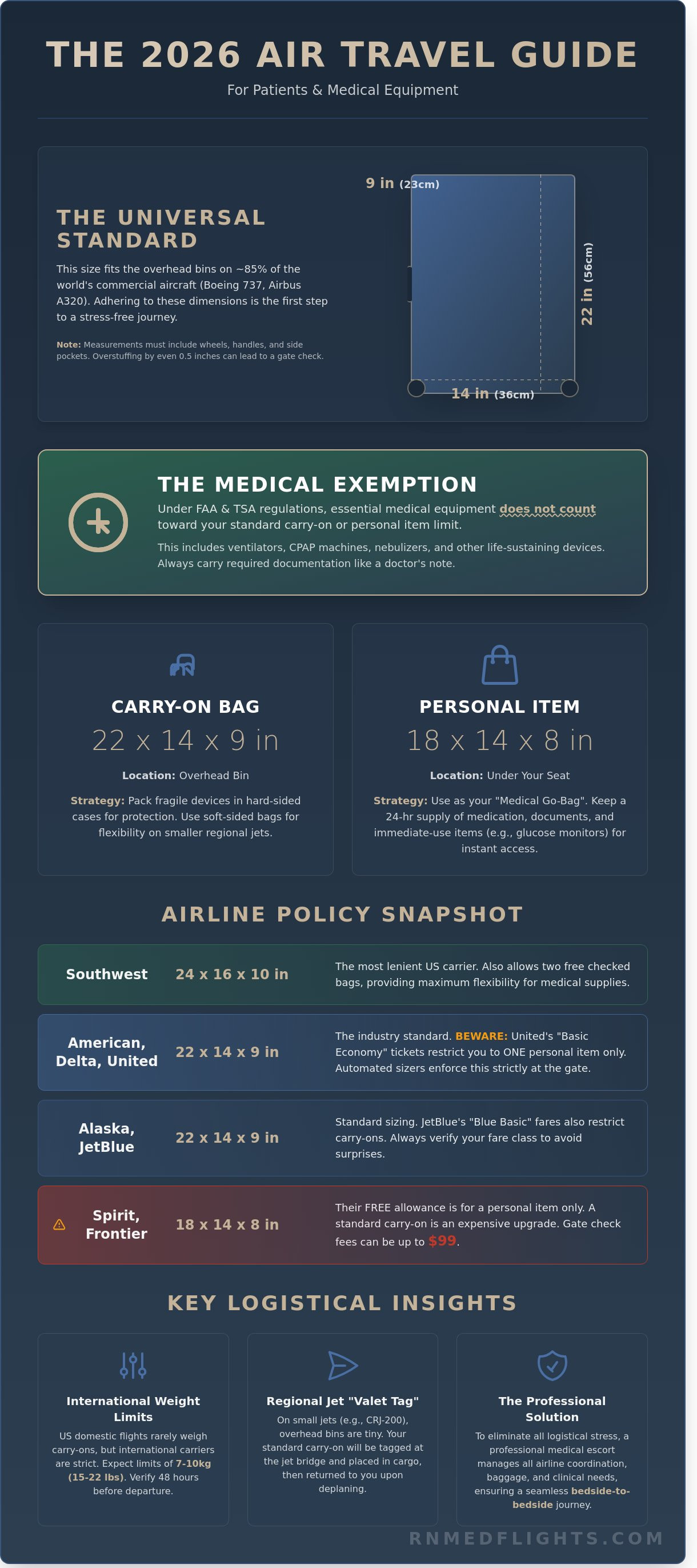
The universal benchmark for a carry on size remains 22 x 14 x 9 inches, or 56 x 36 x 23 centimeters. This specific geometry ensures that luggage fits into the overhead compartments of the Boeing 737 and Airbus A320 families, which comprise approximately 85% of the global narrow-body fleet. Sticking to these dimensions provides peace of mind that your essential items stay with you rather than being moved to the cargo hold. Our clinical teams often observe that maintaining control over your luggage is the first step in a stress-free journey, especially when managing complex health needs.
Accuracy in measurement is vital for seamless boarding. Airlines don't just measure the storage shell of the bag; they calculate the total volume including wheels, top handles, and any protruding side pockets. If a bag is overstuffed by even 0.5 inches, it may fail to clear the gate check. Some carriers utilize a "linear inch" requirement instead of individual dimensions. You calculate this by adding the length, width, and height together, with 45 linear inches being the standard limit for major US carriers like United and American Airlines as of 2026.
Weight restrictions represent a significant point of divergence between domestic and international travel. While most US domestic airlines don't strictly weigh cabin bags, international carriers frequently enforce a limit between 7kg (15 lbs) and 10kg (22 lbs). We recommend verifying these limits 48 hours before departure, as exceeding them can lead to unexpected delays and physical strain during the boarding process.
The Difference Between a Carry-On and a Personal Item
A personal item is designed for under-seat storage and typically adheres to dimensions of 18 x 14 x 8 inches. Common examples include laptop bags, small backpacks, or purses. For patients and families, we view the personal item as your "medical go-bag." It should contain your 24-hour supply of medication, specialized clinical documentation, and immediate-use items like glucose monitors or inhalers to ensure they are accessible without leaving your seat.
Soft-Sided vs. Hard-Sided Luggage
Choosing between materials depends on your specific clinical and logistical requirements. Soft-sided bags offer a "squeeze factor" that allows them to conform to the irregular shapes of narrow overhead bins on regional jets. In contrast, hard-sided luggage provides uncompromising integrity for the protection of fragile medical devices, such as CPAP machines or nebulizers, against external pressure. The metal sizer box located at the airport boarding gate serves as the final authority for determining if your luggage meets the required carry on size before you are permitted to board.
Comparing Carry-On Limits Across Major Global Airlines
Mastering the specifics of carry on size is a clinical necessity for a seamless travel experience. The "Big Three" US carriers, American, Delta, and United, generally adhere to a standard dimension of 22 x 14 x 9 inches. While the measurements are uniform, enforcement is not. United Airlines employs automated gate sizers at approximately 40% of its domestic hubs to strictly monitor Basic Economy passengers. These travelers are restricted to a single personal item that must fit under the seat, creating a logistical hurdle for those unprepared for the "Basic Economy trap."
Low-cost carriers like Spirit and Frontier utilize a different financial model entirely. Their complimentary personal item limit is a restrictive 18 x 14 x 8 inches. If a bag exceeds these dimensions by even half an inch, gate agents may impose fees reaching $99 at the boarding terminal. This rigid enforcement can cause significant emotional distress during an already taxing journey. For families managing complex needs, our bedside-to-bedside medical transport eliminates these logistical variables by providing a dedicated clinical team to handle every detail of the transition.
Regional jets present the final hurdle in domestic logistics. Aircraft like the Embraer 145 or the Bombardier CRJ-200 feature overhead bins that are 30% smaller than those on mainline Boeing 737s. On these flights, standard rollaboard bags are typically "valet tagged" at the aircraft door. This means your luggage is placed in the cargo hold and returned to you on the jet bridge immediately upon deplaning, rather than at the baggage carousel.
Domestic US Airline Size Chart
Southwest Airlines: 24 x 16 x 10 inches. They remain the most lenient carrier, offering two free checked bags alongside a generous carry-on allowance.
Alaska Airlines: 22 x 14 x 9 inches. They are known for high compliance but offer more flexibility with soft-sided bags that can be compressed.
JetBlue: 22 x 14 x 9 inches. Blue Basic fares do not include overhead bin space, meaning any bag larger than a backpack must be checked for a fee.
International Carrier Restrictions
International travel introduces a shift from size-based limits to weight-based restrictions. Lufthansa and Emirates often enforce a strict 7kg to 8kg (15 to 17.6 lbs) weight cap for cabin luggage. This is a sharp contrast to US domestic flights where weight is rarely measured. British Airways is a notable exception, allowing up to 23kg (51 lbs) as long as the passenger can lift the bag into the bin unassisted. Always audit the smallest aircraft in your itinerary. A bag that fits on a transoceanic Airbus A350 may be rejected during a short-haul connection on a turboprop aircraft in Europe or Asia.
The Medical Exception: Flying with Equipment and Medication
Understanding airline regulations becomes simpler once you recognize that your health and safety take priority over standard cabin logistics. Under FAA 14 CFR 382.121 and TSA guidelines, medical devices and necessary supplies don't count toward your standard baggage allowance. This federal protection provides a vital safety net for patients who require specialized gear to remain stable during transit. You can bring a dedicated medical bag as a free third item, regardless of the standard carry on size limits enforced for other passengers.
A medical necessity is defined as any equipment required to manage a health condition during travel. These items must be allowed in the cabin to ensure patient safety. The list of exempt "free" items typically includes:
CPAP and BiPAP machines for sleep apnea
Breast pumps and associated milk storage kits
Portable Oxygen Concentrators (POCs)
Nebulizers and specialized dialysis equipment
Mobility aids such as canes, crutches, or walkers
For patients requiring higher levels of clinical support, commercial stretcher services offer a specialized alternative. These configurations typically occupy 6 to 9 seats in the economy cabin to accommodate the patient and the medical team. In these instances, the standard carry on size rules are superseded by the clinical requirements of the mission. We ensure that advanced life support equipment is positioned for immediate access, providing the bedside-to-bedside continuity that defines our standard of care.
Managing Medications and Liquids
The TSA 3-1-1 rule provides a specific exception for medically necessary liquids, gels, and aerosols. You aren't limited to 3.4 ounces (100ml) for items like insulin, saline, or liquid nutrition. While a doctor's note isn't a legal requirement for domestic travel, carrying a signed statement from your physician facilitates a smoother screening process at the checkpoint. Our flight nurses recommend keeping "rescue meds," such as EpiPens or nitroglycerin, in your personal item under the seat. You shouldn't store life-saving medications in the overhead bin where they might be inaccessible during unexpected turbulence.
Traveling with Large Medical Devices
If you're traveling with a Portable Oxygen Concentrator, it must be on the FAA-approved list for cabin use. Airlines require you to carry enough battery life to cover 150% of your scheduled flight time to account for potential tarmac delays. For nebulizers or dialysis equipment, ensure the device is clearly labeled for gate agents. You should attach a bright, durable "Medical Equipment" tag to these bags to avoid gate-check disputes and ensure your life-sustaining gear remains in the cabin with you at all times.
Strategic Packing: Maximizing Your 22 x 14 x 9 Space
Maximizing the standard 22 x 14 x 9 carry on size requires a clinical approach to organization. Every square inch must serve a purpose, especially when you're transporting life-sustaining equipment alongside personal items. Use the bundle wrapping technique to protect fragile monitors or nebulizers. This method involves wrapping soft clothing layers tightly around your medical devices to create a shock-absorbent core. It prevents shifting during turbulence and eliminates the need for bulky bubble wrap.
Strategic layering is essential for a seamless security experience. Place your electronics and prescription bottles in a clear, removable organizer at the top of your bag. This allows for rapid TSA inspection without disrupting the integrity of your neatly packed supplies. You'll also want to adhere to the 48-hour rule. Pack enough medication and sterile supplies to sustain your health for two full days beyond your scheduled arrival. Data from 2024 indicates that nearly 15% of international flight disruptions last longer than six hours; having a 48-hour buffer ensures you aren't left vulnerable during a delay.
Weight distribution affects both your physical strain and the safety of your gear. Place heavy medical equipment, such as a portable oxygen concentrator, at the bottom of the bag near the wheels. This lowers the center of gravity. It keeps the suitcase stable and prevents it from tipping over in crowded terminals, which protects your expensive clinical tools from impact damage.
The Flight Nurse’s Essential Carry-On Checklist
Our medical teams utilize a standardized kit to maintain patient stability during transport. Your bag should mirror these professional standards to ensure safety and comfort. We recommend including these specific items:
Clinical Essentials: 10 pairs of nitrile gloves, a 3.4 oz bottle of hospital-grade sanitizer, and a calibrated pulse oximeter.
Patient Comfort: 20-30 mmHg graduated compression socks to manage circulation and electrolyte replacement packets for hydration.
Communication: A 20,000 mAh external battery pack and a printed list of your medical history and emergency contacts.
Avoiding the Gate-Check: Tips for Priority Boarding
Medical travelers shouldn't risk gate-checking bags containing essential gear. Under the Air Carrier Access Act, you've got the right to pre-board if you need extra time to stow medical equipment. Approach the gate agent 30 minutes before boarding begins. Inform them you're traveling with life-critical medical supplies that cannot be placed in the cargo hold. This proactive step ensures you're among the first on the aircraft, allowing you to secure overhead space directly above your seat. Keeping your gear within reach is a non-negotiable safety standard for any medical journey.
If you require professional oversight and logistical support during your journey, contact
.
How Professional Medical Escorts Simplify Travel Logistics
Traveling with a medical condition involves more than just measuring a suitcase. While standard carry on size limits of 22x14x9 inches apply to most passengers, medical travelers face unique hurdles that go beyond physical dimensions. RN MEDflights provides bedside-to-bedside continuity, managing every piece of equipment and personal luggage so the family doesn't have to. We handle the physical baggage you can't carry; we ensure oxygen concentrators and specialized supplies meet 2026 TSA and FAA safety standards without delay.
Our team manages ground ambulance transfers at both ends of the journey. We handle airline check-in and security clearance, navigating the complex 2026 terminal layouts that often require 20 minutes of additional transit time for mobility-impaired passengers. A dedicated flight nurse acts as an expert advocate, ensuring the flight crew respects your medical rights and accommodates necessary equipment. This allows you to focus on the patient's comfort while we manage the logistics of the overhead bin and the 22x14x9 requirements.
Beyond the Bag: Comprehensive Medical Support
A specialized Flight Coordinator begins the pre-flight planning process 48 to 72 hours before departure. They verify medical clearances and coordinate with airline disability desks to confirm equipment compatibility. Nurse-led transport is significantly safer for non-emergency repatriation because our staff can intervene immediately if a patient's condition changes at 35,000 feet. You can learn about our Commercial Airline Medical Escort services to see how we prioritize clinical integrity during every mile of the trip.
Requesting a Seamless Medical Journey
Securing a professional medical escort is a straightforward process designed to reduce your stress. You can obtain a detailed quote for international or domestic medical relocation by providing the patient's current clinical status and destination. The RN MEDflights team maintains 24/7/365 availability, responding to urgent transport requests within 2 to 4 hours in most cases. We provide a steady hand throughout the entire process, from the first phone call to the final bedside handoff. Contact RN MEDflights for professional medical travel support today to ensure a safe, dignified, and uncompromising journey for your loved one.
Mastering Your 2026 Air Travel Logistics
Success in 2026 air travel requires a precise understanding of the standard 22 x 14 x 9 inch carry on size. While major airlines maintain these dimensions, your medical needs shouldn't be restricted by overhead bin space. Federal guidelines under the Air Carrier Access Act ensure that 100% of essential medical devices and medications travel with you without extra fees. Navigating these regulations while managing a health condition demands expert oversight to prevent complications at the gate.
RN MEDflights provides the clinical authority needed for these complex journeys. As a veteran-owned small business, we offer a nurse-centric approach where licensed RN flight escorts manage every detail. Our team provides comprehensive bedside-to-bedside coordination, ensuring your equipment and care remain seamless from your home to your final destination. We'll handle the logistics so you can focus on recovery and comfort during your flight. Ensure a safe, stress-free journey with RN MEDflights. Your health and safety are our highest priorities on every mile of the journey.
Frequently Asked Questions
Does a CPAP machine count as a carry-on bag?
A CPAP machine doesn't count toward your standard baggage limit because it's classified as essential medical equipment under Department of Transportation rule 14 CFR Part 382. You can bring your device in its own dedicated case in addition to your standard carry on size bag and personal item. Our flight coordinators recommend labeling the case as Medical Equipment to ensure a seamless boarding process and avoid any confusion with gate agents.
What happens if my carry-on is 1 inch too big?
Your bag will likely be gate-checked if it exceeds the standard airline dimensions by even 1 inch, as most sizer boxes have zero tolerance for oversized luggage. Airlines like American and United currently charge between $30 and $65 for bags that must be moved to the cargo hold at the last minute. To maintain peace of mind, always verify your carry on size with a tape measure before arriving at the airport.
Can I bring a separate bag for my medications?
You can bring a separate bag dedicated exclusively to medications and life-sustaining supplies without it counting against your baggage allowance. The TSA allows passengers to carry medically necessary liquids, gels, and aerosols in volumes larger than 3.4 ounces if they're declared at the security checkpoint. We suggest keeping 100% of your critical prescriptions in this separate bag to ensure they remain accessible during the flight and aren't accidentally checked into the cargo hold.
How many bags can I carry on if I have a medical escort?
You're entitled to your standard airline baggage allowance plus any necessary medical equipment when traveling with a specialized medical escort. This usually means one carry-on, one personal item, and unlimited bags containing only medical supplies or devices. Our RN Medflights teams provide bedside-to-bedside support, managing these logistics for you to ensure that 100% of your specialized equipment arrives safely at your final destination without extra fees or delays.
Do airlines charge for medical equipment in the cabin?
Airlines don't charge fees for medical equipment carried in the cabin, as mandated by the Air Carrier Access Act. This federal law ensures that devices like ventilators, respirators, and CPAP machines are transported free of charge for all passengers. If an airline representative attempts to charge you, cite 14 CFR Part 382 to protect your rights. Our team is available 24/7/365 to help patients navigate these complex regulatory requirements during transport.
What are the TSA rules for liquid medications in carry-ons?
Medically necessary liquids are exempt from the TSA 3-1-1 rule, meaning you can carry more than 3.4 ounces or 100 milliliters in your hand luggage. You must declare these items to a TSA officer at the start of the screening process for a manual inspection. In 2024, the TSA processed millions of passengers with medical needs, and having your prescriptions in their original pharmacy containers helps ensure a dignified and efficient security experience.
Is a diaper bag considered a personal item or a carry-on?
Most major carriers like Delta and Southwest treat a diaper bag as an additional free item that doesn't count as a personal item or a carry-on. This policy allows parents to bring essential supplies for infants without sacrificing their own luggage space. Always check your specific carrier's contract of carriage, as 90% of domestic airlines offer this exception, but some ultra-low-cost carriers may have more restrictive 2026 guidelines regarding total bag counts.
Can I bring a portable oxygen concentrator (POC) on a commercial flight?
You can bring a portable oxygen concentrator on a commercial flight provided the device is FAA-approved and has a label stating it meets oxygen requirements. Passengers must ensure their battery life lasts for 150% of the total flight duration to account for potential delays on the tarmac or in the air. Our specialized flight coordinators verify these technical specifications for every patient, providing the uncompromising safety and reliability required for high-altitude medical travel.


