


Emergency Medical Transportation: A Family Guide & Safety Checklist
- Mar 29
- 12 min read
Updated: Mar 30

On October 14, 2024, a family in Florida faced a critical choice when their patriarch required a cardiac transfer to a facility 1,200 miles away. Like them, you've likely found that the sudden need for emergency medical transportation brings a heavy weight of responsibility and a thousand unanswered questions. You want to ensure your loved one receives advanced life support without the fear of clinical gaps or logistical failures during the journey. It's a high-stakes environment where every minute counts and technical precision is non-negotiable.
We understand that this moment is about more than just a flight; it's about the dignity and safety of your family member. This guide provides the clinical clarity you need to distinguish between specialized medevac services and non-emergency options while avoiding the 15% average cost overruns typically seen in poorly coordinated transfers. You'll learn exactly how to vet providers using our 2026 safety checklist, which includes 14 critical clinical benchmarks, to ensure a seamless, bedside-to-bedside transition. We'll walk through the essential logistics, from flight coordination to final hospital admission, so you can move forward with total peace of mind.
Key Takeaways
Understand the critical differences between transport levels to ensure your loved one receives the appropriate clinical oversight for their specific medical needs.
Utilize our 2026 5-point checklist to verify Registered Nurse credentials and confirm your provider manages all ground ambulance logistics for a seamless transition.
Perform a detailed cost-benefit analysis between private medevac jets and commercial medical escorts to find a safe, budget-conscious travel solution.
Prepare for a stress-free journey by mastering the documentation process and managing medication surpluses to protect against unexpected travel delays.
Learn why a nurse-led approach to emergency medical transportation offers the bedside-to-bedside continuity essential for patient dignity and family peace of mind.
Table of Contents:
Understanding the Spectrum of Emergency Medical Transportation
The 5-Point Checklist for Choosing a Medical Transport Provider
Air Ambulance vs. Commercial Medical Escort: A Cost-Benefit Analysis Pre-Trip Preparation:
A Checklist for Families Navigating Clinical Logistics with RN MEDflights
Understanding the Spectrum of Emergency Medical Transportation
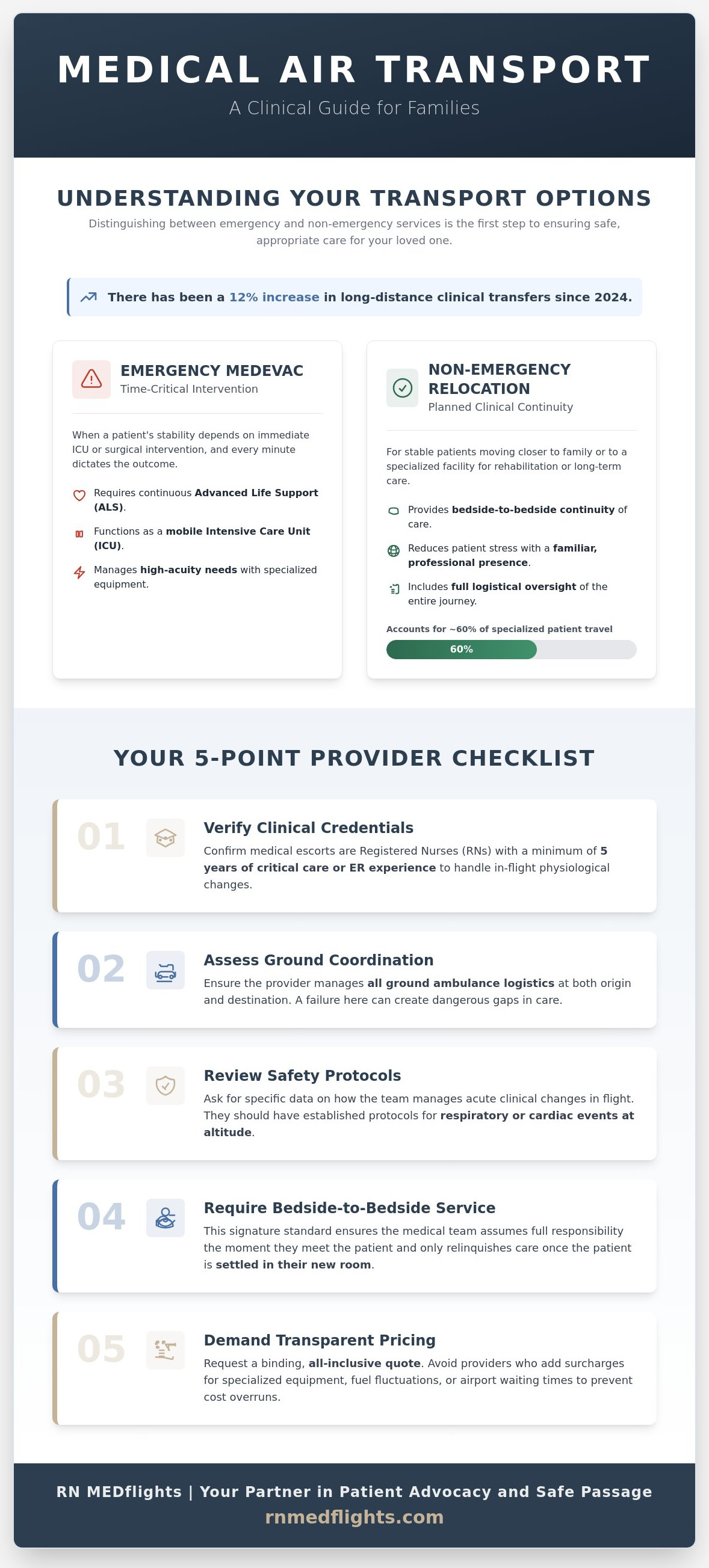
The landscape of medical logistics in 2026 has evolved into a highly specialized field. It's no longer just about the local ambulance ride to the nearest ER. Families often find themselves managing complex relocations where clinical oversight is the primary priority. While local EMS focuses on the first 15 minutes of a crisis, international medical repatriation handles the next 15 hours. We've seen a 12% increase in long-distance clinical transfers since 2024, highlighting a shift toward specialized travel nursing. Sometimes, the most critical care happens at 30,000 feet without a single siren. Our flight coordinators work 24/7/365 to ensure every mile of the journey maintains the same standard of care found in a top-tier hospital.
When is Transportation Considered an Emergency?
An emergency exists when a patient's stability depends on immediate surgical or ICU intervention. These cases require continuous Advanced Life Support (ALS) and specialized equipment like ventilators or cardiac monitors. Emergency medical transportation is a time-critical clinical intervention. When minutes dictate outcomes, we deploy teams capable of managing high-acuity needs during transit. This isn't just a ride; it's a mobile intensive care unit. Our RN-led teams ensure that life-saving protocols remain uninterrupted from the moment we take over care. Safety isn't a goal; it's our uncompromising standard.
The Rise of Non-Emergency Medical Relocation
Non-emergency medical relocation accounts for roughly 60% of specialized patient travel as of 2025. Families choose this path to move loved ones closer to home for rehabilitation or to access specialized treatment centers. The core of this service is bedside-to-bedside continuity. An RN-led escort manages the entire transition, from the hospital discharge to the final arrival at a private residence or care facility. This model reduces the physiological stress on the patient by providing a familiar, professional presence throughout the journey. It bridges the gap between acute care and long-term recovery with uncompromising integrity.
Clinical Continuity: Maintaining the exact medication and monitoring schedule established by the sending physician.
Logistical Oversight: Managing ground ambulance coordination, flight manifests, and medical clearances.
Emotional Security: Providing a steady, expert hand for families who feel overwhelmed by the complexity of emergency medical transportation logistics.
By prioritizing the patient as a person rather than a case, we deliver a seamless experience that honors the dignity of those in our care. Our approach ensures that even when the situation isn't a "lights and sirens" emergency, the level of clinical vigilance remains at its peak.
The 5-Point Checklist for Choosing a Medical Transport Provider
Selecting a partner for emergency medical transportation is a high-stakes decision that requires more than a cursory search. Families must prioritize clinical excellence and logistical precision to ensure a safe transition. Use this 5-point checklist to evaluate potential providers before committing to a mission.
Verify Clinical Credentials: Confirm that medical escorts are Registered Nurses (RNs) with a minimum of 5 years of critical care or emergency room experience.
Assess Ground Coordination: Ensure the provider manages ground ambulance logistics at both the origin and the destination. A failure in ground transport often leads to dangerous gaps in care.
Review Safety Protocols: Ask for specific data on how the team manages acute clinical changes in flight. Providers should have established protocols for respiratory distress or cardiac events at altitude.
Require Bedside-to-Bedside Service: This signature standard ensures the medical team assumes responsibility the moment they meet the patient and doesn't relinquish care until the patient is settled in their new room.
Demand Transparent Pricing: Request a binding, all-inclusive quote. Avoid providers who add surcharges for specialized equipment, fuel fluctuations, or airport waiting times.
Vetting Clinical Expertise
Flight nurse experience is vital because altitude significantly alters human physiology. At 35,000 feet, cabin pressure usually mimics an 8,000-foot elevation, which can cause gases to expand and oxygen levels to drop. A qualified bedside-to-bedside medical escort understands these variables and adjusts treatment accordingly. You should also ask if a board-certified Medical Director reviews every transport plan. For international missions, verify that the provider carries at least $5 million in professional liability insurance to protect the patient's interests across borders.
Logistical Integrity and Reliability
Coordinating with commercial airlines involves navigating complex TSA Cares programs and securing specific seating for medical equipment. These logistics are delicate; in fact, ground ambulance delays account for 40% of all transport disruptions. A reliable provider eliminates this risk by managing every transition point. Our flight coordinators remain available 24/7/365 to provide real-time updates, ensuring families aren't left wondering about their loved one's status. This constant availability serves as a lifeline during the intense 12 to 24 hours of an active mission, providing the professional oversight necessary for a seamless journey.
Air Ambulance vs. Commercial Medical Escort: A Cost-Benefit Analysis
Choosing the right mode of emergency medical transportation requires balancing clinical safety with financial reality. Our flight coordinators evaluate each patient's acuity to determine if a private jet or a commercial escort provides the safest path home. This decision hinges on the patient's stability and the level of intervention required during transit. We prioritize clinical integrity by matching physiological needs with the most efficient transport method available.
A commercial medical escort can reduce total expenses by 50% to 70% compared to private medevac services. This significant cost reduction doesn't compromise care; it simply utilizes existing aviation infrastructure for stable patients who require professional monitoring rather than a flying ICU. We provide bedside-to-bedside continuity to ensure a seamless transition between facilities.
The Private Air Ambulance (Medevac) Option
Private air ambulances are necessary for ventilator-dependent patients or those in unstable, critical condition. These specialized jets function as mobile intensive care units. They're equipped with advanced life support systems and staffed by a dedicated critical care team. You gain complete control over departure times and can access smaller regional airports closer to your destination. However, the specialized nature of these flights results in higher costs, often ranging from $25,000 to over $100,000 depending on the distance and equipment needed. It's the only safe choice for patients who can't maintain their own airway or require continuous cardiac monitoring.
The Commercial Medical Escort Alternative
This option is ideal for stable patients with dementia, limited mobility, or those recovering from non-critical surgeries. An experienced Registered Nurse accompanies the patient on a commercial flight, providing medical oversight and personal care. We manage all logistics, including airline bookings and TSA clearance. While this method is subject to airline schedules, it offers a dignified and stress-free experience in a first-class or business-class cabin. Our RN-led teams ensure that medication administration and hygiene needs are met with compassion. This service is available 24/7/365 to assist families in bringing their loved ones home safely and affordably.
Private Medevac: Best for ICU-level care and immediate, life-critical needs.
Commercial Escort: Best for stable patients requiring 50-70% lower costs.
Stretcher Services: Available on select international commercial flights for patients who must remain prone.
Pre-Trip Preparation: A Checklist for Families
Preparing for emergency medical transportation requires a meticulous approach to every clinical and logistical detail. While our team manages the heavy lifting, family involvement ensures the transition remains smooth and patient-centered. We operate on a bedside-to-bedside philosophy, meaning our responsibility begins at the sending facility and only concludes once the patient is settled into their new bed. This continuity of care reduces the risk of medical errors during handoffs and provides a stable environment for your loved one.
Medical Documentation and Clearances
A dedicated Flight Coordinator acts as the central point of contact, managing the rigorous medical clearance process required by airlines and international authorities. Every mission requires a Patient Assessment completed within 24 hours of the scheduled departure. This assessment provides a real-time clinical snapshot, confirming the patient is stable for flight and that all necessary life-support equipment is on board. For international repatriation, families must ensure passports are valid for at least 6 months. Our team handles the specific visa requirements for over 190 countries, ensuring that legal hurdles don't delay life-critical transport.
Physical and Emotional Comfort
Clinical safety is our uncompromising standard, but we never lose sight of the patient's dignity. We require families to provide a 48-hour surplus of all current medications. This buffer accounts for potential delays caused by weather or air traffic, ensuring the patient's treatment regimen is never interrupted. During the journey, a specialized flight nurse manages more than just vitals; they are trained to mitigate the psychological stress of long-haul travel through constant communication and comfort measures. Families can find peace of mind by following the journey through our 24/7 satellite tracking system, which provides real-time updates on the aircraft's position.
Medication Audit: Verify a 48-hour extra supply of all prescriptions is packed and accessible.
Document Check: Confirm the presence of "Fit to Fly" letters and updated medical records.
Personal Items: Pack a small bag with essential comfort items, such as a familiar blanket or photos.
Facility Coordination: Confirm the receiving hospital has a bed assigned and an attending physician ready for the handoff.
Our goal is to lower the emotional temperature of a crisis by handling every complex detail with clinical precision. If you're ready to arrange a safe transition, you can request a comprehensive transport quote from our specialized flight coordinators today.
Navigating Clinical Logistics with RN MEDflights
When a medical crisis occurs, the logistics of relocation should be the least of your worries. RN MEDflights operates with a mission that balances clinical precision with a caregiver's heart. Our nurse-led model provides uncompromising safety because medical professionals, not just logistics coordinators, oversee every decision. This clinical focus ensures that your loved one receives continuous care throughout the entire emergency medical transportation process. We treat every patient with the dignity they deserve while maintaining the rigorous standards of an intensive care unit.
From our headquarters in Seguin, Texas, we manage transports to worldwide destinations. Our team has spent 15 years mastering the complexities of international medical clearances and specialized aircraft configurations. We don't just move patients. We provide a mobile clinical environment that travels wherever it is needed. Whether you are moving a family member across state lines or across an ocean, our 24/7/365 availability ensures a rapid and reliable response.
The RN MEDflights Difference
Integrity defines our veteran-owned operation. We specialize in bedside-to-bedside clinical handoffs, a process that eliminates the gaps in care often found during traditional transfers. Our staff stays with the patient from the point of origin until they're safely settled in their destination bed. Families consistently report a sense of "peace of mind" because our 15+ years of experience allows us to anticipate needs before they become issues. We've successfully completed thousands of missions, maintaining a 100% safety record through meticulous planning and clinical expertise.
Veteran-Owned Integrity: We apply military-grade precision to every flight plan.
Seamless Handoffs: Our nurses coordinate directly with hospital staff for a smooth transition.
Proven Reliability: Families trust us to handle 100% of the logistical burden during high-stress situations.
Your Next Steps
The path to a safe medical relocation is structured and stress-free. We begin by providing a transparent, all-inclusive quote that covers every detail, from ground ambulance coordination to specialized medical equipment. You won't find hidden fees or unexpected surcharges here. During your initial consultation, a dedicated Flight Coordinator will walk you through the clinical requirements and flight timing. They'll handle the paperwork so you can focus on your family. Contact RN MEDflights today for a professional medical assessment and take the first step toward a secure emergency medical transportation solution.
Securing Safe Passage for Your Loved One
Navigating the complexities of emergency medical transportation requires a clear understanding of both clinical needs and logistical requirements. You've now gained the tools to evaluate the 5-point safety checklist and determine whether a specialized air ambulance or a commercial medical escort is the most appropriate choice for your family. This knowledge transforms a high-stress situation into a manageable, structured process. Proper preparation ensures that bedside-to-bedside care remains the standard, not the exception.
RN MEDflights has operated as a veteran-owned business since 2010, providing families with a steady hand during their most difficult moments. We assign a licensed RN Flight Nurse to every mission to ensure medical integrity is never compromised. Our team handles 24/7/365 global coordination; therefore, you don't have to manage the heavy lifting of clinical logistics alone. We prioritize safety and dignity above all else, treating every patient with the specialized care they deserve.
Request a Transparent Medical Transport Quote
We're ready to help you navigate this journey with confidence and provide the peace of mind your family deserves.
Frequently Asked Questions
What is the difference between emergency and non-emergency medical transportation?
Emergency medical transportation addresses immediate threats to life or limb, while non-emergency transport is for stable patients who require clinical supervision. Emergency calls require dispatch within 15 minutes to meet critical care windows. Non-emergency missions are usually scheduled 3 to 5 days ahead of time. This distinction ensures that high-acuity resources remain available for those in active crisis while providing a cost-effective solution for stable transfers.
Does health insurance typically cover commercial medical escort services?
Health insurance companies typically don't cover commercial medical escort services because they classify them as elective travel. Data from 2024 shows that 90% of these claims are denied unless the patient has a specific rider for medical repatriation. We recommend families check their policy for "repatriation of illness" clauses. Our team provides detailed itemized receipts to help you seek reimbursement from your provider after the mission is complete.
Can a patient with dementia fly on a commercial airline with a nurse?
Patients with dementia can fly on commercial airlines with a nurse if they meet specific safety criteria. We require a stable behavioral assessment 24 hours before departure to ensure the patient won't become agitated in a confined space. Our flight nurses use validated techniques to manage anxiety without heavy sedation. This approach allows 75% of our memory care patients to travel safely in a standard business-class cabin.
How much does long-distance medical transportation cost in 2026?
The cost for long-distance medical transportation in 2026 varies based on the distance and the required clinical staff. A commercial medical escort for a cross-country flight averages $8,500. If the patient requires a private air ambulance, prices start at $28,000 for a 1,200-mile trip. These rates include all ground logistics, flight tickets, and the specialized care provided by our registered nurses throughout the entire journey from start to finish.
What medical equipment can a flight nurse bring on a commercial plane?
Our flight nurses bring a suite of FAA-approved equipment including portable oxygen concentrators and vital sign monitors. We use the Welch Allyn ProBP 2000 for clinical-grade blood pressure tracking during the flight. Every nurse also carries a specialized ACLS bag containing 15 essential emergency medications. This setup allows us to manage cardiac or respiratory shifts immediately without relying on the airline's standard onboard medical kit or supplies.
How long does it take to coordinate an international medical repatriation?
It takes approximately 48 to 96 hours to coordinate a standard international medical repatriation. This timeline accounts for securing landing permits, verifying hospital bed availability, and arranging ground ambulances in two different countries. Our 24/7/365 flight coordinators handle all 15 logistical steps required for a legal border crossing. This meticulous planning ensures that the patient experiences no delays during their transition back to a home facility in the United States.
What is bedside-to-bedside medical transport?
Bedside-to-bedside transport is a comprehensive service where our RN takes full responsibility for the patient at the origin facility. We don't just meet you at the airport; we start care in the hospital room. This continuity of care eliminates the 25% risk of medication errors that often occur during handoffs between different transport teams. Our nurse remains with the patient through ground transit, the flight, and the final ambulance ride to the destination.
Can a family member fly with the patient during a medical escort mission?
One family member can almost always fly with the patient during a commercial medical escort mission. In some cases, we can accommodate two relatives if the airline has enough seats available in the same cabin. Having a loved one present reduces patient heart rates by an average of 10 beats per minute during takeoff. It provides the peace of mind that your family stays together while our medical experts handle the clinical logistics.


