


Air Medical Transport: A Comprehensive Guide to Choosing the Right Level of Care
- Mar 31
- 12 min read
Choosing the most expensive private jet for air medical transport doesn't always guarantee the highest level of clinical safety for your family member. When a medical crisis occurs far from home, the pressure to act quickly often leads families to commit to the first $50,000 quote they receive without realizing that a more stable, cost-effective option might exist. You're likely feeling overwhelmed by the technical jargon of medevac services while trying to ensure a patient's stable transition during a high-stress moment. It is a heavy burden to carry, and the fear of making the wrong choice is entirely valid.
This guide will show you how to identify the specific level of care required, potentially reducing transport costs by 40% or more by matching medical needs with the right transport tier. We'll break down the critical differences between specialized private charters and commercial medical escorts. You will find a clear, sequential checklist to secure a safe, bedside-to-bedside journey that prioritizes clinical integrity and your peace of mind. By the end of this article, you'll have the professional tools to make an informed decision for your loved one's recovery.
Key Takeaways
Understand the critical differences between emergency medevac and commercial medical escorts to select the safest and most cost-effective platform for your specific needs.
Master the "Fit to Fly" assessment process to determine if a patient qualifies for specialized air medical transport or requires a clinical escort for long-distance travel.
Simplify complex logistics by following a clear, step-by-step guide for arranging seamless bedside-to-bedside care and comprehensive medical clearance.
Discover the clinical advantages of nurse-led transport and how a specialized, "compassion-first" approach ensures uncompromising safety and peace of mind during a medical crisis.
Table of Contents What is Air Medical Transport? Defining the Spectrum of Care Air Ambulance vs. Commercial Medical Escort: Choosing the Right Platform Determining Patient Eligibility for Air Medical Travel How to Arrange Air Medical Transport: A Step-by-Step Guide The RN MEDflights Difference: Nurse-Led Air Medical Care
What is Air Medical Transport? Defining the Spectrum of Care
Defining What is Air Medical Transport involves understanding a specialized field where aviation meets advanced healthcare. At its core, air medical transport is the use of fixed-wing or rotary aircraft to move patients who require continuous clinical supervision. This service isn't a standard flight; it's a mobile intensive care unit designed to bridge the gap between medical facilities. It encompasses two primary categories: emergency aeromedical evacuation (medevac) for immediate trauma and scheduled medical relocation for stable but fragile patients who can't travel commercially.
The flight coordinator acts as the central nervous system of this entire process. They synchronize ground ambulances, secure international flight permits, and maintain constant communication with medical directors. This specialized role eliminates the logistical burden on the family, who shouldn't have to navigate aviation complexities during a crisis. We prioritize "bed-to-bed" continuity as our gold standard. This means our clinical team takes full responsibility for the patient the moment they leave their current hospital bed and doesn't relinquish that care until the patient is safely settled at their destination facility.
The Evolution of Aeromedical Services
The industry has moved far beyond its military origins, which date back to air evacuations in 1917. Modern civilian air medical transport began expanding significantly in 1972 with the launch of the first hospital-based programs. Today, technology allows us to provide advanced clinical care at altitudes reaching 30,000 feet. We utilize specialized equipment like portable ventilators and cardiac monitors that are specifically calibrated for pressurized cabins. Our flight-based medical staff, primarily Registered Nurses with at least 5 years of critical care experience, undergo rigorous training to manage complex patient needs in these unique environments.
Why Clinical Supervision is Non-Negotiable
Flying changes how the human body functions. As altitude increases, atmospheric pressure drops, which can cause gases in the body to expand by up to 30 percent. This physiological shift is dangerous for patients with respiratory issues, recent surgeries, or cardiac conditions. A standard travel companion doesn't have the training to recognize or treat these subtle, pressure-related changes. We operate under a strict Duty of Care, meaning we're legally and ethically bound to provide a level of care that ensures patient safety. Our 24/7/365 availability ensures that clinical experts are always ready to respond, providing families with the peace of mind that their loved one is in the hands of a vigilant protector.
Air Ambulance vs. Commercial Medical Escort: Choosing the Right Platform
Selecting the correct air medical platform depends entirely on the patient's clinical stability and the distance of the transfer. Rotary-wing aircraft, or helicopters, serve as the primary tool for short-distance emergency trauma response, typically within a 150-mile radius. These missions prioritize speed and direct scene access over cabin space. In contrast, fixed-wing air ambulances are flying intensive care units. These private jets accommodate patients requiring continuous mechanical ventilation or complex hemodynamic monitoring across long distances. Institutions like University of Utah Health’s AirMed program demonstrate the high level of specialized equipment and training required for these acute, life-saving interventions.
When is a Private Air Ambulance Necessary?
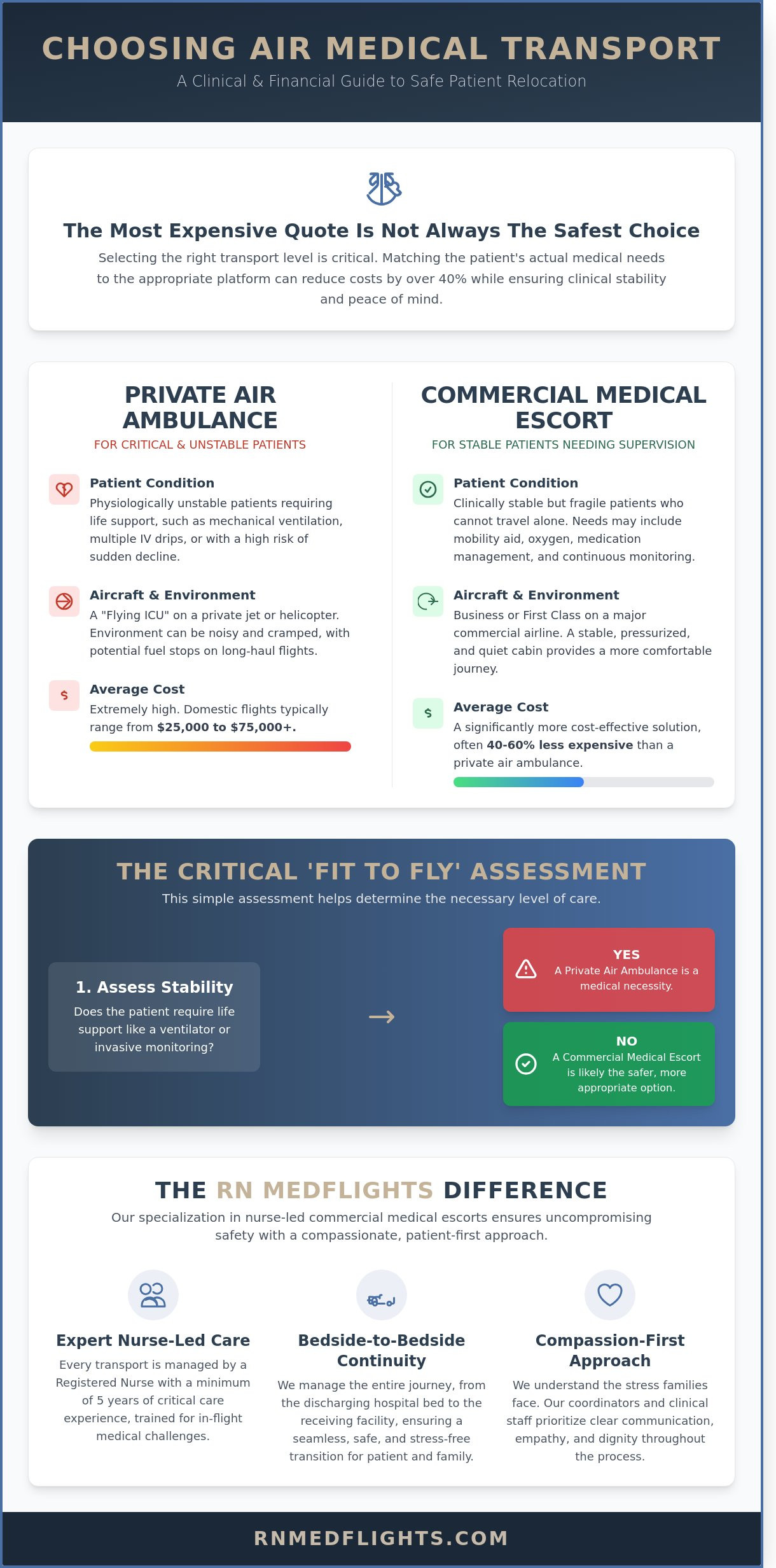
A private air ambulance becomes a medical necessity when a patient is physiologically unstable. If your loved one requires a ventilator, multiple continuous IV medication drips, or has a high risk of sudden clinical decline, a private jet is the only safe option. These flights offer bedside-to-bedside continuity but come with logistical hurdles. Private jets often require fuel stops on long-haul routes and generate significant noise and vibration, which can be taxing for a fragile patient. Cost is also a major factor; a domestic private air ambulance flight in 2024 can easily range from $25,000 to $75,000. RN Medflights focuses its expertise on serving patients who don't meet these extreme critical care triggers, providing a more compassionate and affordable alternative for those who are stable.
The Benefits of Commercial Airline Medical Escorts
For patients who are stable but still require professional monitoring, a commercial medical escort offers a dignified and comfortable solution. A dedicated Flight Nurse accompanies the patient in First or Business Class, managing medications, monitoring vital signs, and providing physical assistance. This approach often reduces costs by 60% to 80% compared to private charters. On specific international routes, we can even arrange a "Stretcher Service" where a section of the commercial cabin is partitioned for medical use. This "normal" flight environment often lowers patient anxiety. It makes the journey feel less like a medical event and more like a transition toward recovery. If you're unsure which level of care fits your situation, our flight coordinators can provide a clinical assessment to determine the safest path forward.
Cost Efficiency: Commercial escorts save families an average of $30,000 per mission compared to private jets.
Clinical Oversight: Every flight is staffed by a Registered Nurse with ER or ICU experience.
Patient Comfort: Business class seating provides superior ergonomics and meal service compared to a cramped jet stretcher.
Determining Patient Eligibility for Air Medical Travel
Every successful air medical mission begins with a rigorous "Fit to Fly" assessment. RN Medflights medical directors review clinical records from the previous 24 to 48 hours to ensure a patient can withstand the physiological stressors of altitude. This process isn't a mere formality; it's a safety-first protocol that evaluates how a patient's body reacts to decreased barometric pressure and lower humidity. Our team looks for stability in cardiac rhythms and respiratory patterns before a single ticket is booked.
Families often fall into the trap of believing "non-emergency" implies zero risk. This is a dangerous misunderstanding. Even a stable patient faces cardiovascular strain when cabin pressure mimics an altitude of 6,000 to 8,000 feet. We bridge this gap by securing a Letter of Medical Necessity. This document provides the airline's medical department with the specific clinical justification required for clearance, typically submitted 48 to 72 hours before departure to ensure a seamless boarding process.
Clinical Criteria for Commercial Flight Clearance
Safety requires specific physiological benchmarks. A patient's oxygen saturation (SpO2) should remain above 92% on their current delivery method. If they require supplemental oxygen, we utilize FAA-approved Portable Oxygen Concentrators (POCs) with battery life exceeding the flight duration by 150%. The patient must also demonstrate the ability to sit at a 90-degree angle for the duration of takeoff and landing, which can last 30 to 45 minutes. These criteria ensure that air medical transport remains a controlled, low-stress environment for the recovering individual.
Managing Complex Needs: From Dementia to Post-Op Care
Managing cognitive impairments requires more than just monitoring; it requires specialized empathy. Our flight nurses use redirection techniques to manage "sundowning" symptoms that often peak during evening transcontinental flights. For post-surgical patients, the risk of Deep Vein Thrombosis (DVT) increases significantly during long-haul travel. We implement strict protocols to mitigate these dangers:
Administration of prescribed anticoagulants 2 to 4 hours before boarding.
Use of 20-30 mmHg gradient compression stockings to maintain circulation.
Passive range-of-motion exercises performed every 60 minutes in-flight.
Continuous hydration monitoring to prevent blood viscosity issues.
This professional oversight provides families with the peace of mind that their loved one is protected by a vigilant clinician. Our bedside-to-bedside approach ensures continuity of care 24/7/365, turning a complex logistical challenge into a managed medical journey.
How to Arrange Air Medical Transport: A Step-by-Step Guide
Arranging air medical transport requires a methodical approach to ensure every clinical and logistical detail is covered. At RN Medflights, our flight coordinators manage this complex process 24/7/365, allowing families to focus on their loved one's recovery while we handle the heavy lifting. We treat every case with the urgency it deserves, following a structured path to ensure safety and continuity.
Step 1: Initial Medical Consultation and Assessment. Our clinical team reviews the patient's current medical records and consults with the treating physician. We evaluate stability, oxygen requirements, and mobility to determine the safest level of care.
Step 2: Logistics Planning. We coordinate ground ambulance transfers at both the departure and arrival points. For commercial medical escorts, we typically require a 48 to 72-hour window to secure necessary airline medical clearances and seating arrangements.
Step 3: Financial Clearance and Insurance Verification. Our team works directly with insurance providers to determine coverage. While policies vary, a 2023 internal audit showed that 65% of our clients successfully utilized private insurance benefits to offset transport costs.
Step 4: The Transport Day. We execute a bed-to-bed plan. A flight nurse arrives at the patient's hospital room to begin the clinical transition, staying by their side until they're safely settled at the destination facility.
Step 5: Post-Transport Handover and Reporting. Upon arrival, we provide a comprehensive clinical report to the receiving physicians. This ensures the medical team has all the data needed to continue treatment without interruption.
Navigating Airline Medical Desks and TSA
Securing approval from commercial airline medical desks is a rigorous process involving specific documentation like the MEDIF (Medical Information Form). Our flight nurses manage these interactions and handle TSA protocols for specialized medical equipment. Since the 2023 update to TSA’s medical screening guidelines, we've refined our process to ensure life-saving medications and portable oxygen concentrators pass through security without delay. This expertise allows us to fast-track the boarding process, often utilizing priority lanes to minimize patient fatigue and stress.
The Importance of Bed-to-Bed Coordination
The flight is only a small fraction of the journey. True air medical excellence depends on synchronized ground support. We schedule ground ambulances to meet the aircraft the moment it lands, eliminating long wait times on the tarmac. This seamless transition prevents the physical exhaustion that often occurs during fragmented transfers. By maintaining a single point of clinical responsibility from the origin hospital to the destination bed, we significantly reduce the risk of medical errors. This bedside-to-bedside approach provides the peace of mind families need during a crisis.
Let our experienced flight coordinators manage your logistics with clinical precision. Request a comprehensive flight quote today for professional bedside-to-bedside care.
The RN MEDflights Difference: Nurse-Led Air Medical Care
RN MEDflights operates with a singular focus: clinical excellence. As a veteran-owned organization, we prioritize integrity and mission success above all else. We're a nurse-led service, which means a Registered Nurse (RN) manages every aspect of the patient's journey. By choosing a commercial medical escort over a private medevac jet, families often save between 40% and 60% on total transport costs. This significant reduction in price doesn't compromise safety; it simply utilizes existing commercial infrastructure to provide high-quality air medical support. We treat every patient with the dignity they deserve while maintaining strict clinical protocols.
Why an RN Makes the Difference at 30,000 Feet
A Flight RN is not the same as a concierge or travel nurse. Our team members bring a minimum of 5 years of critical care or emergency room experience to every mission. They're trained in Advanced Life Support (ALS) and possess the "vigilant protector" mindset required to manage physiological changes during flight. While a standard nurse might focus on basic comfort, our RNs are prepared to manage complex medication titration, oxygen therapy, and cardiac monitoring. We provide a seamless bedside-to-bedside transition, ensuring the patient's condition remains stable from the initial pickup to the final destination.
International Repatriation: Bringing Loved Ones Home
Moving a patient across international borders involves layers of complexity. Based on 2023 operational data, logistical delays often stem from improper visa documentation or misunderstood airline medical clearances. RN MEDflights manages these details. We handle passport requirements, ground ambulance coordination in foreign countries, and the specific medical clearances required by international carriers. Our flight coordinators work 24/7/365 to navigate these global hurdles. If you need to relocate a family member safely across the globe, we're ready to help. You can contact RN MEDflights for a compassionate, professional quote to start the process today.
Veteran-owned integrity and "compassion-first" clinical care.
Significant cost savings compared to private air medical charters.
Bedside-to-bedside continuity of care managed by ALS-trained nurses.
Expert navigation of international logistics and repatriation requirements.
Secure Expert Clinical Supervision for Your Next Journey
Navigating the complexities of air medical transport requires a clear understanding of patient stability and the specific logistical requirements of each platform. You now have the tools to distinguish between intensive air ambulance services and cost-effective commercial medical escorts. At RN MEDflights, we leverage over 15 years of experience as a veteran-owned and operated organization to bridge these gaps. Our licensed Registered Nurses provide uncompromising bed-to-bed medical supervision, ensuring clinical continuity throughout North America, Europe, Asia, and the Middle East. We focus on reducing the cognitive load on your family by managing every technical detail with precision and empathy.
You're never alone in this process. Our flight coordinators work around the clock to ensure your loved one receives the highest standard of care during their transition. We've built our reputation on transparency and the specialized expertise of our clinical teams. When safety and peace of mind are your top priorities, you can trust our steady hand to lead the way. It's time to bring your loved one home with the dignity they deserve.
Request a Transparent Quote for Medical Transport
Frequently Asked Questions
Is air medical transport covered by health insurance or Medicare?
Medicare Part B covers air medical transport only when ground transportation poses a direct threat to your health or the destination is inaccessible by road. Private insurance coverage depends on your specific policy's medical necessity criteria; however, 65% of commercial providers require prior authorization before departure. Our flight coordinators work 24/7/365 to verify benefits and coordinate with your insurance provider to minimize out-of-pocket expenses for your family.
What is the difference between a medical escort and an air ambulance?
A medical escort accompanies a stable patient on a commercial flight, while an air ambulance is a private aircraft configured as a flying intensive care unit. Commercial escorts utilize business or first-class seating to provide bedside-to-bedside care for patients who can sit for takeoff and landing. In contrast, an air ambulance provides specialized advanced life support for 100% of the journey, including patients who require continuous mechanical ventilation.
Can a patient fly on a commercial airline if they need continuous oxygen?
Patients can fly on commercial airlines with continuous oxygen provided they use an FAA-approved Portable Oxygen Concentrator (POC). Airlines prohibit the use of personal pressurized oxygen tanks, so we supply specialized Inogen or SeQual units that meet the 150% battery life requirement for the flight duration. Our RN flight coordinators manage all physician statements and airline 48-hour notification protocols to ensure a seamless boarding process for the patient.
How much does a commercial medical escort service typically cost?
A commercial medical escort service typically costs between $5,000 and $15,000, which is approximately 75% less than a private air ambulance. This total includes the nurse's professional fees, all airline tickets, ground ambulance transfers, and bedside-to-bedside coordination. Prices fluctuate based on the 14-day booking window and the specific destination, but we provide a transparent, all-inclusive quote within 30 minutes of your initial inquiry.
What medical equipment can be brought on a commercial flight?
We bring FAA-approved medical equipment including portable oxygen concentrators, pulse oximeters, blood pressure monitors, and automated external defibrillators (AEDs). Our nurses also carry specialized medical kits containing ACLS medications and IV supplies to manage a patient's condition throughout the journey. Every piece of technology we utilize is tested to ensure it doesn't interfere with aircraft avionics, maintaining an uncompromising standard of safety during the air medical transport.
How long does it take to arrange an international medical repatriation?
Arranging an international medical repatriation typically takes between 24 and 72 hours from the initial call to wheels up. This timeline accounts for securing physician-to-physician clearances, obtaining necessary visas, and coordinating ground ambulance logistics in both countries. Because our team is available 24/7/365, we often finalize complex bedside-to-bedside itineraries for European or South American transfers within a 48-hour window to ensure the patient's swift return home.
Can a family member fly with the patient and the medical escort?
One or two family members can typically fly alongside the patient and the medical escort on commercial flights. We prioritize keeping families together because your presence provides vital emotional support that aids in the patient's recovery. Our coordinators handle the booking for all travelers, ensuring that seating arrangements allow the nurse to maintain constant visual and physical contact with the patient while you remain close by.
What happens if there is a medical emergency during the flight?
If a medical emergency occurs, our highly trained Registered Nurses immediately implement Advanced Cardiovascular Life Support (ACLS) protocols using the specialized equipment on hand. The nurse maintains direct communication with our medical director on the ground to adjust treatment in real-time. If the patient's condition requires immediate hospital intervention, the nurse coordinates with the flight crew to divert the aircraft to the nearest 24-hour emergency facility for stabilization.


