Medical Flight Day: What Patients and Families Can Expect
Families who aren’t traveling with the patient can receive information to track the flight online in real time. Knowing what to expect on the day of a medical flight also means understanding how care is coordinated before departure, during the journey, and after landing.
It’s natural to want a clear picture of what will happen and how you’ll stay informed. The day is organized around the patient’s medical needs, with the flight team coordinating with the originating care team and continuing care throughout the journey. This guide explains how to prepare, what the patient may experience in the cabin, and what family members can expect, whether they’re traveling alongside the patient or following the flight from elsewhere.
Table of Contents
Is the air ambulance flight experience different for a sedated versus an awake patient?
An awake patient can describe symptoms and follow instructions during boarding. A sedated patient may not be able to do so, so the medical team relies on observation and available clinical information. In either case, the flight crew coordinates with the originating facility’s care team so the handoff reflects the patient’s current needs.
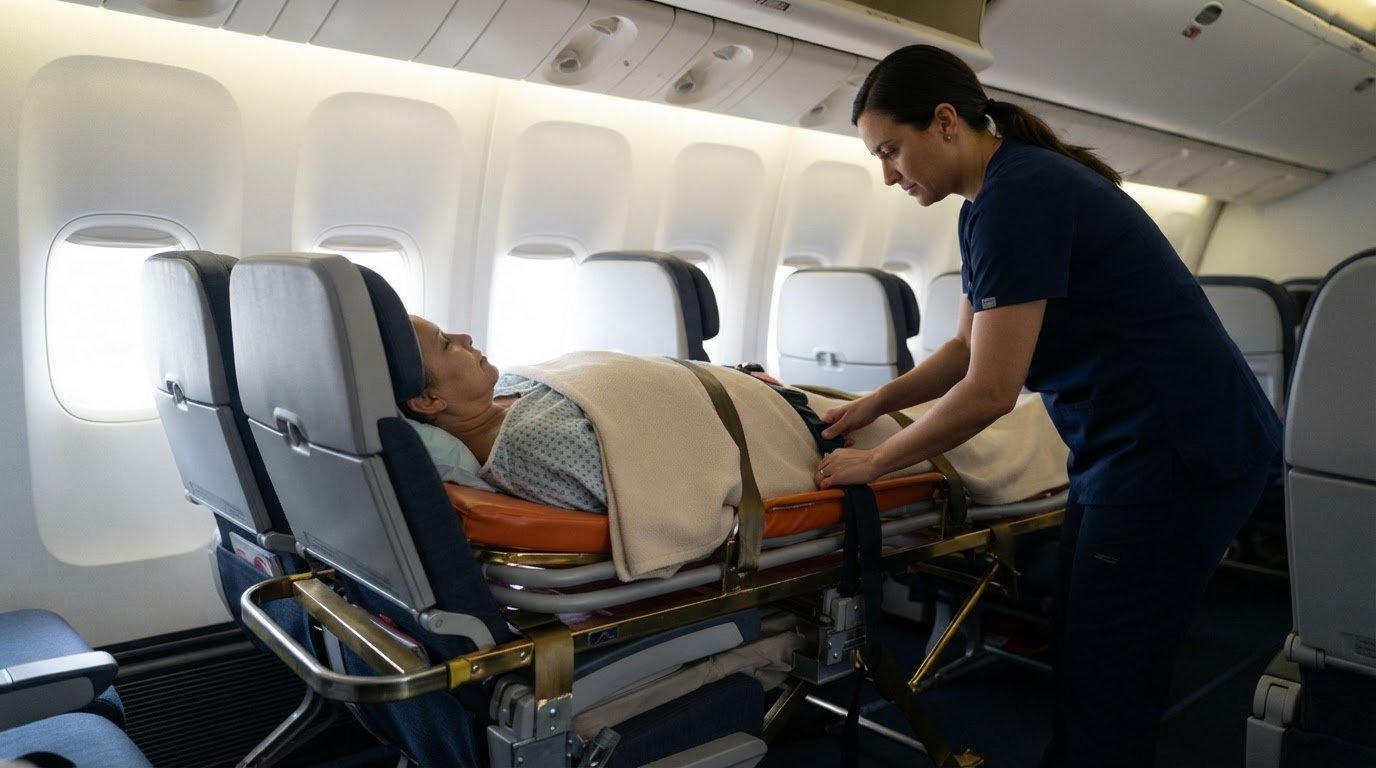
The type of flight shapes the process. An air ambulance uses a dedicated aircraft for medical transport, while a commercial airline medical escort accompanies a patient on a scheduled flight. A stretcher may be available depending on the airline and route. The aircraft, ground transfers, and planned medical support all affect the arrangements.
Before departure, the medical crew meets with the patient and facility team to gather clinical information and coordinate continuity of care. A physical examination can help the crew understand the patient’s condition before transfer. Ground-based medical consultations also support planning: when cabin-altitude or pressure adjustments are needed, the crew incorporates them into the flight plan before departure.
Ground ambulance transfers connect the care facility, airport, and receiving facility. The ground team coordinates arrival at the aircraft, where boarding follows the patient’s mobility and medical needs. A stretcher is commonly used for safe transport. The crew manages the transfer and brings the patient into the aircraft’s medical setup, rather than treating boarding as an ordinary passenger process.
Once airborne, the medical crew monitors the patient and adjusts care as needed. If the patient’s condition changes, the crew communicates with the receiving facility so its team can prepare. After landing, an ambulance typically takes the patient to that facility; the medical team supports check-in and the care handoff. These ground steps help maintain continuity between locations.
A family member may accompany the patient when the arrangement allows. During the flight, a traveling family member remains seated and buckled; the number who can travel depends on the aircraft or airline seating and medical configuration. Loved ones who stay behind can receive information to track the flight online in real time.
There is no single arrival time for every medical flight. The itinerary and ground transport plan determine when the patient needs to be ready, so the originating facility coordinates preparation and boarding. If the patient’s condition changes, the care teams may need to reassess the plan and coordinate before departure or during the journey.
Public or private health insurance may cover part of a medical flight when it is medically necessary and treatment is unavailable locally; coverage varies and may require pre-approval. Medicare coverage depends on the applicable benefit and circumstances, so those general conditions alone don’t establish whether a particular flight is covered.
Onboard medical equipment and emergency kits
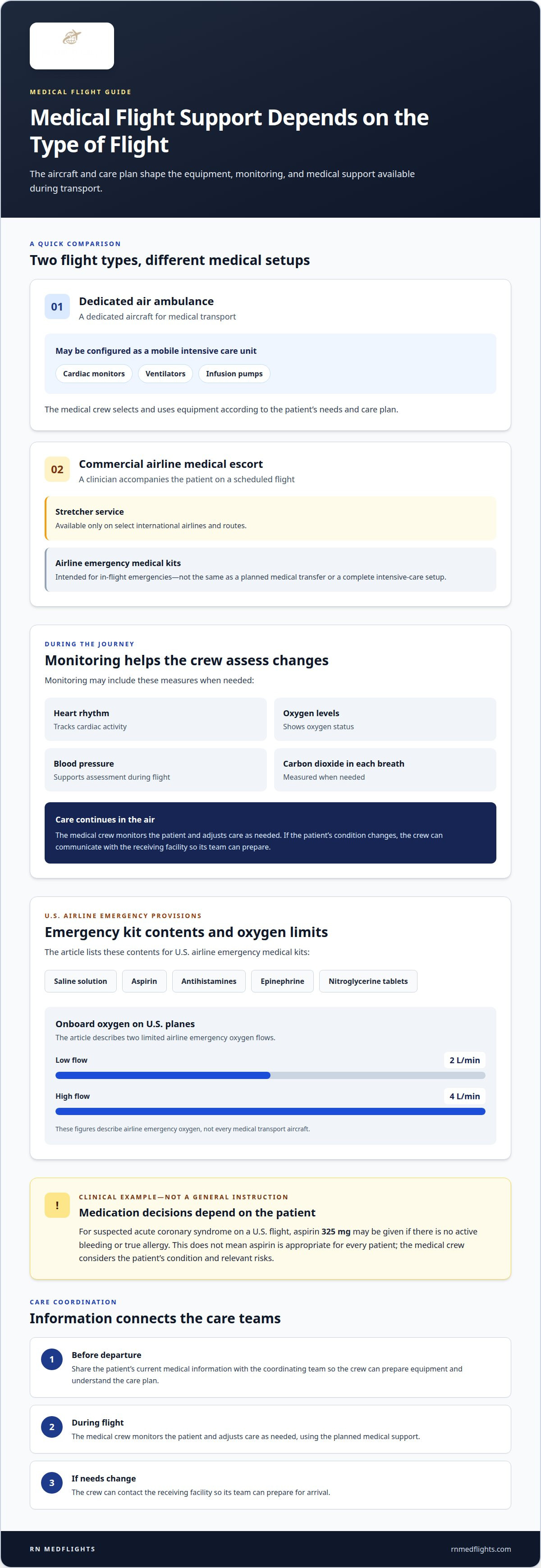
Patients are transferred into the aircraft using the arrangement planned for their condition, then monitored by the medical crew throughout the flight. Monitoring can include heart rhythm, oxygen levels, blood pressure, and carbon dioxide in each breath when needed. This gives the crew information to assess changes and adjust care during the journey.
The equipment depends on the type of flight. A dedicated air ambulance may be configured as a mobile intensive care unit, with cardiac monitors, ventilators, and infusion pumps. These support patients who need closer monitoring or respiratory and infusion care. The aviation medical team uses equipment according to the patient’s needs and the care plan.
With a commercial airline medical escort, the patient travels on a scheduled flight accompanied by a clinician. Airline stretcher service is available only on select international airlines and routes. Airline emergency medical kits are intended for emergencies and are not the same as the arrangements for a planned medical transfer. The flight type and travel plan determine what support is available.
For U.S. airline emergency medical kits, the listed contents include saline solution, aspirin, antihistamines, epinephrine, and nitroglycerine tablets. These supplies are for in-flight emergencies, not a complete intensive-care setup. On U.S. planes, onboard oxygen is limited to low flow at 2 L/min or high flow at 4 L/min. Those figures describe airline emergency oxygen, not every medical transport aircraft.
Medication administration also depends on the clinical situation. For suspected acute coronary syndrome on a U.S. flight, aspirin 325 mg may be given if there’s no active bleeding or true allergy. That example doesn’t mean aspirin is appropriate for every patient. The medical crew considers the patient’s condition and relevant risks before care decisions.
One reported in-flight shortness-of-breath case described a passenger breathing without assistance after about 30 minutes of onboard oxygen. That example illustrates a response in one case, not a standard treatment duration or expected outcome. A patient’s needs and response guide monitoring and care during a medical flight.
For families, the practical step is to share the patient’s current medical information with the coordinating team before departure. That helps the crew prepare equipment and understand the care plan. If a patient’s condition changes during flight, the crew can contact the receiving facility so its team can prepare for arrival. For an arranged medical flight, equipment planning and crew coordination are part of the overall transfer, not simply a matter of bringing an emergency kit.
Preparing documents, corrective lenses, and medication details
Clear, current documentation helps the care teams understand the patient’s condition and coordinate the transfer. Before departure, the originating provider and transport team organize relevant medical information, such as recent clinical notes, a medication list, allergies, and care instructions. Records should reflect the patient’s current needs, not just an earlier diagnosis.
Medication details help the care team understand the patient’s treatment plan. Provide a current list of medicines, including doses, timing, and any known reactions. Include prescribed medicines and regular over-the-counter products the patient uses. This information helps the team understand the patient’s medication needs during travel.
Corrective lenses can support communication and comfort. If the patient uses glasses for reading or distance vision, keep them accessible without interfering with transfers or care. A patient who reads instructions or uses a phone to communicate may need their usual lenses. If the patient cannot manage personal items independently, a family member can keep the glasses and case together.
For a patient with a disability, explain practical needs before boarding. Describe how the patient moves, communicates, and manages personal care. For example, share whether they use a wheelchair, need help transferring, or rely on an assistive communication device. This information helps coordinate ground transport and boarding around the patient’s needs.
If an ECG is part of the patient’s examination or care plan, the team can explain its role and prepare the patient for the test. An ECG records the heart’s electrical activity through adhesive leads placed on the skin, including the chest. Tell the provider about skin sensitivities or discomfort with adhesives. The examination and any required preparation depend on the patient’s clinical plan.
Keep essential information organized for the handoff. Current clinical records, a medication list, and details about corrective lenses or assistive devices help the receiving team understand the patient’s needs. For example, note if the patient uses distance glasses or needs help communicating without them. The medical team can pass relevant details to the receiving provider as care transitions.
Family members can help gather current records and details about the patient’s personal care, while the medical teams coordinate the clinical handoff. Share medication changes, new symptoms, or updated instructions with the originating provider before travel. Accurate, relevant information helps the transport team plan around the patient’s needs and supports coordination from departure through arrival.
Baggage limits and passenger identification
A medical aircraft’s layout leaves less room for personal baggage than a standard commercial cabin. Medical equipment, the patient’s position, and the care team all shape the available space. On a commercial flight, a stretcher configuration can also change cabin capacity. For these reasons, pack around the travel plan rather than assuming ordinary airline baggage allowances apply.
Before departure, identify what the patient will need during the journey and separate it from belongings that can travel another way. Keep essential personal items accessible to the patient or accompanying family member. Baggage arrangements depend on the aircraft configuration and operational requirements. Packing compactly helps keep access to the patient and equipment clear.
Identification is another important part of preparation. In the United States, all passengers on a medical flight need a REAL ID-compliant form of identification. This applies to the patient and any family member traveling with them. Keep each traveler’s identification easy to retrieve during check-in and boarding, rather than packed inside a bag that may be stowed.
If the patient cannot hold or present identification independently, a family member or care team can keep it accessible for travel. If the patient uses a wheelchair or needs help moving between ground transport and the aircraft, coordinate who will carry documents and essential belongings. This keeps identification within reach during transfers.
Vision needs can affect how travel documents are handled. If the patient relies on glasses to read, keep them with accessible personal items rather than packed away. This can help during document review, communication, and arrival. Tell the coordinating team which items are essential so the baggage plan reflects the patient’s needs and the available space.
Different flight arrangements involve different check-in, boarding, and baggage steps. Commercial airline travel follows airline procedures, while a dedicated medical aircraft has a layout planned around the patient and crew. Ground transport may also be part of the journey, so belongings need to be manageable across each transfer. The coordinating team can explain how baggage fits the planned route and arrangements.
Use a short packing plan: keep identification accessible, separate essential personal items, and avoid assuming standard baggage standards apply. For example, a patient’s glasses and travel document may need to stay close, while nonessential belongings can be handled separately. If a family member has a question about what can travel in the cabin, consult the team coordinating the flight before packing. That answer depends on the specific aircraft and medical operations.
Cabin experience for awake and sedated patients
An awake patient can speak with the accompanying clinician, describe discomfort, and follow instructions during the flight. A sedated patient may not be able to report symptoms or respond in the same way. The clinician adapts observation and communication to the patient’s ability to participate and the planned level of care.
For an awake patient, the crew can explain what is happening and ask about concerns such as pain, nausea, or difficulty breathing. A family member traveling with the patient may offer familiar support during the flight. The medical crew remains responsible for monitoring and care, whether or not a relative is present.
Sedation changes how the team assesses a patient, not the need for ongoing monitoring. The medical crew observes the patient’s condition and uses clinical information available during the flight. Monitoring can include heart rhythm, oxygen levels, blood pressure, and carbon dioxide in each breath when needed. A cardiac monitor, when part of the aircraft’s equipment, helps the crew follow heart activity.
Cabin conditions also shape the experience. Commercial aircraft cabins are typically pressurized to an elevation of 5000-8000 feet, and gas expands by about 30% at typical commercial cabin pressure. These aviation factors matter when a patient has a condition affected by cabin pressure. When adjustments are needed, the crew incorporates them into the flight plan before departure.
For a commercial flight with a medical escort, a cabin stretcher may be used depending on the airline and route. The patient’s position and the available cabin configuration affect how the crew provides assistance. On a dedicated medical aircraft, the cabin arrangement can support a different level of medical equipment. In either setting, the care plan guides positioning and observation.
If a patient’s condition changes in flight, the medical crew can adjust care and communicate with the receiving facility. That team can prepare for the patient’s arrival. During a refueling stop, the same medical crew stays with the patient and continues care on the ground and in the air. A stop therefore doesn’t mean the patient is left without the medical team.
Families can tell the clinician how the patient usually communicates, including whether hearing loss, confusion, or sedation affects responses. An awake patient may answer directly; when a patient cannot communicate, the clinician relies on observation and available clinical information. These details help the team understand the patient’s responses.
For a flight plan shaped around the patient’s cabin and care needs, discuss medical flight arrangements.
RN MEDflights: private flight nurse
RN MEDflights can help families coordinate a private flight nurse when a patient needs medical support during air travel. The appropriate arrangement depends on whether the patient can travel on a scheduled commercial flight or needs a domestic medical relocation with bed-to-bed support.
A Commercial Airline Medical Escort may suit a patient stable enough for a scheduled route, while Bed-to-Bed Medical Transport can coordinate continuity across the ground and air portions of a transfer. These services help families plan around the patient’s care needs, cabin arrangements, and receiving-facility handoff.
Share the patient’s current condition, care requirements, and travel circumstances to discuss the suitable transport arrangement. For support planning a medical journey, contact RN MEDflights.
Plan the next step with confidence
A clear understanding of what to expect on the day of a medical flight can make planning feel more manageable. The next step is to match the journey to the patient’s needs, destination, and travel circumstances. Consider whether the patient needs support on a scheduled airline route, a domestic transfer, or travel between countries. These details help shape a practical conversation about the care and coordination required.
RN MEDflights provides Commercial Airline Medical Escort, Domestic Medical Relocation, and International Medical Repatriation. Each service addresses a different travel situation. Sharing the patient’s current circumstances and destination helps clarify the support needed for the journey. Families can also discuss how the travel plan connects with the patient’s existing care.
When you’re ready to discuss the journey, contact RN MEDflights about your flight. A considered next step can help you approach the planning process with greater clarity and care.
Frequently Asked Questions
Can family members track the flight in real time?
Families who aren’t traveling can receive information to track the flight online in real time. The designated contact person also receives the planned itinerary by email the night before the flight. Choose one family contact to share updates, so everyone receives consistent information. Flight tracking helps loved ones follow the journey, but it doesn’t replace updates about the patient’s care.
Does care continue if the flight includes a refueling stop?
Yes. If the medical flight includes a refueling stop, the same medical crew stays with the patient and continues care on the ground and in the air. The stop is part of the flight plan, not a change in the patient’s care team. Families can use the itinerary to understand that a planned stop may occur before arrival, without interpreting it as a handoff to a new crew.
How is the environment different?
An aircraft cabin differs from a hospital room in pressure, space, and access to equipment. At commercial cabin altitude, even healthy passengers may have oxygen saturation of 90-93%. This is one reason the medical team considers the patient’s condition and travel needs when planning care. The cabin is also more confined, so movement and access to the patient are shaped by the aircraft’s layout.
What happens step by step on the day of a medical flight?
The day generally involves coordination before departure, ground transport, boarding, in-flight supervision, and a handoff on arrival. The itinerary gives the designated contact a schedule to follow, while the originating facility helps coordinate the patient’s departure. Knowing what to expect on the day of a medical flight also means understanding that care teams may need to coordinate if the patient’s condition changes.
What medical documents and identification are needed for a medical flight?
Prepare current clinical records, medication details, and identification for each traveler. In the United States, passengers on a medical flight need a REAL ID-compliant form of identification. Keep the patient’s medical information together so it can support the care handoff. For example, recent treatment notes can help the receiving team understand the context behind current instructions, rather than relying only on a brief verbal update.
What should patients and caregivers pack for a medical flight?
Pack lightly because medical transport arrangements can leave less room for personal baggage than a standard commercial flight. Prioritize identification, essential personal items, and any corrective lenses the patient uses. Keep important belongings accessible during transfers rather than buried in luggage. For example, the patient’s glasses should be easy to reach for reading or communication. Baggage arrangements depend on the aircraft and route.
What safety risks and emergency procedures should patients expect during a medical flight?
The medical team monitors the patient and responds to changes according to the planned level of care. On a commercial flight, the airline emergency medical kit is intended for in-flight emergencies, not as a substitute for dedicated medical transport equipment. If the patient’s condition changes, the medical crew can adjust care and communicate with the receiving facility. The appropriate arrangements depend on the patient’s needs and flight type.
What happens after landing, including transfer to the receiving hospital?
After landing, the patient is typically transferred by ambulance to the receiving facility. The medical flight team helps with check-in and communicates important details about the patient’s condition to the receiving care team. This handoff gives the destination team information to continue care and helps the patient settle before responsibility transitions. The planned ground arrangements connect the airport arrival with the next stage of treatment.