Medical Escort Cost for International Flights: Prices and Factors
International medical escort costs don’t have one fixed price. For flying internationally with a medical escort, the quote depends on the route, the patient’s care needs, and the airline arrangements. The price is provided after a quote request. The key question is whether the patient is medically stable and cleared by a physician to fly on a scheduled commercial flight.
It’s understandable to want a clear budget while making a safe travel plan. The right option depends on the patient’s care needs, not price alone. A commercial medical escort may suit a medically stable patient cleared by a physician to fly who needs clinical support during a regular airline journey.
This article explains the factors that shape the cost, what care and trip planning can involve, and how escorted commercial travel compares with an air ambulance or traveling alone. It also clarifies when a commercial flight may not be suitable, so you can understand the choices and the considerations behind them.
Table of Contents
How Much Does a Medical Escort Cost?
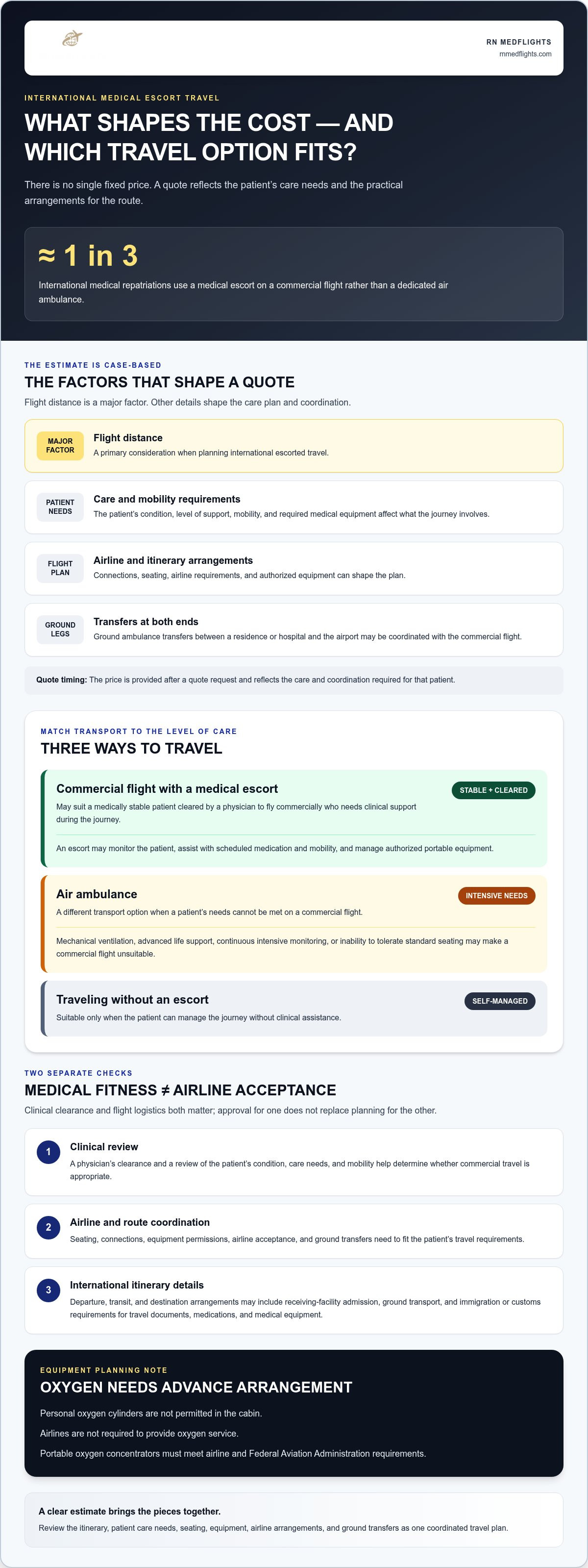
For families flying internationally with a medical escort, the cost depends on the route, the patient’s care needs, and the airline arrangements involved. The price is based on the case and provided after a quote request. Flight distance is a major factor, while connections, seating, medical equipment, and ground transfers can also shape the travel plan. A clear estimate reflects the actual care and coordination required for that patient.
A medical escort for international air travel is a medical professional who accompanies a patient on a scheduled commercial flight. The service is intended for patients stable enough to fly commercially but who need clinical support during travel, such as monitoring, medication assistance, or oxygen support. For example, someone who can remain seated but needs observation may be considered for escorted travel.
Eligibility depends on the patient’s condition and required care. RN MEDflights’ commercial medical escort services are for medically stable patients cleared by a physician to fly. A clinical review considers the patient’s needs, mobility, and travel requirements to determine whether a commercial flight is appropriate.
An escort can monitor the patient, assist with medical needs, and respond if complications arise, but a commercial cabin is not an airborne intensive care unit. Patients requiring mechanical ventilation, advanced life support, or continuous intensive monitoring should travel by air ambulance. A critically ill patient who must lie flat may also need a dedicated medical aircraft rather than standard seating.
Ground transport covers a different part of the journey. An ambulance can transfer a patient between a residence or hospital and an airport, while the medical escort accompanies them on the commercial flight. RN MEDflights coordinates bed-to-bed medical transport, including ground ambulance transfers at both ends. Airline stretcher service is available only on select airlines and routes.
During the flight, an escort may monitor vital signs, assist with scheduled medication, support mobility, and manage authorized portable equipment. Oxygen requires advance planning: personal oxygen cylinders aren’t permitted in the cabin, and airlines aren’t required to provide oxygen service. Portable oxygen concentrators must meet airline and Federal Aviation Administration requirements.
To choose and verify a reputable service, look for licensed nurses, paramedics, or doctors with aviation medicine training, and assess whether the proposed care matches the patient’s needs. EURAMI and CAMTS are examples of organizations whose accreditation may indicate consistent care standards. Ask for a clear outline of clinical responsibilities and travel coordination.
The cost of flying internationally with a medical escort reflects the patient’s needs and the practical arrangements for the route. Reviewing the itinerary, seating, equipment, and ground transfers together helps clarify what the estimate covers.
Medical escort versus air ambulance or unaccompanied travel
The right option depends on the patient’s condition, mobility, and need for clinical support. A medically stable patient cleared by a physician to fly may travel on a scheduled commercial flight with an escort. The escort provides planned support during the flight, while an air ambulance is a separate transport option for patients whose needs cannot be met on a commercial flight. Traveling alone is suitable only when the patient can manage the journey without clinical assistance.
For an older adult, a person recovering from an injury, or someone with limited mobility, an escort can help with transfers, seating, medication schedules, and communication with airline staff. Consider an older traveler who can remain seated but needs help walking through the airport and monitoring during a long flight. That differs from a patient who cannot tolerate sitting upright or needs continuous intensive monitoring, for whom a commercial flight is unsuitable.
Long-distance travel also matters medically. The risk of deep vein thrombosis rises during extended travel, and the risk of blood clots is considerably higher after recent surgery or a hospital stay. An escort can monitor the patient and assist with movement when appropriate, following the care plan. This support does not make every patient fit to fly; the patient’s condition and required level of care determine the suitable transport mode.
Ground transport and air travel solve different parts of the journey. An ambulance can transfer a patient from a hospital to an airport, while the escort provides care aboard the commercial flight. If the patient needs help at both ends, coordinating ground transfers with flight arrangements can reduce gaps between care settings. A commercial stretcher is another airline option for patients who must lie down, subject to airline approval and aircraft configuration.
International repatriation adds coordination across the departure, transit, and destination points. Approximately 1 in 3 international medical repatriations uses a medical escort on a commercial flight rather than a dedicated air ambulance. The itinerary needs to connect the patient’s current care setting with the receiving facility, including ground transport and admission arrangements. Immigration and customs requirements in the destination country affect entry, travel documents, and the handling of medications or medical equipment. Transit countries can add separate requirements, so these details belong in route planning.
Traveling without an escort avoids arranging an accompanying medical professional, but leaves the patient responsible for their own needs during check-in, boarding, and flight. A family member can provide company, but doesn’t replace clinical monitoring when that care is required. Compare the options by asking what the patient can safely do independently, what assistance they need in the airport and cabin, and whether their condition requires air ambulance-level care. Clinical need and safety, not price alone, should guide the choice.
Medical escort responsibilities during international flights
On a commercial airline flight, the medical escort maintains continuity between the patient’s care plan and the journey. Responsibilities can include monitoring vital signs, assisting with scheduled medications, supporting mobility, and managing authorized portable medical equipment. For example, an escort can observe a patient during boarding and help them follow the medication schedule during a connection. The escort responds to changes within the scope of the planned care; a commercial cabin does not provide intensive care.
Oxygen needs require specific planning. Personal oxygen cylinders aren’t permitted in the aircraft cabin, and airlines aren’t required to provide oxygen service. A portable oxygen concentrator must meet airline and Federal Aviation Administration requirements. The escort helps manage authorized equipment and the agreed care plan, while airline clearance addresses whether the equipment and seating arrangements are accepted for that flight.
Medication support also depends on preparation. The escort can help administer scheduled medications and monitor the patient’s response during travel. A current medication list and clear instructions help align the hospital’s discharge plan with care in transit. For a longer flight or a complex medical case, providers may deploy a team of two escorts to maintain continuous care. The team arrangement depends on the case’s clinical demands.
Door-to-door arrangements connect the flight with ground transport at both ends. A coordinated journey can include transfer from a hospital to the departure airport, assistance through the flight, and ground ambulance coordination after landing. The receiving hospital, rehabilitation facility, or nursing home can be arranged before the patient arrives. This continuity helps prevent a gap between the flight plan and the next stage of care.
International flights can involve connections, airline announcements, and conversations with airport staff. The escort helps support the patient during the journey. A concise written summary of diagnoses, medications, equipment, and mobility needs can help keep communication consistent across the route. Include the destination and any connecting airports in the travel plan.
Insurance and flight costs are separate parts of planning. Air ambulance insurance may cover medical escorts and basic services, but the policy terms determine what is covered. The commercial itinerary, required care, seating, oxygen arrangements, and ground transfers all shape the travel plan. A clear cost breakdown separates airfare and care arrangements from other transport needs, so families can understand which parts relate to the flight and which relate to ground coordination.
Medical review, airline clearance, and trip logistics
International escorted travel involves two separate decisions: clinical fitness to fly and airline acceptance. The review also connects the care plan with the aircraft, seating, equipment, and ground transport.
Medical Review and Airline Clearance
Clinical review considers whether a medically stable patient has physician clearance to fly and whether the planned support fits their needs. Airline clearance is the carrier’s separate decision about accepting the passenger and arrangements for the flight.
Airlines assess the patient’s medical information, mobility, seating needs, and equipment. A medical escort can coordinate the clinical details, but the airline determines its own requirements. For stretcher travel, approval depends on the aircraft configuration; installation can occupy 6 to 9 economy seats. The distinction matters because clinical fitness alone does not secure the required airline accommodation.
Commercial airlines handle medical travel under their own policies, so requirements vary by carrier. Stretcher arrangements are available only on select airlines and routes and depend on airline approval and aircraft configuration. Wheelchair arrangements must also follow the carrier’s process.
Booking Notice and Clearance Timing
Booking notice is the time needed to arrange flights and submit medical details for airline review. It matters because the carrier may need to assess equipment, seating, and other travel arrangements.
Some airline accommodations require up to 48 hours’ notice, while airline medical coordination is typically initiated 48 to 72 hours before departure. Complex cases may require medical documentation 7 days in advance. These timelines can affect which flights work, particularly when the route has connections or specific seating needs. Starting early gives the airline time to review the proposed arrangements before travel.
Airline Medical Forms
A MEDIF form is an airline medical information form used to present a passenger’s condition and travel needs for review. It matters because the carrier uses the submitted details to assess the requested arrangements.
The form can connect the treating clinician’s information with the planned flight, including mobility, oxygen, equipment, and escort support. Complete responses help the airline assess the actual travel plan rather than a general description. Portable oxygen concentrators must meet airline requirements and those of the Federal Aviation Administration. The airline’s review remains separate from the patient’s clinical assessment.
Booking and Arrangement Steps
Booking and coordination bring the medical plan, airline review, and transport itinerary together. A clear sequence helps families understand how each decision affects the next.
Gather current medical information, the treating clinician’s fit-to-fly assessment, and details of the patient’s mobility and care needs.
Plan the route, seating, equipment, and any ground transfers between the hospital, airport, and receiving facility.
Submit the airline’s requested medical forms and supporting records, then coordinate clearance and approved accommodations.
Finalize flights and ground medical transport once the clinical plan and airline arrangements align.
This sequence is especially useful for long-distance routes, where connections can add airline reviews and coordination between care settings.
International medical escort cost ranges
Flying internationally with a medical escort involves costs shaped by the route, the patient’s care needs, and the arrangements required for the journey. There isn’t one fixed price: RN MEDflights provides a case-specific quote after reviewing the travel needs. Flight distance is one consideration, while the itinerary also affects planning. A direct route and a journey with connections involve different arrangements.
Start by considering the full route, not only the distance between the departure and destination airports. A connection may require the patient to change aircraft, manage a longer airport stay, or coordinate care across flight segments. For example, an itinerary with a connection can require different timing and assistance from a direct commercial flight. These route details help shape the travel plan and its estimate.
Airline seating and patient mobility create another cost consideration. A patient who can travel seated has different arrangements from someone who must lie flat. Commercial stretcher service requires airline approval and depends on aircraft configuration. Because the installation can occupy 6 to 9 economy seats, this option involves a distinct booking arrangement from a standard passenger seat.
The care plan also matters. A patient who needs monitoring or scheduled medication assistance has different support needs from someone requiring oxygen equipment. Longer flights or complex medical cases may call for a team of two escorts to maintain continuous care. Those clinical requirements influence staffing and equipment planning, rather than being determined by distance alone.
Ground transfers add another layer to an international journey. A patient may leave a hospital by ambulance, travel to the airport, and continue to a receiving facility after landing. The flight is only one part of the plan. Pickup, airport transfers, and arrival arrangements all affect the coordination required.
When flying internationally with a medical escort, consider the route, seating, clinical support, equipment, and ground arrangements together. A quote based on these details helps families understand how the patient’s needs shape the plan. It also clarifies how connections, stretcher arrangements, or transfers affect the journey.
Commercial escorted travel and a private air ambulance are different transport options. The appropriate choice depends on the patient’s clinical requirements. RN MEDflights’ commercial medical escort service is for medically stable patients cleared by a physician to fly. Cost comparisons are useful only after the patient’s transport needs are clear.
For a useful estimate, gather the departure and destination, preferred travel dates, the patient’s mobility needs, care requirements, and any ground-transfer details. This information helps connect the route with the clinical plan. The cost depends on the arrangements needed for that case, not a single standard rate.
RN MEDflights: Commercial Airline Medical Escort
RN MEDflights provides Commercial Airline Medical Escort for patients who are stable enough to travel on a scheduled flight but need medical support during the journey. Its team also coordinates International Medical Repatriation and Bed-to-Bed Medical Transport, connecting the flight with ground ambulance services at both ends. This can help families plan continuity from the current care setting to the destination. If a patient needs intensive care or cannot travel safely on a commercial airline, an escort flight may not be the appropriate option. Share the patient’s route, mobility needs, and care requirements to discuss the transport plan. Contact RN MEDflights to discuss an international medical journey.
Plan the next step with clarity
For a patient and family, the next step is to turn travel needs into a coordinated plan. Bring together the intended destination, the patient’s current care priorities, and the support they need to feel prepared for the journey. These details help frame the conversation around what matters most to the patient, not just the flight itinerary.
For families considering flying internationally with a medical escort, RN MEDflights offers Commercial Airline Medical Escort and International Medical Repatriation. It also provides Domestic Medical Relocation for journeys within the United States. Each service addresses a different transport need, helping families discuss the situation in practical terms.
Share the patient’s travel needs and discuss the appropriate next step with RN MEDflights. Contact RN MEDflights about your travel needs. A calm, clear plan can help you move forward with greater confidence and keep the patient’s needs at the center.
Frequently Asked Questions
Can a family member travel too?
A family member can travel on the same flight as the patient and medical escort. Include them in itinerary planning so their seat can be coordinated with the patient’s arrangements. A relative may accompany the patient and help with personal belongings or communication. The family member’s role is supportive; clinical monitoring and care remain the escort’s responsibility.
Can oxygen be used on the plane?
Oxygen use on a commercial flight requires airline coordination. Personal oxygen cylinders aren’t permitted in the aircraft cabin, and airlines aren’t required to provide oxygen service. A portable oxygen concentrator must meet the airline’s requirements and those of the Federal Aviation Administration. The patient’s oxygen needs should be included in the medical travel plan, so equipment and seating arrangements can be reviewed before the flight.
How quickly can you arrange an escort?
Arranging an escort involves clinical review, airline medical clearance, flight booking, and coordination of required ground transfers. The route, airline documentation, and patient’s care needs shape the process. To begin, provide the patient’s current location, destination, medical condition, and mobility needs. This information supports a clinical review and travel plan, including arrangements before boarding.
Need to bring a patient home?
RN MEDflights provides International Medical Repatriation for non-emergency journeys home. The service is designed around the patient’s route and care needs, with bed-to-bed coordination connecting the departure setting, flight, and receiving location. Ground ambulance transfers can be coordinated at both ends when needed. Share the patient’s current location, destination, and medical situation to discuss an appropriate repatriation plan.
What medical conditions qualify for flying with a medical escort?
Commercial medical escort travel is for medically stable patients cleared by a physician to fly. It may suit someone recovering after hospitalization or surgery who needs professional supervision, or a senior with limited mobility who can travel on a commercial flight. The patient’s care needs and ability to tolerate the planned seating matter. Patients requiring ICU-level care, such as mechanical ventilation, need a different transport option.
What is the difference between a medical escort, an air ambulance, and airline special assistance?
A medical escort is a qualified medical professional who accompanies a patient on a commercial flight and provides planned clinical support. An air ambulance is a dedicated medical aircraft for patients whose condition requires that level of transport. Airline special assistance addresses travel access needs, such as help moving through the airport; it isn’t a substitute for clinical supervision. A wheelchair request alone doesn’t provide medical monitoring.
What medical clearance and documents do airlines require for international travel with an escort?
Airlines set their own medical clearance requirements and may request medical forms and supporting records. The treating physician’s assessment, current condition, mobility, medication needs, and planned equipment help explain the patient’s travel requirements. Keep the itinerary and clinical details consistent across submitted documents. For example, a passenger traveling with a portable oxygen concentrator needs the equipment details included for airline review.
Can a medical escort provide oxygen, medication, or in-flight medical care on a commercial flight?
A medical escort can monitor the patient, assist with scheduled medications, support mobility, and manage authorized portable medical equipment during the journey. Oxygen use must follow airline arrangements and equipment requirements; personal oxygen cylinders aren’t permitted in the cabin. A portable oxygen concentrator must meet airline and Federal Aviation Administration requirements. The escort provides planned support, not intensive care in a commercial aircraft cabin.