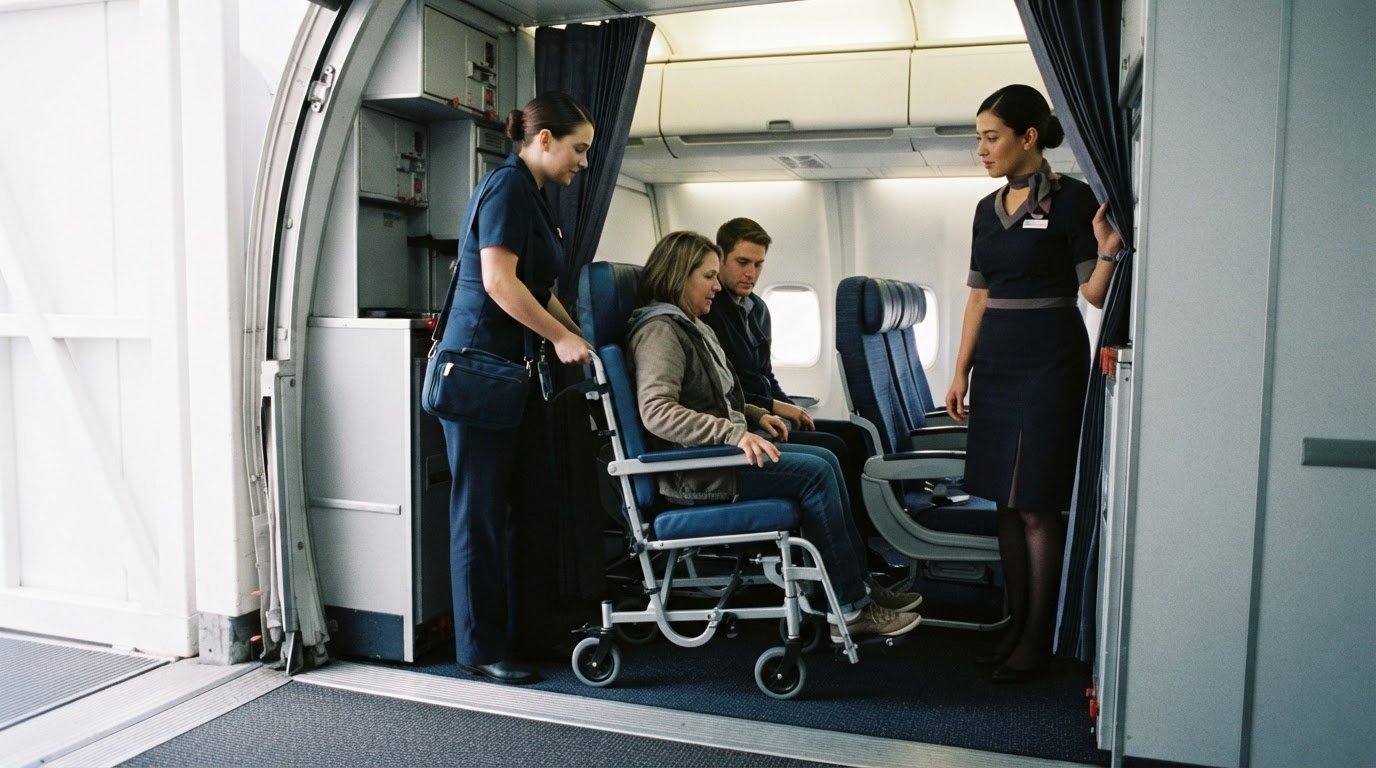
International Ground Transportation Options for Patients
A family member can travel with a patient when the ground transport arrangements accommodate both the companion and the patient’s care needs. Coordinating international ground transportation for patients means planning pickup, transfer, and handoff at the receiving facility as connected parts of the journey. Ground ambulances commonly handle the first or last leg of an international medical trip, or a shorter cross-border journey when road travel is more practical.
It’s understandable to want someone familiar beside the patient, especially when travel involves multiple drivers, facilities, and handoffs. Companion arrangements work best when planned alongside the patient’s transport needs, rather than left until the ride is booked.
This guide explains how to choose between ground and air transport, plan for companions and luggage, and coordinate rides with healthcare facilities. It also covers practical details that help families and care teams organize a clearer, more connected journey.
Table of Contents
Choosing between air ambulance, commercial medical escort, stretcher service, and ground ambulance
Choose transport based on the patient’s condition, required support, and route. Coordinating international ground transportation for patients often means linking road transfers with an air journey.
Ground Transfers and Cross-Border Journeys
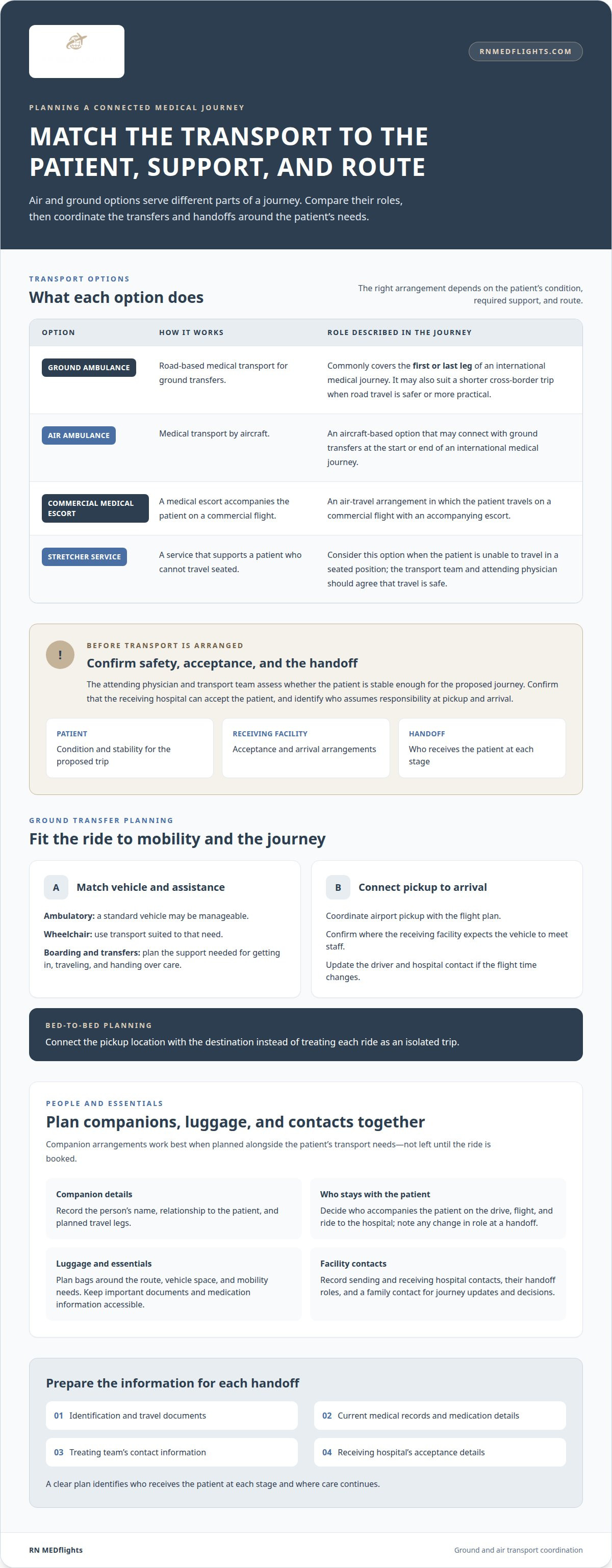
Ground ambulances commonly cover the first or last leg of an international medical journey. They may also suit shorter cross-border trips when road travel is safer or more practical. For an airport transfer, coordinate pickup with the flight plan and the receiving facility’s arrival arrangements. A clear handoff identifies who receives the patient at each stage and where care continues.
Ambulatory, Wheelchair, and Door-to-Door Options
Match the vehicle and assistance to the patient’s mobility. An ambulatory patient may manage a standard vehicle, while someone who uses a wheelchair needs transport suited to that need. Bed-to-bed planning connects the pickup location with the destination, rather than treating the ride as an isolated trip. The key is to plan the support needed for boarding, travel, and handoff.
Air and ground transport serve different parts of the journey. An air ambulance is an aircraft-based medical transport option; a ground ambulance handles road transfers. A commercial medical escort accompanies a patient on a commercial flight, while a stretcher service supports patients who cannot travel seated. The attending physician, transport team, and receiving hospital need to agree that travel is safe.
For travel between U.S. states or medical facilities, no single transport option suits every patient. A practical plan accounts for patient stability, acceptance by the receiving facility, the route, and a safe handoff. Confirm that the receiving hospital can accept the patient before arranging transport. These steps help coordinate the transfer without assuming that requirements are the same everywhere.
Prepare travel documents and clinical information before international departure. Gather the patient’s identification and travel documents, current medical records, medication details, and the treating team’s contact information. Include the receiving hospital’s acceptance details in the transfer plan. These records help the transport team understand the patient’s condition and coordinate care across each handoff.
For a medically fragile patient, the central safety concern is whether travel could worsen their condition. The attending physician and transport team assess whether the patient is stable enough for the proposed journey. Ground transfers also create a high-risk handoff, so identify who assumes responsibility at pickup and arrival. Emergency transportation is different from a planned medical transfer.
Non-emergency medical transportation costs in major U.S. cities depend on the case, including the route, mobility support, and ride arrangements; the price is given after a quote request. A city name alone doesn’t determine the cost because trip requirements also shape the service.
For emergency ground or air transportation, MASA core protections apply in the United States and Canada. This scope matters when reviewing whether a protection applies to a journey, since it does not describe coverage outside those countries.
Companions, luggage, and facility contacts
Plan the companion, baggage, and hospital handoffs as parts of one journey. For example, a family member may travel beside the patient on one leg, then meet them at the receiving facility after a separate transfer. The transport plan should identify who accompanies the patient and who receives them at each destination.
A companion’s role depends on the patient’s ability to travel and the assistance needed along the route. A family member may provide familiar support, while clinical monitoring requires an appropriate care arrangement. Decide who stays with the patient during each leg, including the drive to the airport, the flight, and the ride to the hospital. Record any handoff where the companion’s role changes.
Pack for the planned route, not an assumed standard allowance. Separate essential items from luggage that can travel independently, and assign someone to keep important documents and medication information accessible. For example, the family member riding with the patient can carry the folder needed at check-in and hospital arrival. Vehicle space and the patient’s mobility needs determine how bags can be managed during ground transfers.
Companion details: Include the person’s name, relationship to the patient, and planned travel legs.
Mobility needs: Note whether the patient walks, uses a wheelchair, or needs help transferring.
Luggage plan: Identify which bags travel with the patient and who manages other belongings.
Facility contacts: Record the sending and receiving hospital contacts and their roles in the handoff.
Give each facility a clear contact point. The sending hospital can communicate the patient’s departure arrangements, while the receiving hospital can prepare for arrival and clarify where the vehicle should meet staff. A named contact at each end helps resolve practical issues, such as a changed arrival time or a different entrance. Include a family contact for updates and decisions during the journey.
Before departure, align the ground pickup with the flight schedule and the receiving facility’s arrival plan. If the flight time changes, the driver and hospital contact need the updated details. Keep the patient’s assistance needs consistent across handoffs, so the next team understands how the patient travels and who accompanies them. This coordination also clarifies who provides monitoring during each segment.
Coverage is separate from logistics. Review what an existing health plan covers for international care and evacuation, since some plans cover certain care but not all evacuation costs. Medicare does not cover medical costs incurred outside the United States, according to the Centers for Medicare & Medicaid Services. Keep coverage information with the travel documents so the responsible family member can access it during the journey.
When a patient needs someone alongside them across connected travel legs, travel companion support can be part of the planning. This helps families account for the companion’s role alongside luggage, facility contacts, and the patient’s assistance needs.
Driver availability and advance scheduling
Driver availability depends on the route, pickup time, vehicle needs, and transfer plan. A scheduled ride may involve more than one driver, especially when an airport transfer connects with a hospital journey. Share the patient’s mobility needs, required assistance, pickup location, destination, and expected timing. These details help shape a structured plan around the actual trip rather than a generic booking.
Submit the request with the information needed to coordinate the trip. Include the patient’s name, a reliable contact, the sending facility, the receiving facility, and the preferred travel window. Note whether the patient walks, uses a wheelchair, or travels on a stretcher. If the ride connects with a flight, include its itinerary so the ground pickup can align with arrival arrangements.
Advance scheduling gives the transport team time to coordinate drivers and facility contacts. It also makes changes easier to communicate across the journey. For example, if a flight time changes, the revised arrival information can be shared with the driver and receiving hospital. A named contact at each location helps prevent uncertainty about the pickup point or who receives the patient.
Route: Provide each pickup and destination, including any airport or facility transfer.
Patient needs: Describe mobility, transfer assistance, and stretcher requirements.
Timing: Share the planned travel window and flight details when relevant.
Contacts: Identify the family, facility, and receiving-team contacts for coordination.
Timing can vary by trip. A Texas customer testimonial describes booking transportation for a father in 30 minutes. That individual account is not a scheduling standard; the route, patient’s needs, and coordination required all affect planning. A multi-stop journey involving a hospital and airport requires different arrangements from a single pickup and drop-off.
Insurance and transport coordination are separate tasks. Keep relevant coverage information with the travel documents, and identify who handles insurance communications. Coverage terms can differ, so don’t assume insurance has arranged the driver or facility handoff just because a ride is scheduled. Record the contact responsible for each task to avoid gaps between travel planning and coverage administration.
For emergency medical transportation, a planned ride is not a substitute for emergency response. Long-distance patient transport is not a replacement for 911 or EMS. Scheduling instead supports a planned journey where the patient’s condition and receiving arrangements allow travel. The attending physician, transport team, and receiving facility need to agree that the move is safe before the trip proceeds.
Once the request is submitted, keep one structured record of confirmed logistics. Include the driver’s pickup instructions, facility contacts, travel timing, and any changes shared with the team. This record helps family members and care staff work from the same plan, especially when the journey includes separate ground and flight segments.
Healthcare providers arranging rides for patients
For a healthcare provider, a patient ride is part of access to care, not just a vehicle booking. Non-emergency medical transportation helps people reach appointments when mobility, health, or practical barriers prevent independent travel. A clear process connects the appointment schedule, the patient’s needs, the vehicle, and the receiving location.
Transportation barriers can disrupt planned care. In a February 2026 survey of 150 healthcare professionals commissioned by Uber, 57% linked missed healthcare visits to transportation barriers. More than half estimated that 11-20% of missed appointments were directly tied to those barriers. These findings underline why ride planning belongs alongside appointment coordination.
A structured workflow helps providers move from a ride request to a completed handoff:
Identify the need: Record the appointment time, pickup and destination, mobility needs, and assistance required.
Match the vehicle: Select transportation that fits how the patient can travel, including wheelchair access where needed.
Coordinate the trip: Share arrival instructions and contact details with the patient, driver, and receiving facility.
Close the loop: Record whether the ride occurred and communicate relevant delays to care staff.
Across U.S. states, providers should treat each ride as a distinct coordination task. A patient traveling from home to a clinic may need different support from someone transferring between medical facilities. The pickup location, mobility, appointment timing, and arrival instructions all affect the vehicle plan. Don’t assume one ride arrangement fits every patient or destination.
World Health Organization guidance treats ground transfer as a high-risk handoff that should be planned and checked carefully. For example, staff can clarify who receives the patient on arrival and what information must accompany the handoff. Clear responsibility reduces confusion between the sending location, driver, and receiving team.
Billing also needs a defined process. Providers should keep transportation records distinct from clinical notes and document the ride’s purpose, route, and completion status. Coverage varies by plan, so a scheduled ride should not be treated as proof of insurance payment. Clear billing procedures help distinguish transportation coordination from coverage or reimbursement decisions.
For a patient with limited mobility, specify the assistance needed at both ends of the ride. A clinic appointment, for example, may require coordination between the pickup contact and staff prepared to receive the patient. If timing changes, providers can update the driver and facility contact through the same communication path. This structured approach connects transportation with the care visit.
What ground transportation options are available for international patients traveling to the United States?
After arriving in the United States, an international patient may need a ride from the airport to a hospital, lodging, or another care location. The suitable option depends on the patient’s mobility, medical needs, and destination. A planned transfer can connect the arrival point with the next step in the patient’s care.
Ambulatory transport may suit a patient who can walk and travel without clinical support during the ride. A standard vehicle may work for straightforward travel, but it doesn’t provide medical monitoring. For example, a patient who can manage transfers independently may need a different arrangement from someone who needs help boarding or leaving the vehicle.
Wheelchair-accessible transport is appropriate when a patient travels seated in a wheelchair. The plan should account for the patient’s mobility and assistance needs, as well as the destination’s drop-off arrangements. A ride to a hospital entrance differs from one to a clinic with a designated arrival point. Clarify the exact destination with the receiving facility.
Ground ambulance transport can be used for airport transfers and other road legs when the patient needs ambulance transport. Ground ambulances commonly handle the first or last leg of an international medical journey. They may also be practical for shorter cross-border trips. The patient’s condition and the care required during travel help determine whether this option fits.
These options differ in purpose. A rideshare or standard vehicle provides transportation, not clinical care. A ground ambulance is designed for medical transportation. If the patient can travel by air but needs an escort, a commercial medical escort is distinct from an air ambulance. A stretcher service supports a patient who cannot travel seated on a commercial flight.
For a patient arriving at a U.S. airport, plan the ground ride around the arrival terminal, receiving location, and patient’s ability to transfer. Connect the airport pickup with the correct facility entrance and a named receiving contact. If the patient has a companion, include their travel arrangements in the plan. This makes the vehicle, pickup details, and destination part of one coordinated transfer.
Before arranging the trip, the attending physician and transport team need to agree that travel is safe. The receiving hospital should accept the patient before transport is arranged. These decisions shape whether the patient can travel by standard vehicle, wheelchair-accessible transport, or ambulance. The route alone does not determine the right mode.
For a transfer that links an international arrival with a U.S. care destination, coordinate the patient’s ground transfer as part of the journey plan.
RN MEDflights: International Medical Repatriation
RN MEDflights coordinates medical transport when a patient needs a connected journey between facilities or countries. For international travel, its support can include Commercial Airline Medical Escort and Bed-to-Bed Medical Transport, with Ground Ambulance Coordination for road transfers. Domestic Medical Relocation can help when the required move is within the United States.
These services can suit patients who need more than an independent ride, such as linked ground and air arrangements or support moving between care locations. The right option depends on the patient’s condition, travel needs, and route.
Contact RN MEDflights to discuss the patient’s transport needs and journey.
Make the next transfer easier to coordinate
The next step is to turn the patient’s travel needs into one clear plan. Start with the intended destination, the care team’s guidance, and the patient’s ability to travel. Then align the ground journey with arrangements at each end. A family member or facility contact can help keep the right people informed as plans take shape.
Careful coordination matters most where one part of the journey meets another. A clear plan gives drivers, facilities, and companions a shared understanding of the patient’s needs and the intended handoff. For families managing a cross-border move, coordinating international ground transportation for patients helps connect road travel with the broader medical journey.
RN MEDflights can support transport planning through Commercial Airline Medical Escort, International Medical Repatriation, and Domestic Medical Relocation. To discuss arrangements for a patient’s journey, contact RN MEDflights to coordinate transport.
With the right details and a coordinated plan, you can take the next step with greater clarity.
Frequently Asked Questions
Can a family member travel with the patient?
Yes, a family member can accompany the patient when the travel arrangements allow. Include the companion’s name and intended role in the itinerary, such as helping with communication or meeting the patient on arrival. For example, if the family member travels separately, identify who will meet the patient at the destination. A travel companion can also support patients during travel.
How fast can it be arranged?
Timing depends on the patient’s readiness to travel and how quickly each part of the trip can be coordinated. Medical clearance, receiving-facility acceptance, route planning, and driver arrangements all affect the schedule. A journey involving an international flight and ground transfers takes coordination across more steps than a single local ride. Share the patient’s current location, destination, and clinical needs to begin planning.
Is international medical transportation covered by insurance?
Coverage varies by health plan, and some plans cover international care without covering all evacuation costs. Medicare does not cover medical costs incurred outside the United States, according to the Centers for Medicare & Medicaid Services. Additional medical evacuation coverage may be worth considering, depending on the trip and policy. Review the relevant policy language for transportation, evacuation, and care abroad, and keep insurance details accessible to the person managing the trip.
How do you coordinate airport pickup and ground transportation for an international patient?
Build the pickup plan around the flight arrival, patient mobility, destination, and receiving contact. Share the arrival details and meeting point with the ground transport team, then align the ride with the receiving facility’s instructions. If the itinerary changes, communicate revised flight information to the driver and destination contact. For example, a hospital transfer needs a specific arrival location and someone prepared to receive the patient.
What medical transport services are available for patients who need a wheelchair, stretcher, or ambulance?
Options include wheelchair-accessible ground transport, ground ambulance coordination, and commercial airline stretcher service on select international airlines and routes. RN MEDflights also provides Commercial Airline Medical Escort and bed-to-bed medical transport, including ground ambulance coordination at both ends of the journey. The appropriate arrangement depends on the patient’s mobility and medical needs, plus the route. These options support planned medical travel; emergency transportation requires emergency response services.
How can hospitals and medical travel coordinators arrange accessible transportation?
Hospitals and coordinators can start with a referral describing the patient’s mobility, transfer assistance, pickup location, destination, and appointment or arrival timing. For example, specify whether the patient uses a wheelchair and needs help moving between the vehicle and facility. Assign a contact at the sending location and destination, then share itinerary changes through the same communication path to keep the handoff clear.
How can international patients coordinate transportation with hospitals, hotels, and caregivers?
Use one shared itinerary that names each destination, the contact responsible there, and the planned arrival time. Include the hospital, hotel, caregiver, and transport team when each has a role in the transfer. For example, a caregiver can meet the patient at a hotel while the hospital contact handles a later appointment arrival. Keep the patient’s travel documents and contact details with the person accompanying them.