How Commercial Airline Stretcher Service Works
A bedbound passenger can’t fly on a commercial stretcher without medical escorts. A commercial airline stretcher service lets a medically stable person lie down during the flight, but the airline must approve the arrangement and the patient must travel with qualified medical professionals. For international transport, at least two medical professionals accompany each patient.
It’s understandable to wonder whether your mom can travel this way and what care she’ll need along the route. This guide explains who may be suitable for stretcher transport, why an escort is essential, and how the airline’s approval process works. It also follows the journey beyond the aircraft, including how ground transportation to and from the airport fits into a coordinated transfer. You’ll learn what the medical team can do during the flight, what factors may affect approval, and when a commercial flight may not provide the level of care a patient needs. That way, you can better understand the options and the steps involved in planning a safe, supported journey.
Table of Contents
Can a bedridden person fly and be transported by air?
A medically stable patient may travel by air on a stretcher if cleared by a physician to fly and accompanied by a qualified medical professional. Airline approval depends on the patient’s condition, care needs, route, and available stretcher arrangements.
For a closer look at scheduled medical flights and how proper planning ensures a smooth journey with RN MEDflights, watch this informative overview:
Patient Eligibility and Medical Stability
Stretcher transport is intended for patients who are medically stable but cannot safely sit in a standard airline seat. The distinction matters: a bedridden patient may qualify, while someone needing intensive care or continuous emergency intervention is not suited to this form of travel. Both basic life support and advanced life support patients may be eligible for international stretcher flights.
Medical Clearance and Airline Approval
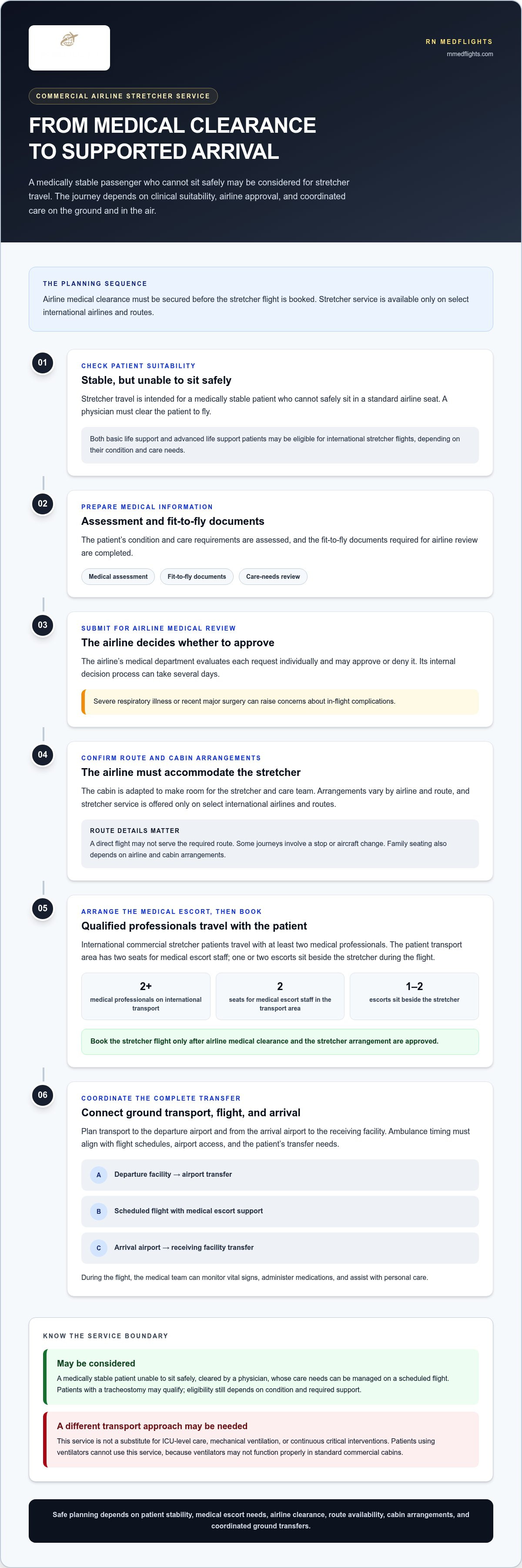
Medical clearance means assessing the patient’s condition and completing the fit-to-fly documents required for airline review. The airline’s medical department evaluates each request individually and may approve or deny it. Its internal decision process can take several days, so clearance must be secured before booking the stretcher flight. Severe respiratory illness or recent major surgery can raise concerns about in-flight complications.
Booking Requirements
Booking requires a medical assessment, fit-to-fly documents, airline medical clearance, and coordination of the stretcher arrangement. What are the requirements for booking an airline stretcher service? The patient must be assessed, the required medical documents completed, and the airline’s medical department must approve the request before the flight is booked. These steps establish whether the patient’s care needs can be managed during travel.
Medical support is part of the transport plan, not an optional extra for a bedbound passenger. International commercial stretcher patients travel with at least two medical professionals. The patient transport area has two seats for medical escort staff, and one or two escorts sit beside the stretcher during the flight. The team can monitor vital signs, administer medications, and assist with personal care.
The airline must adapt the cabin to accommodate a stretcher, and arrangements vary by airline and route. Since stretcher transport is available only on select international airlines and routes, the airline must approve the setup before travel can be planned.
Whether family members can travel too depends on the airline’s seating and cabin arrangements. Planning should also include transport to and from the airports, since the patient may need support at every stage. Medical stability, escort needs, airline clearance, route, and cabin space all help determine whether scheduled air travel is suitable.
What medical conditions are suitable for commercial stretcher transport?
Stretcher service is not available on every airline or route. RN MEDflights’ airline stretcher transport is available on select international airlines and routes, so approval and route arrangements must be established before booking.
Suitability depends on whether the patient can travel safely with the care available on a scheduled flight. Patients with a tracheostomy may qualify for international commercial stretcher transport. Patients using ventilators cannot use this service, because ventilators may not function properly in standard commercial cabins. A tracheostomy alone does not determine eligibility; the patient’s condition and required support also matter.
The patient’s medical needs and airline approval determine whether stretcher travel can proceed. A commercial airline medical escort is for medically stable patients cleared by a physician to fly. It is not a substitute for transport requiring ICU-level care, mechanical ventilation, or continuous critical interventions; those needs require a different transport approach.
Commercial stretcher transport can be more economical than an air ambulance because it uses a scheduled passenger flight rather than a dedicated aircraft. The trade-off is that the route, airline schedule, cabin layout, and patient’s care needs shape what can be arranged. A direct flight may not serve the required route, and some journeys involve a stop or aircraft change. Those details affect the overall coordination and should be considered alongside the medical plan.
Air ambulance and commercial stretcher transport serve different clinical and logistical needs. An air ambulance is appropriate when a patient needs immediate medical intervention or has an extreme illness. A scheduled stretcher flight is intended for a medically stable patient who cannot sit safely in a standard seat. The commercial aircraft must accommodate the stretcher, medical equipment, and escort staff, while the air ambulance provides a dedicated aircraft for the transport mission.
The total price depends on the case and is provided after a quote request; factors include route, airline arrangements, medical staffing, equipment, and ground transfers. Ground coordination connects the departure facility to the airport and the arrival airport to the receiving facility. Ambulance timing must align with flight schedules, airport access, and the patient’s transfer needs. Coordinating these handoffs helps maintain continuity between hospital care and the scheduled flight.
How does commercial airline stretcher service work?
A scheduled-flight stretcher lets a patient lie down while traveling, with medical escorts seated nearby. Key limitations include airline approval, cabin and route constraints, and the level of care available during flight.
Stretcher Arrangements on Scheduled Flights
An airline stretcher setup converts part of the passenger cabin into a space for the patient, stretcher, equipment, and medical staff. Preparing the cabin usually requires removing 6-12 seats, often in the economy section. A curtain partitions the area during flight, creating separation from other passengers while allowing escorts to remain close.
The airline must approve and arrange the stretcher before the flight can be booked. Routes and cabin arrangements vary, and the itinerary may include a stop or aircraft change. A scheduled flight follows its available route and operating arrangements, so plan the patient’s transfers around the complete itinerary.
Patient Comfort and Safety
The stretcher allows a patient who cannot sit safely in a standard seat to lie down during travel. The curtain provides privacy, while the nearby medical team can observe the patient. Comfort and safety depend on matching the flight arrangements to the patient’s condition, care needs, and ability to tolerate the planned journey.
Airline oxygen capability may reach 50 PSI, and oxygen flow may reach 15 liters per minute, depending on the airline and route. These figures describe potential aircraft capabilities, not a guarantee that a particular patient’s respiratory needs can be met. Some patients may not be suitable for this service if their medical support needs cannot be met on board.
Medical Team Staffing and In-Flight Care
One or two medical escorts sit beside the stretcher during a commercial flight. On international commercial stretcher journeys, each patient travels with at least two medical professionals. The team can monitor vital signs, administer medications, and assist with personal care, keeping planned medical support with the patient throughout the flight.
Before departure, the medical team assesses the patient and completes fit-to-fly documents for airline review. After approval, coordination connects the patient’s needs with the cabin setup and flight arrangements. During travel, the escort team provides care within its capabilities; a patient needing intensive care or continuous emergency intervention requires a different transport approach.
Family members may be able to travel with the patient, depending on the airline’s seating arrangements. The destination, any planned stop, and possible aircraft change all affect how the journey unfolds. A clear plan connects the scheduled flight with ground transfers and the patient’s care needs at each stage.
Airline and airport ground-transport coordination
A stretcher flight is only one part of a patient’s journey. RN MEDflights coordinates bed-to-bed transport, including ground transport to and from the airports, airline logistics, and delivery to the receiving bed.
A patient may need stretcher transport when a medical condition prevents safe travel in a standard airline seat. The ground plan should account for that need from the outset. For example, if the patient leaves a hospital on a stretcher, the vehicle and transfer arrangements must support the trip to the airport without requiring the patient to sit.
Ground transport planning means aligning the vehicle and airport handoff with the scheduled flight. The plan needs the flight details, departure timing, patient’s mobility needs, and receiving destination. RN MEDflights coordinates ground transport and airline logistics as parts of the same bed-to-bed journey.
The transfer from the facility bed to the stretcher is a key transition. The medical team and transport crew coordinate the move into the ground vehicle and onward to the aircraft. On arrival, the process continues in reverse, with the patient transferred from the aircraft to ground transport and then delivered to the receiving bed.
Each handoff needs clear responsibility. The sending facility shares relevant care information with the medical team, while the ground crew receives the practical details needed for vehicle loading and travel. The airport transfer plan should identify who accompanies the patient and who receives them at the destination. This continuity matters most when the patient cannot independently move between the bed, stretcher, vehicle, and aircraft.
Ground ambulance transport is appropriate when the patient needs a lying position or medical support between locations. A private air flight does not remove the need for these ground connections. Even when the flight itself is arranged, the patient still needs transport to the departure airport and from the arrival airport. For a route involving O’Hare, Midway, or another airport, the required vehicle and handoff plan depend on the patient’s condition and the facilities involved.
Build the itinerary around the patient’s transfer needs, not just the flight schedule. Connect the departure and receiving facilities with the ground-transport endpoints and planned handoffs. If the patient’s mobility or condition changes before travel, the transport plan may need to change as well.
Commercial airline stretcher service
A commercial airline stretcher adapts a scheduled passenger flight for a patient who must remain lying down. The airline’s approval, route, cabin arrangement, and patient’s medical needs all affect whether the journey can be organized.
Cabin preparation is a substantial change, not simply placing a stretcher in an empty row. The airline usually removes 6-12 seats to create space for the patient, medical equipment, and escort staff. The stretcher is commonly installed in the rear economy cabin, behind a curtain that separates the patient area from other passengers. The installed stretcher bed is described as FAA-approved.
Aircraft type matters because cabin layout and route availability shape the arrangement. Boeing 777, 747, and 787 aircraft, along with the Airbus A320, are examples used for stretcher transport. The airline must be able to accommodate the stretcher configuration on the selected aircraft. A route that works on one aircraft may not fit another flight’s cabin plan.
Route planning can also affect travel time and transfers. International stretcher transport is available on flights to and from Europe, the Middle East, Asia, and the Pacific Rim, but not between North and South America. Some journeys require a stop or aircraft change. Each change adds another point for medical and ground coordination, so families should consider the complete route to the hospital destination, not only the first departure.
Airline approval and scheduling can take several days, and arranging an international stretcher flight typically takes 7 to 10 days. The airline’s medical department reviews each request before the stretcher flight is booked. This timing makes the option unsuitable for urgent evacuations. It works best when the patient’s medical condition allows time for review and planned travel.
Medical equipment must also match the patient’s needs and the aircraft’s capabilities. Depending on the airline and route, oxygen flow may reach 15 liters per minute. That figure describes a possible flow range, not a universal cabin setting. Ventilators may not function properly in standard commercial cabins, which limits this option for patients who depend on ventilator support.
The practical takeaway is to assess three connected factors: patient stability, aircraft configuration, and route logistics. A long distance may make scheduled travel useful, but stops, aircraft changes, and ground transfers still shape the plan. For help coordinating a patient’s stretcher flight and related transfers, start planning medical transport.
RN MEDflights: Commercial Airline Medical Escort
RN MEDflights provides Commercial Airline Medical Escort for medically stable patients cleared by a physician to fly. Its licensed clinicians accompany patients on scheduled commercial flights, while the company coordinates airline logistics and ground transport as part of a bed-to-bed journey.
For transfers involving a hospital, airport, and receiving facility, Bed-to-Bed Medical Transport and Ground Ambulance Coordination can support the connected ground journey. Domestic Medical Relocation is another option when the patient needs to move between locations within the country. Each service addresses a different part of the transport plan.
Contact RN MEDflights to discuss the patient’s travel needs and request a clinical review and quote.
Plan the Next Step With Care
The decision is not only how your loved one will travel. It is how the journey connects the current care setting with the next stage of recovery. A commercial airline stretcher service may be part of that plan when the patient is medically stable, cleared by a physician to fly, and approved by the airline.
RN MEDflights provides Commercial Airline Medical Escort for medically stable patients cleared by a physician to fly. Its International Medical Repatriation and Domestic Medical Relocation services support different patient-transfer needs. Bed-to-bed coordination connects the flight with ground transport and delivery to the receiving bed.
Share the patient’s current situation, intended destination, and travel needs to begin a focused conversation about the appropriate service. Contact RN MEDflights to discuss care. A clear plan can help you move forward with greater confidence and keep your loved one’s needs at the center.
Frequently Asked Questions
Can I take my mom on an airline stretcher without a medical escort?
No. A bedbound passenger cannot travel on an airline stretcher without a medical escort who can provide care during the flight. Each patient on an international commercial stretcher flight travels with at least two medical professionals. Your mother’s medical needs shape the care plan, and family members can often travel too, depending on cabin seating. A relative can offer personal support, but cannot replace the required medical team.
How long does it take to arrange an international commercial stretcher flight?
Arranging an international stretcher flight typically takes 7 to 10 days. The airline’s medical review can take several days, and medical clearance must be secured before booking. This timing matters if a hospital discharge or receiving-facility admission is being planned around travel. Share the intended destination and the patient’s current care needs early, so the medical documents, airline review, and transfer arrangements can be considered together.
How the Commercial Stretcher Process Works?
The process begins with a clinical review and the airline’s medical approval. Once the airline approves the request, the stretcher arrangement and flight can be booked. RN MEDflights coordinates the patient’s ground transport and airline logistics as part of bed-to-bed service. For a hospital transfer, include the receiving bed and arrival handoff in the plan, not just the departure.
Are there other flying options if a passenger cannot sit onboard an airplane?
Yes. A scheduled-flight stretcher may suit a medically stable patient who cannot sit safely. A lie-flat business-class seat is another possibility only if the passenger can sit upright for at least thirty minutes, and potentially up to one hour. Patients needing immediate intervention or intensive care may require an air ambulance instead. The patient’s ability to tolerate the seat and the care needed in flight guide the choice.
Can airlines refuse stretcher requests?
Yes. The airline’s medical department reviews each request individually and can deny it when the risk of in-flight complications is high. Severe respiratory illness or recent major surgery may raise concerns during that review. The decision considers the patient’s condition and care requirements alongside the airline’s ability to accommodate them. A family should factor possible refusal into discharge and arrival planning, especially when timing depends on a particular flight.
How do you choose the right flight for a bedridden patient?
Choose a flight by matching the patient’s medical needs with the airline’s stretcher arrangement, route, and available care. Check whether the itinerary includes a stop or aircraft change, since each transfer adds coordination. Consider the patient’s oxygen requirements and the receiving facility’s timing as well. For example, a route with a connection may create additional handoffs, making a direct itinerary preferable when it fits the clinical and airline arrangements.
How much does commercial airline stretcher service cost?
The price depends on the case and is provided after a quote request. Factors include the route, airline arrangements, medical staffing, required equipment, and ground transfers. These elements vary with the patient’s needs and itinerary, so a general figure would not describe every journey. When reviewing a transport plan, consider the complete trip between facilities, not just the airline portion, because ground coordination forms part of the arrangement.
How far in advance must a stretcher flight be arranged?
Plan for an international commercial stretcher flight to take 7 to 10 days to arrange. Airline approval and scheduling can take several days, so this option is not suited to urgent evacuations. The timeline includes medical review and clearance before the flight is booked. If a hospital transfer depends on a planned arrival, coordinate the receiving facility and ground transport around the expected flight arrangements.