Hospital-to-Hospital Transfer Coordination for Care Teams
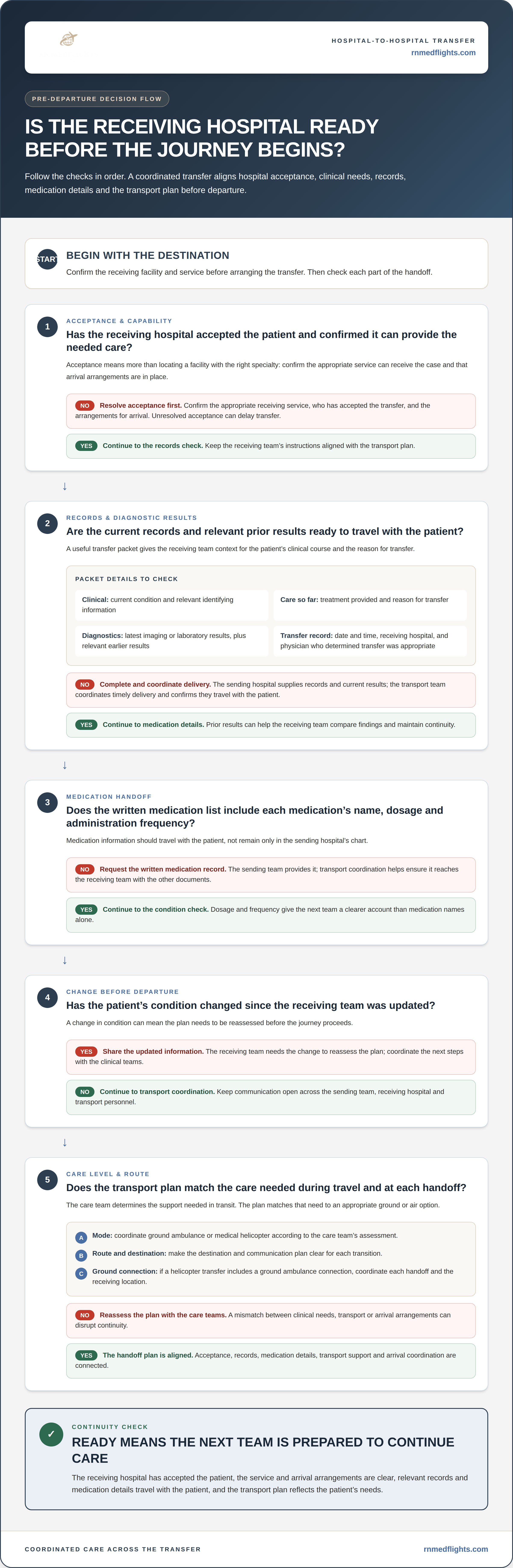
A transfer is seamless only when the receiving hospital is ready before the journey begins. To understand how to ensure a seamless hospital-to-hospital transfer, care teams need to confirm acceptance, match the patient’s needs to the care available on arrival, and coordinate records and diagnostic results to support continuity.
Coordinating a transfer can feel demanding when a patient’s condition is changing and several teams must act together. A clear plan gives everyone a shared understanding of what has been agreed, what care is needed during transport, and what information must reach the receiving team.
This guide explains how to confirm hospital acceptance, plan an appropriate level of care, share medical records and diagnostic results, and coordinate the handoff. It also covers how professional medical transport coordination can support continuity between facilities, keeping the focus on the patient and the next stage of care.
Table of Contents
Inbound and outbound medical and behavioral health transfers
How a medical transport provider confirms the receiving hospital can accept the patient
How a medical transport provider coordinates timely record delivery with hospital support staff
How a medical transport provider helps prepare the appropriate level of care on arrival
How a medical transport provider shares previous serial diagnostics for comparison
Inbound and outbound medical and behavioral health transfers
Transfers depend on a clear clinical handoff between the sending and receiving teams. The plan should align hospital acceptance, records, medication details, transport mode, and the care needed during the journey.
Diagnostic Results and Medical Records
A transport provider coordinates the transfer of current records with the sending team and receiving hospital. The packet should include available diagnostic results, treatment provided, the reason for transfer, and relevant identifying and clinical information. For example, the receiving team needs the latest imaging or laboratory results alongside relevant earlier results to understand the patient’s clinical course and avoid gaps in the handoff.
The sending hospital supplies the records and current results; the transport team coordinates their timely delivery and confirms they travel with the patient. Transfer documentation should include the date and time, receiving hospital, and physician who determined the transfer was appropriate, along with the reason. These details help the receiving team connect the paperwork to the patient and the transfer plan.
Ground and Air Transport Coordination
Ground ambulance and medical helicopter transport require coordination among the patient’s clinical team, the sending team, and the receiving hospital. The care team determines the support needed during travel; the transport plan matches that need to an appropriate ground or air option. If a helicopter transfer includes a ground ambulance connection, teams coordinate each handoff and the receiving location.
Common delays include unresolved hospital acceptance, incomplete records, and changes in the patient’s condition that require the plan to be reassessed. A mismatch between clinical needs and transport or arrival arrangements can also disrupt continuity. Ground and air coordination should include a clear route, destination, and communication plan for each transition.
Medication Information During Transfer
Medication information should travel with the patient, not remain only in the sending hospital’s chart. Caregivers should request a written list of medications given in the hospital, including each medication’s dosage and how often it was administered. The receiving team can review the list alongside current clinical records to understand recent treatment and continue the handoff accurately.
The sending team provides the medication record, while transport coordination helps ensure it reaches the receiving team with the other transfer documents. A list showing each medication’s name, dosage, and administration frequency, for example, gives the next care team a clearer account than medication names alone.
Transfer Laws and EMTALA Requirements
In the United States, EMTALA requires an appropriate medical screening examination for a person presenting with an emergency medical condition. If one exists, the hospital must provide necessary stabilizing treatment or arrange an appropriate transfer. Federal law also authorizes requirements for appropriate transfers to protect transferred individuals’ health and safety.
State requirements may add further rules. According to the Washington State Legislature, Washington requires general hospitals to maintain a transfer agreement in their service area as a condition of licensure. Transfer costs and insurance coverage depend on the patient’s plan and transport arrangements, so the care team should establish the applicable billing and authorization process during planning.
How a medical transport provider confirms the receiving hospital can accept the patient
Acceptance involves more than finding a facility with the right specialty. The transport provider coordinates with the sending team and receiving hospital to establish a clear destination, appropriate clinical capability, and workable handoff before departure.
The provider shares the patient’s current clinical needs with the receiving facility and confirms that the appropriate service can receive the case. This connects the referring physician with the receiving service responsible for the next stage of care. For example, a patient needing specialty assessment should be directed to a facility equipped for that service, rather than one chosen only for convenience. The provider also aligns the transport plan with the receiving team’s instructions.
Confirmation should clarify who at the receiving facility has accepted the transfer and what arrangements are in place for arrival. The provider coordinates communication among the referring physician, receiving team, and transport personnel. If the patient’s condition changes before departure, the receiving team needs the updated information to reassess the plan. Clear responsibility for each call and handoff reduces uncertainty about whether the destination is ready.
Load balancing is different from choosing a destination for one patient. During a system-wide patient-flow response, facilities may coordinate transfers to distribute demand and available capacity. New York State’s December 21, 2021 guidance addressed level-loading transfers under its Surge and Flex Health Care Coordination System. It applies to the state disaster emergency declared under Executive Orders No. 4 and No.11. Under that guidance, the sending facility must be at or near capacity, and the receiving facility must be notified before transfer.
That New York process also requires a written transfer order and documentation of the discussion with the patient. The patient or authorized decision-maker must be consulted, although consent is not required for a level-loading transfer under that guidance. If they object, the care team explains the benefits of transfer and the risks of remaining, then discusses the need for transfer. This connects system-level flow decisions to the patient’s circumstances.
For larger patient moves, a Patient Move Champion can coordinate responsibilities across clinical and support teams. This role is typically held by a respected clinical director- or manager-level staff member with strong communication skills and the ability to manage large teams. For an individual transfer, the provider should still clarify who communicates acceptance, updates the family, and confirms arrival arrangements.
Patient preference matters alongside clinical need and facility capability. The team should explain the destination and transfer plan clearly, then account for relevant concerns when coordinating the move. The appropriate facility is the one suited to the patient’s care needs and confirmed transfer plan, not simply the first available option.
How a medical transport provider coordinates timely record delivery with hospital support staff
In the United States, a medical transport provider coordinates the transfer plan with the sending hospital and receiving facility. This connects transportation arrangements with record delivery, clinical updates, and the patient’s arrival. To understand how to ensure a seamless hospital-to-hospital transfer, care teams need clear responsibility for each communication step and a shared plan for sending information.
The sending team supplies available records and diagnostic results, along with accurate hospital contacts. The provider coordinates with support staff, such as medical records or transfer-center personnel, to route the documents. If a new result arrives before departure, the sending team can forward it for inclusion. Clear contact details help prevent an important report from going to the wrong department.
Data-driven coordination tracks practical milestones rather than relying on scattered calls. The provider can document whether the receiving facility has accepted the patient, which records have been sent, and whether the transport arrangements align. For example, if an imaging report is missing from the transfer packet, the coordinator can identify the gap and work with hospital staff to route it.
When a registered nurse is assigned to the case, nursing support can add clinical context. The nurse can help organize relevant information and communicate updates between care teams. Responsibilities remain distinct: hospital staff provide and authorize records, while the transport coordinator tracks the transfer plan and record delivery. This makes it clearer who handles a new result or a change in the patient’s status.
A centralized transfer center or coordination desk can provide one point of contact for status updates. It can connect the sending facility, receiving team, transport personnel, and hospital support staff around the same plan. To ensure a seamless hospital-to-hospital transfer, the coordinator identifies who is responsible for each handoff and how urgent updates should reach the right team.
Transfer-center coordination does not replace acceptance by the receiving clinical service. The provider aligns transport timing with the receiving team’s instructions and communicates any changes to the plan. If the expected arrival time changes, the receiving contact needs an update so the transfer record, arrival expectations, and patient movement remain aligned.
In interviews and focus groups with 27 front-line nurses in skilled nursing facilities, nurses often described receiving transfer paperwork exceeding 80 pages. A structured packet helps staff find current results and essential details within lengthy records. The coordinator can organize current diagnostics, relevant prior records, and transfer documents, then track delivery with the receiving contact. This gives both care teams a clearer record set for the handoff.
How a medical transport provider helps prepare the appropriate level of care on arrival
Arrival planning connects the patient’s clinical needs with the receiving facility’s preparations. The transport provider shares relevant updates with hospital staff, coordinates arrival details, and helps organize the handoff. For a patient moving from emergency care to a specialty service, this means communicating the required level of care and any changes before arrival.
The receiving team needs a practical understanding of the patient’s condition, not just a destination and estimated arrival time. The provider coordinates with the sending team to relay relevant clinical updates, support needs, and transport arrangements. If the patient’s condition changes during preparation, the sending team can communicate the change so receiving staff can reassess their preparations.
The required level of care depends on the patient’s needs and the services arranged at the receiving facility. A patient needing critical care, for example, may require a different receiving team and arrival plan from someone transferring for a routine assessment. The provider coordinates the transport handoff with the care teams, while the receiving hospital determines its clinical response and prepares the appropriate staff and resources.
Specialty capability can guide planning. Wellstar Cobb and Wellstar Kennestone Regional Medical Centers have Level III NICUs, while Wellstar Children’s Hospital of Georgia has a Level IV NICU. These examples show why the relevant service at the receiving facility matters: the transfer discussion should clearly communicate the patient’s needs so the receiving team can prepare the appropriate care setting.
Arrival preparation also involves practical communication with patients and families. A medical transport provider can coordinate updates through the agreed contact and share changes to arrival arrangements with the care team. Families can receive information about the expected handoff and where to reunite with the patient. Receiving staff can help loved ones find facilities such as bathrooms, a cafeteria, or a pharmacy.
A major patient move may require a broader team than the transport crew. Boston Children’s leaders worked with over twenty teams representing clinical, nursing support, and support services to prepare people and the building. This example highlights the value of assigning clear responsibilities for receiving the patient, internal communication, and family support during a coordinated move.
After arrival, the handoff should connect the transport team, receiving clinicians, and patient or family. The provider coordinates communication so receiving staff know the patient has arrived and can continue the planned care. Hospital teams can then help the patient become familiar with the new room and reunite loved ones with them. These practical steps support continuity beyond the journey.
How a medical transport provider shares previous serial diagnostics for comparison
Serial diagnostics show how a patient’s findings change over time. For a hospital referral, the transport coordinator works with the sending team to gather current results and relevant earlier studies, then routes them to the receiving team. A dated sequence helps clinicians compare results rather than review a single snapshot without clinical context.
The sending hospital supplies diagnostic records and identifies which results relate to the referral. These may include reports and available images from tests performed during the current episode, alongside relevant earlier studies. For example, pairing a current imaging report with an earlier report gives the receiving physician a clearer basis for comparison. Clinical interpretation remains the responsibility of the treating teams.
To keep the sequence usable, the provider coordinates a structured handoff. Records should identify the patient and show when each diagnostic test was performed. The coordinator can group current results with relevant earlier studies, then send the packet through the hospital’s established process. This organization helps the receiving team locate the latest result and its comparison point.
Timing matters. The transport provider coordinates delivery with hospital support staff and the receiving contact, while the sending team supplies new results as they become available. If a diagnostic report is pending when transport planning begins, the coordinator can communicate its status and route it once the hospital releases it. The handoff should distinguish available findings from outstanding items.
Patients and families can support this process by providing accurate patient and referral details, identifying the sending hospital’s records contact, and sharing relevant prior reports or imaging already in their possession. The care team can clarify which studies are clinically relevant. This helps prevent unrelated records from obscuring a comparison while preserving the information clinicians need for the transfer.
Communication should continue through receipt, not stop when files are sent. The coordinator aligns the diagnostic packet with the transfer documents and confirms the receiving contact has the information needed for the handoff. If a result changes the clinical picture before departure, the sending team communicates the update so the receiving physician can consider it alongside earlier findings.
For example, a referral involving repeated imaging benefits from clearly labeled reports arranged by test date. The receiving team can compare the current study with earlier results and ask the sending physician focused questions. This supports continuity without asking transport personnel to interpret diagnostic findings or make treatment decisions.
For coordinated medical transport and transfer handoffs, discuss bed-to-bed medical transport and the records flow that supports the patient’s referral.
RN MEDflights
RN MEDflights coordinates hospital-to-hospital medical transfers when care teams need help connecting transport arrangements with a patient’s care plan. Depending on the journey and clinical needs, support may include Domestic Medical Relocation, Bed-to-Bed Medical Transport, Ground Ambulance Coordination, or Commercial Airline Medical Escort.
Coordination can align transport arrangements with facility handoffs, records, and arrival details established by the care teams. The appropriate arrangement depends on the patient’s needs and planned mode of travel. Clear communication about hospital acceptance, clinical requirements, and records helps teams maintain continuity as care moves between facilities.
For support planning a hospital-to-hospital transfer, contact RN MEDflights.
Move the Transfer Plan Forward
For care teams considering how to ensure a seamless hospital-to-hospital transfer, the next step is to agree on a shared plan for continuity after arrival. Identify who will receive post-transfer updates, how unresolved questions will reach the appropriate clinician, and who will communicate with the patient or family. This clarity helps the handoff continue beyond the journey.
RN MEDflights supports medical relocation and transfer coordination through services including Commercial Airline Medical Escort, International Medical Repatriation, and Domestic Medical Relocation. These services can connect a patient’s transport needs with the care team’s transfer plan, while clinical decisions remain with treating professionals.
When you’re ready to discuss the transfer, contact RN MEDflights about transfer support. A clear next step can help everyone involved approach the transition with greater confidence and keep attention on the patient’s ongoing care.
Frequently Asked Questions
Who is responsible for coordinating and accepting an interhospital transfer?
The sending care team initiates the transfer, the receiving hospital determines acceptance, and the transport coordinator organizes the movement between them. The sending physician documents why transfer is appropriate, while the receiving team confirms the destination and relevant service. Under EMTALA in the United States, hospitals must provide an appropriate screening examination for a person presenting with an emergency medical condition and, when one exists, stabilizing treatment or an appropriate transfer.
What medical criteria determine whether a patient is stable enough for transfer?
The treating physician assesses whether the patient’s condition can be managed safely during the proposed journey. That assessment considers current clinical status, the support and monitoring needed en route, the likelihood of a meaningful change, and whether the transport team can meet those needs. The physician also weighs whether the transfer itself could worsen the patient’s condition. The record should identify the physician’s decision and explain why the transfer is appropriate.
What patient records, test results, and consent forms should clients provide for a hospital transfer?
Provide patient identification, current clinical information, treatment details, medication information, the reason for transfer, and the receiving hospital’s details. Include current diagnostic reports and relevant earlier results, such as prior imaging for comparison. A written medication list should show each hospital-administered medication, its dosage, and how often it was given. Include transfer-related consent or consultation documentation used for the specific case, and ensure the transfer information accompanies the patient.
How does a medical transport provider choose ambulance or air medical transport options for an interhospital transfer?
The transport plan should match the patient’s clinical needs and the receiving facility’s arrangements. The care team communicates the support required during travel; the coordinator considers whether ground ambulance or air transport can meet those needs and connect with the destination. For example, air travel may also require ground transport at both ends. The arrangement should account for safe handoffs and the receiving team’s arrival plan.
How does a medical transport provider coordinate physician-to-physician handoff and communicate critical care needs?
The provider connects the sending physician with the receiving clinical team and relays relevant updates through the agreed contacts. The handoff should clarify the patient’s current condition, treatment already provided, support needed during transport, and any changes before arrival. For example, if new diagnostic results affect the care plan, the sending team communicates them promptly. The transport coordinator aligns communication with the journey, while physicians direct clinical decisions.


