Transporting a Stable Ventilator Patient on a Commercial Flight: A 2026 Safety Guide
- Jun 17
- 12 min read
The most effective way to relocate a loved one who requires mechanical ventilation isn't necessarily a private jet. For many families, transporting a stable ventilator patient on a commercial flight offers a superior clinical environment with the same life-saving equipment at a fraction of the cost of a private air ambulance. While the idea of traveling at 30,000 feet with complex respiratory needs feels overwhelming, modern FAA regulations and specialized medical escort services have turned this high-stakes logistics challenge into a safe and routine reality.
You're likely facing the crushing stress of high medical bills and the confusing maze of airline medical clearance (MEDIF) forms. It's natural to worry about how a flight nurse will manage a ventilator in a standard cabin or what happens during ground transfers. This guide explains how you can achieve a seamless bed-to-bed transport solution while reducing your total costs by 50 to 70 percent compared to private charters. We'll walk you through the 2026 safety protocols, battery requirements, and the precise steps clinical teams take to ensure your family member remains safe, comfortable, and clinically stable from takeoff to touchdown.
Key Takeaways
Learn why transporting a stable ventilator patient on a commercial flight is a clinically sound alternative that significantly reduces travel costs compared to private air ambulances.
Identify the specific medical benchmarks and stability requirements necessary to secure airline medical clearance for respiratory-dependent travel.
Understand how specialized flight nurses manage the complex MEDIF paperwork and FAA battery requirements to ensure a smooth boarding process.
Discover how commercial stretcher services provide a private, ICU-level environment within the cabin of a standard wide-body aircraft.
See how bed-to-bed logistics coordinate every detail of the journey, including ground ambulance transfers and continuous clinical monitoring from the hospital to the final destination.
Table of Contents
Can a Ventilator-Dependent Patient Fly on a Commercial Plane?
The landscape of international medical travel has shifted significantly by 2026. It's now a common, safe practice to facilitate transporting a stable ventilator patient on a commercial flight when managed by a specialized clinical team. Airlines permit patients requiring mechanical ventilation to board as long as the equipment is FAA-approved and the patient meets strict physiological benchmarks. This isn't just about saving money. It's about utilizing the robust infrastructure of commercial aviation to provide a steady, pressurized environment for long-distance relocation.
To visualize how these missions look in practice, watch this overview of a clinical flight mission:
A critical factor in this process is the presence of a private flight nurse. During altitude changes, cabin pressure fluctuates. These changes can affect how air behaves within the lungs and the ventilator circuit. Your flight nurse monitors these shifts in real-time. They adjust ventilator settings to maintain perfect respiratory sync. This level of vigilant, one-on-one oversight ensures that the patient’s breathing remains effortless even as the aircraft climbs to cruising altitude. We handle every technical detail so the family can focus on emotional support.
Stability Criteria for Air Travel
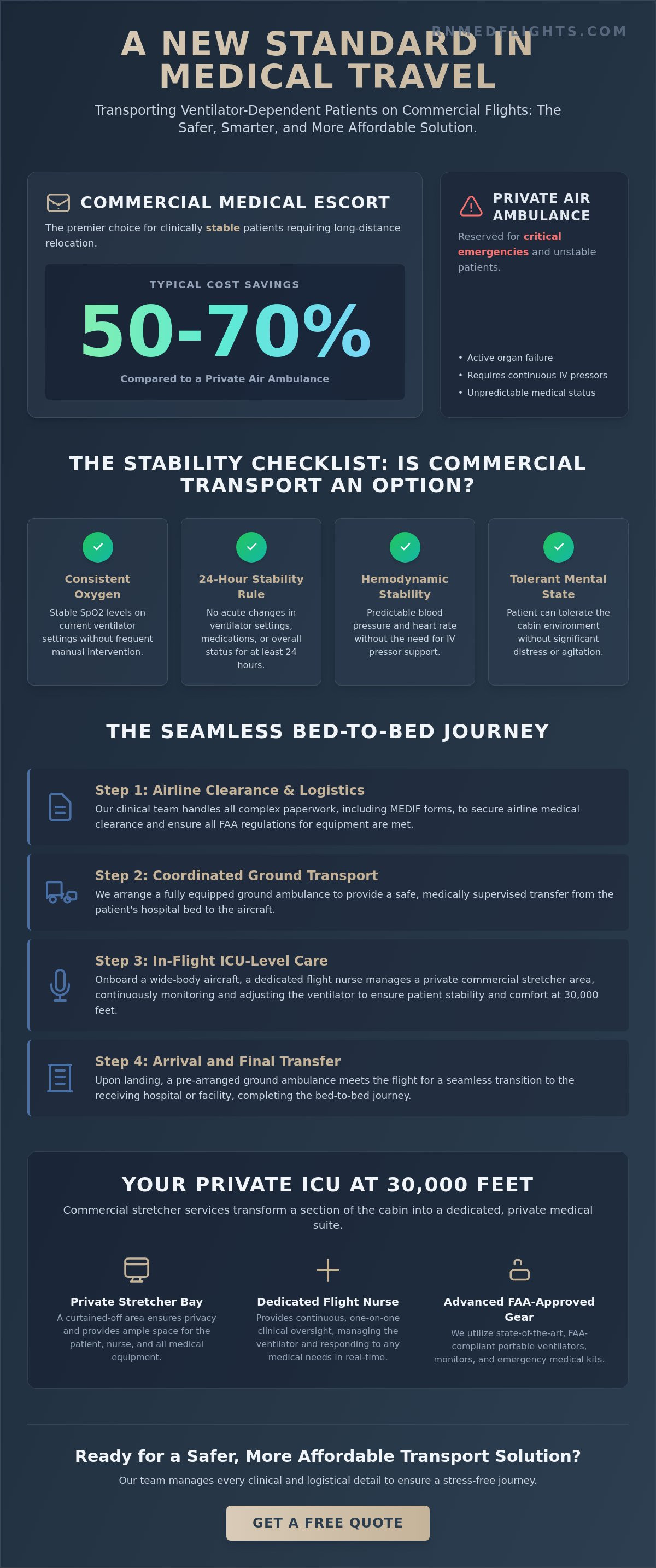
Before an airline grants medical clearance, the patient must be clinically stable. We define this through several non-negotiable benchmarks. First, the patient must maintain consistent oxygen saturation levels (SpO2) on their current ventilator settings without frequent manual intervention. We also follow the 24-hour rule. This requires that there have been no acute changes in ventilator settings, medication dosages, or overall medical status for at least one full day. Hemodynamic stability is equally vital. The patient's blood pressure and heart rate must be predictable and manageable without the need for IV pressors. Finally, the patient must be in a mental state that allows them to tolerate the cabin environment without significant distress.
The Difference Between Emergency and Non-Emergency Transport
It's vital to distinguish between emergency evacuations and non-emergency medical relocations. If a patient is in a state of active organ failure or requires continuous ICU-level titration of life-saving drugs, a private air ambulance is mandatory. However, for those who are stable but dependent on technology, transporting a stable ventilator patient on a commercial flight is often the superior choice. Commercial cabins are pressurized to a high standard that promotes healthy lung expansion. This often provides a more comfortable atmosphere than smaller, low-flying private craft. By choosing a commercial medical escort, you're opting for a controlled, scheduled, and highly professional environment that prioritizes safety without the logistical volatility of emergency flight operations.
The Airline Clearance Process: Navigating MEDIF and MedAif
Securing approval from an airline's medical department is often the most daunting hurdle for families. When transporting a stable ventilator patient on a commercial flight, the paperwork must be flawless to prevent delays at the gate. RN MEDflights takes full responsibility for this administrative burden. We bridge the gap between hospital protocols and aviation safety standards. Our process follows a strict, sequential path to ensure every box is checked before the patient leaves their bed.
The journey begins with a detailed physician statement and a physical assessment by our team. We then compile this data into the Medical Information Form (MEDIF) or MedAif. This document tells the airline's medical director exactly why the patient is safe to fly. Next, we verify technical compatibility. We ensure the ventilator meets FAA regulations for in-flight ventilator use, specifically regarding battery life and electromagnetic interference. We calculate the exact number of lithium-ion batteries needed to power the device for 150% of the flight duration. Finally, we secure the "Fit to Fly" certificate. This document is a critical requirement for international travel and customs clearance.
Required Medical Documentation
Airlines require more than just a doctor's note. We provide a comprehensive "Bed-to-Bed" clinical summary that outlines the patient's entire medical history and current respiratory needs. If the mission involves international repatriation, we also manage the complex customs declarations for medical equipment and medications. We coordinate directly with the sending hospital to obtain the latest lab results and with the receiving facility to ensure they're ready for the patient’s arrival. Our team handles the ground ambulance coordination at both ends, ensuring that oxygen supplies never dip during the transition. If you have questions about specific requirements, our team can provide a personalized clinical review to discuss your options.
Timeline for Approval
Timing is everything in aeromedical logistics. While airlines technically require a 48-hour notice for MEDIF submission, transporting a stable ventilator patient on a commercial flight realistically requires a 7 to 10-day lead time. This window allows us to handle last-minute requests for additional clinical data or equipment specifications. A flight nurse acts as the patient’s primary advocate during this phase. They speak the language of both clinicians and airline safety officers to push through approvals that might otherwise be stalled. We don't just submit forms; we manage the entire conversation until clearance is granted.
Commercial Stretcher Service: An ICU in the Sky
The physical transformation of a commercial cabin into a clinical suite is a feat of modern aeromedical engineering. While many families assume a private jet is the only option for high-acuity needs, transporting a stable ventilator patient on a commercial flight is successfully achieved by installing a specialized stretcher unit. This setup involves the removal of six to nine standard passenger seats on a wide-body aircraft. This modification creates a dedicated medical bay that functions with the efficiency of a hospital room, providing ample space for the flight nurse to perform life-saving interventions and monitor equipment without obstruction.
This configuration is a strategic choice for families seeking the highest level of care without the prohibitive expense of a private charter. By utilizing the existing infrastructure of major airlines, we provide a solution that is often a fraction of the cost of a private air ambulance. The environment is meticulously organized; every piece of equipment is secured, and every clinical protocol is followed with the same rigor found in a ground-based ICU. This allows for a seamless transition between hospitals while maintaining the patient’s clinical integrity throughout the journey.
Onboard Medical Equipment
We utilize only the highest grade of aeromedical technology. Our teams typically deploy portable ventilators like the Hamilton-T1, which is renowned for its FAA-approved status and its ability to provide ICU-quality ventilation in a compact form. Sourcing such high-spec equipment reliably is a critical part of the process, often involving global suppliers like IMT Medical Devices. Safety is built on redundancy. We adhere to strict regulations requiring enough battery power to last 150% of the maximum expected flight duration. This ensures that even in the event of unforeseen delays, the patient's respiratory support remains uninterrupted. Continuous pulse oximetry and real-time monitoring of respiratory parameters allow our flight nurses to manage the patient's status with precision, adjusting for altitude-induced changes in oxygenation as they occur.
Privacy and Patient Comfort
Maintaining dignity and comfort is a priority for our clinical teams. We use specialized medical curtains to screen off the stretcher area, creating a private bay that shields the patient from the rest of the cabin. This privacy allows the flight nurse to manage hygiene and clinical assessments discreetly. For long-haul international missions, we focus heavily on skin integrity and positioning to prevent discomfort. Families often ask if they can remain close. We coordinate seating so that loved ones can sit in the rows immediately adjacent to the medical bay. This proximity provides emotional security for the patient and allows the family to witness the high standard of care being delivered in real-time.
Bed-to-Bed Logistics: Ensuring a Seamless Transition
The flight itself represents only the middle chapter of a complex clinical story. A successful medical repatriation involves a series of meticulously timed transitions. Transporting a stable ventilator patient on a commercial flight requires an unbroken chain of clinical care. If any link in this chain fails, the patient's safety is compromised. We manage every detail of the bed-to-bed process. This ensures that the patient never experiences a gap in monitoring or respiratory support during the move from one facility to another. Our team handles the heavy lifting so families can focus on being present for their loved ones.
Ground Transport Coordination
We carefully select a non-emergency ambulance service at both the departure and arrival cities. These teams must be experienced in airport operations and high-acuity transfers. Tarmac access is a critical logistical step. It allows the ambulance to drive directly to the aircraft. This minimizes the number of transfers and reduces physical stress on the patient. We also prepare for the unexpected. If a flight is grounded or diverted, our team has contingency plans in place to secure local medical support or temporary hospital admission immediately. We don't leave anything to chance.
The Role of the RN MEDflights Nurse
The RN MEDflights nurse is the constant factor in this journey. They don't just meet you at the airport; they arrive at the sending hospital to perform a final assessment and manage the initial loading. Throughout the journey, they address the physiological impact of the "stress of flight." Factors like cabin noise, vibration, and barometric pressure changes can cause anxiety or increased secretions. The nurse manages these issues in real-time, performing suctioning or adjusting ventilator parameters as needed. They also act as a professional liaison. They communicate with airline crews and navigate customs officials to keep the journey moving smoothly. Continuity of care is our highest priority. To learn more about our end-to-end transport protocols, speak with an RN MEDflights flight coordinator.
The transition of care is a formal process. Once we arrive at the destination facility, our nurse provides a comprehensive hand-off report to the receiving medical team. This includes a full record of the patient's vital signs, ventilator settings, and any interventions performed during the flight. This level of detail ensures that the receiving doctors and nurses can continue treatment without missing a beat. We stay by the patient's side until they're safely settled into their new bed and the receiving staff is fully briefed. This vigilant approach provides the emotional security and clinical safety that ventilator-dependent patients require.
Why Choose RN MEDflights for Ventilator Escort Services?
Choosing a provider for transporting a stable ventilator patient on a commercial flight isn't just a logistical choice; it's a commitment to clinical excellence. RN MEDflights is a veteran-owned organization with over a decade of specialized aeromedical experience. We're a clinically-led team where every mission is managed by a licensed flight RN. This nurse-led oversight ensures that the patient's physiological needs are the priority at every stage. We don't just coordinate flights. We provide a steady, professional presence that bridges the gap between hospital care and international travel across six continents. Our veteran-owned status informs our methodical approach, ensuring we treat every transport with the discipline and attention to detail required for life-critical missions.
Our commitment to transparent pricing removes the financial ambiguity often found in medical transport. You won't find hidden fees for ground ambulance coordination or essential medical supplies in our quotes. We outline every cost upfront so you can make informed decisions for your family. This transparency is part of our heart-of-a-caregiver philosophy, prioritizing your peace of mind alongside the patient's safety. We understand that the patient is a person with a family, not just a medical case, and we reflect that in our empathetic, direct communication style throughout the journey.
Our Commitment to Safety
We maintain strict adherence to FAA and international aviation medicine standards for every relocation. Before we accept a mission, every ventilator patient undergoes a comprehensive pre-flight risk assessment to ensure they meet stability benchmarks. This assessment includes a review of respiratory trends, equipment compatibility, and the patient's ability to tolerate cabin pressure changes. Our uncompromising focus on clinical preparation has resulted in a safety record defined by zero diverted flights throughout our operational history. We take this responsibility seriously; we're the protectors of your loved one's health from the moment we arrive at the bedside until they're safely admitted to their destination facility.
How to Start the Process
To begin, we suggest gathering the patient's current clinical summary, their specific ventilator settings, and the contact details for the sending physician. Having this information ready allows our team to provide a more accurate assessment during your initial consultation. Our clinical coordination team is always ready to respond, maintaining a constant presence to guide you through the logistics of medical relocation. We're here to lower the emotional temperature of the situation by handling every detail with precision and care. When you're ready to explore a safe, cost-effective alternative for transporting a stable ventilator patient on a commercial flight, our experts are standing by. Request a transparent quote for your medical transport today.
Taking the Next Step Toward a Safe Relocation
Navigating the complexities of medical transport shouldn't be a journey you take alone. We've explored how specialized equipment and rigorous airline clearance protocols make transporting a stable ventilator patient on a commercial flight a safe, reliable, and cost-effective reality. By choosing a solution that prioritizes bed-to-bed continuity, you ensure that clinical monitoring never pauses and your loved one remains secure during every transition. This methodical approach reduces the stress on the patient while providing the family with much-needed financial relief.
RN MEDflights brings the weight of clinical expertise to every mission. As a veteran-owned and operated organization with over 15 years of international repatriation experience, we understand the precision required for high-stakes logistics. Our licensed flight RNs manage every technical detail and clinical intervention, providing a steady presence that soothes both patients and their families. You can move forward with confidence, knowing the logistics are in the hands of dedicated medical professionals. We're here to help you find the most secure path home.
Request a Free Clinical Assessment and Quote to begin planning your journey with a team that views your family member as a person, not just a case. Your peace of mind is our priority, and we're ready to guide you through every step of the process.
Frequently Asked Questions
Is a ventilator patient allowed on a regular airline?
Yes, stable patients requiring mechanical ventilation are permitted to fly on commercial airlines under specific safety conditions. The Air Carrier Access Act requires airlines to accommodate passengers with disabilities who use FAA-approved respiratory assistive devices. Our team ensures that the ventilator meets all technical requirements and that the airline's medical department has granted formal clearance for the journey.
How much does it cost to transport a ventilator patient on a commercial flight?
The total cost depends on the destination, the level of nursing care required, and whether a stretcher or a seated medical escort is used. While we provide customized quotes based on a clinical review, transporting a stable ventilator patient on a commercial flight is typically 50 to 70 percent more affordable than a private air ambulance. This makes high-quality medical relocation accessible for families who don't require a private charter.
What is a commercial stretcher service?
A commercial stretcher service is a specialized medical configuration where an airline removes six to nine passenger seats to install a patient bed. This creates a private, ICU-level bay within the aircraft cabin where our flight nurses can provide continuous care. It's an ideal solution for patients who cannot sit upright for long periods but remain clinically stable for air travel.
Can a family member fly with a ventilator patient on a commercial flight?
Yes, we encourage family members to travel with their loved ones whenever possible. We coordinate with the airline to book seating in the rows immediately adjacent to the medical bay or escort. This allows you to stay close to the patient and provide emotional support while our clinical team handles all medical and logistical needs.
What happens if the ventilator fails during the flight?
Our flight nurses are prepared for equipment contingencies with redundant power supplies and manual resuscitation tools. We carry enough battery power to last 150 percent of the flight duration and maintain manual ventilation equipment like Ambu bags at the bedside. The nurse's constant vigilance ensures that any mechanical issue is addressed immediately without interrupting the patient's respiratory support.
How do you get a ventilator through airport security (TSA)?
Medical devices are exempt from standard carry-on limits and are cleared through security using specific clinical documentation. Our flight nurses manage the entire interaction with TSA or international security officials to ensure the patient isn't separated from their life-sustaining equipment. We verify all battery labels and device certifications before the flight to prevent any delays at the checkpoint.
Does insurance cover the cost of a commercial medical escort?
Insurance coverage depends entirely on the specific terms of your policy and whether the transport is deemed "medically necessary." Some international travel insurance plans or comprehensive health policies may provide reimbursement for medical repatriation. We recommend that families contact their insurance providers directly to understand their specific benefits for commercial medical transport services.
How long does it take to arrange a ventilator transport?
The coordination process typically requires 7 to 10 days to ensure every safety protocol is met. This timeline allows our team to complete a comprehensive clinical assessment, secure MEDIF approval from the airline, and synchronize ground ambulance teams at both ends of the journey. We work methodically to ensure a seamless transition that prioritizes the patient's safety above all else.


