


Medical Transport Service Guide: Choosing the Right Care for Long-Distance Travel
- Mar 25
- 12 min read
Updated: Mar 30

The assumption that a $150,000 private air ambulance is the only safe option for long-distance patient relocation is often a costly misconception. For many stable patients, a professional medical transport service utilizing commercial airline escorts offers the same clinical integrity while reducing expenses by up to 70 percent. We understand that you feel the weight of this decision. You want to bring your loved one home, but the complexity of international logistics and the fear of a mid-flight complication feel overwhelming. It's natural to worry about the gaps in care during such a long journey.
We are here to provide the clinical clarity and logistical support you need. This guide will show you how to secure expert clinical supervision and seamless bedside-to-bedside coordination without the unnecessary financial burden of a private jet. We will walk through the specific logistics of oxygen management, airline medical clearances, and the critical role of a 24/7/365 flight coordinator. You'll learn how our nurse-led teams maintain a steady pulse of care from the initial hospital discharge to the final destination, ensuring safety remains the uncompromising priority throughout the entire trip.
Key Takeaways
Understand the critical differences between emergency medevac and non-emergency options to select the safest medical transport service for your loved one's specific clinical needs.
Discover how commercial airline medical escorts provide ICU-level vigilance and specialized equipment at a fraction of the cost of private air ambulances.
Learn to evaluate patient acuity and travel distance to determine when specialized ground transport is a superior alternative to flying.
Master the essential coordination steps for international medical repatriation, ensuring a seamless transition from the discharging facility to the final destination.
Identify the clinical advantages of a nurse-led transport team and how bedside-to-bedside care ensures uncompromising safety throughout the entire journey.
Table of Contents What is a Medical Transport Service in 2026? The Commercial Airline Medical Escort: A Cost-Effective Alternative Comparing Your Options: Ground, Private Air, or Commercial Escort? Planning an International Medical Repatriation Why Choose a Nurse-Led Medical Transport Service?
What is a Medical Transport Service in 2026?
In 2026, a medical transport service functions as a sophisticated clinical bridge between healthcare facilities, extending far beyond a simple ambulance ride. The industry now covers a broad spectrum of care, from local non-emergency medical transport (NEMT) to complex international repatriations. Families often find themselves overwhelmed when a loved one needs to move across the country or across an ocean while requiring professional oversight. Modern solutions have evolved to meet this need, making commercial airline medical escorts a mainstream clinical option. These services provide a lifeline for stable patients, offering a high level of care at a fraction of the cost of traditional private jets.
Emergency vs. Non-Emergency Transport
Determining the appropriate level of care starts with a clinical assessment of the patient's stability. Patients in critical condition or those requiring constant intensive care interventions typically require Air medical services via a private air ambulance. These flights function as flying intensive care units. In contrast, non-emergency medical transport is a planned clinical relocation for stable patients. Clinical criteria for choosing non-emergency services include:
Stability: The patient's vital signs are consistent and don't require immediate emergency intervention.
Oxygen Needs: Patients requiring supplemental oxygen can often be accommodated on commercial flights using portable oxygen concentrators.
Mobility: While patients don't need to be fully mobile, they must be able to be safely transferred into a standard or first-class airline seat.
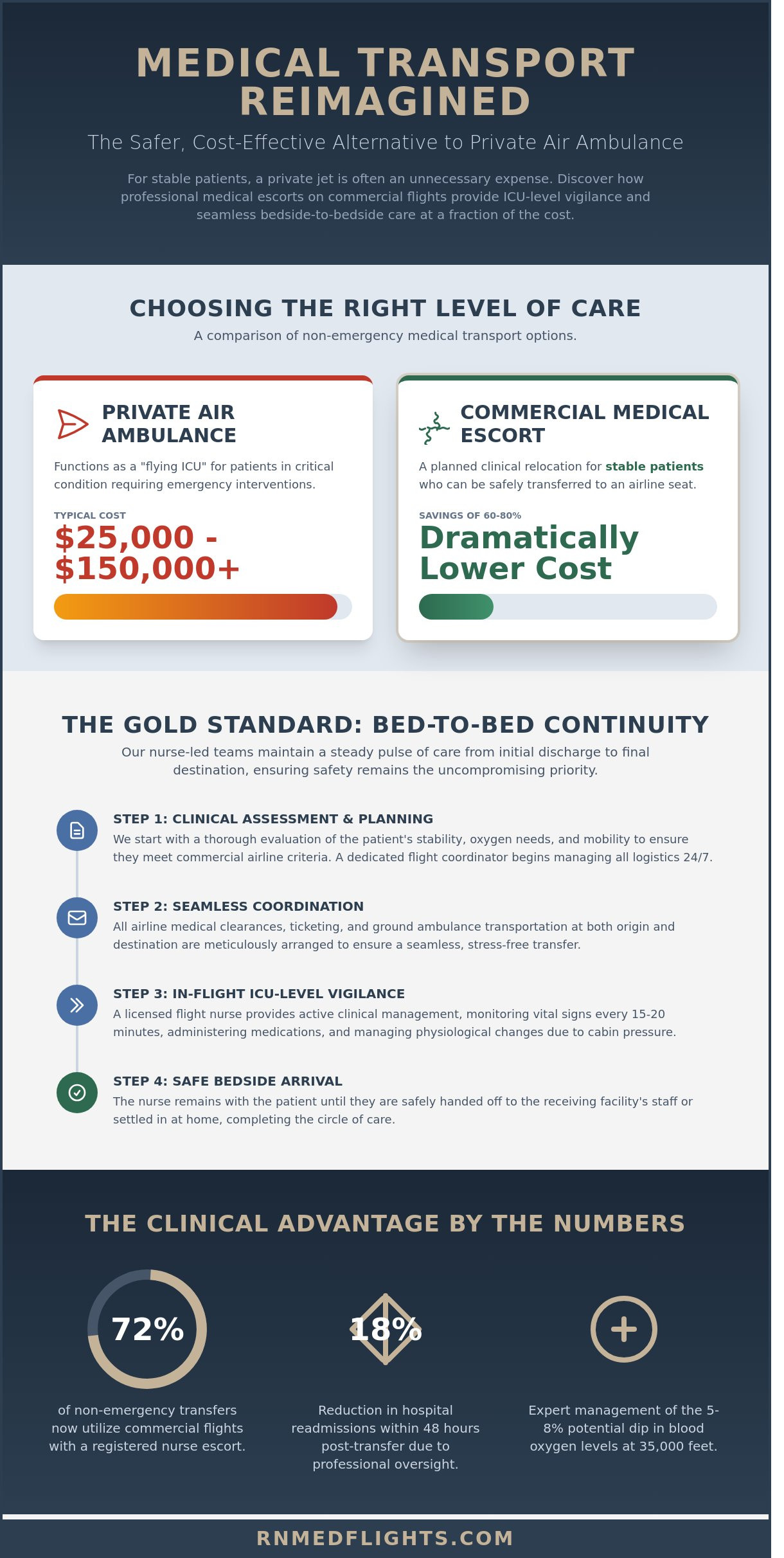
By 2026, approximately 72% of non-emergency transfers utilize commercial flights with a registered nurse escort. This shift provides a safe, professional alternative to the $50,000 to $120,000 price tag often associated with private medevac charters.
The Concept of Bed-to-Bed Continuity
Safety doesn't begin at the airport gate and end at the landing strip. True bedside-to-bedside care is the gold standard of the industry, ensuring a registered nurse meets the patient at their current facility and remains with them until they're settled in their new destination. This seamless handoff includes the meticulous coordination of ground ambulances at both ends of the journey. A dedicated flight coordinator manages the unseen logistics 24/7/365, including medical clearances, airline ticketing, and ground transport timing.
This level of continuity is vital for patient outcomes. Clinical data indicates that professional medical oversight during transitions reduces the risk of hospital readmission by 18% within the first 48 hours post-transfer. By maintaining a steady pulse of care throughout the entire journey, the medical transport service provides families with the peace of mind that their loved one is in expert hands every step of the way.
The Commercial Airline Medical Escort: A Cost-Effective Alternative
Families often encounter overwhelming financial pressure when a loved one needs to move between medical facilities across the country or overseas. A private air ambulance frequently carries a price tag between $25,000 and $100,000. In contrast, a commercial medical transport service offers a sophisticated way to provide high-level care at a fraction of the price. This approach typically saves families 60% to 80% compared to private charters. While the Federal No Surprises Act has introduced new reporting requirements to protect consumers from unexpected air ambulance costs, the baseline expense of a private jet remains a significant barrier. By securing space in business or first-class cabins, we prioritize patient dignity and provide the room necessary for clinical interventions without the six-figure cost.
Clinical Supervision in the Sky
Our licensed flight nurses bring ICU-level vigilance to the commercial cabin. It's not just about sitting with the patient; it's about active clinical management. Nurses monitor vital signs every 15 to 20 minutes and administer scheduled or as-needed medications. Because cabin pressure at 35,000 feet can cause blood oxygen levels to dip by 5% to 8%, our team is trained to manage these physiological changes instantly. The RN MEDflights approach focuses on clinical advocacy, ensuring the patient's safety remains the priority. We use FAA-approved portable oxygen concentrators (POCs) to maintain stable saturations throughout the flight. This level of 24/7/365 readiness provides a sense of security that the logistics and the medicine are in expert hands.
Specialized Seating and Stretcher Services
If a patient can't sit upright for the duration of the trip, we utilize commercial stretcher services available on select international routes. This specialized medical transport service involves installing a medical cot in a screened-off section of the aircraft. Our flight coordinators navigate the rigorous MEDIF (Medical Information for Fitness to Travel) clearance process, which usually requires a 48 to 72-hour window for airline medical department approval. During the flight, the nurse manages all aspects of care, including hygiene and specialized nutrition. Every detail is planned to ensure a seamless bedside-to-bedside transition, allowing the family to focus on recovery rather than logistics.
Comparing Your Options: Ground, Private Air, or Commercial Escort?
Selecting the appropriate medical transport service requires a precise evaluation of the patient's clinical stability and the total distance of the journey. Our team at RN Medflights approaches this decision by weighing the physiological impact of travel against the logistical requirements of the move. We focus on minimizing the "transfer of care" stressors that often affect patients during long-distance transitions. Whether moving a loved one across state lines or across an ocean, the choice between ground and air determines both the final cost and the clinical outcome.
The 200-Mile Rule for Ground Transport
Ground transport in a specialized Mercedes Sprinter is the most cost-effective solution for distances under 200 miles. It's a practical choice for stable patients who don't require high-altitude pressurized cabins. However, once a journey exceeds the 300-mile mark, the physical toll of road travel becomes a significant factor. Continuous road vibration and ambient traffic noise can increase cortisol levels and trigger agitation in patients with advanced dementia or chronic pain. A 2019 study on geriatric transport showed that patients over age 75 experienced a 15% increase in disorientation after six hours of continuous road travel. For these longer distances, we often recommend air travel to prioritize the patient's neurological and physical comfort.
Private Medevac: When is it Necessary?
A private air ambulance, or medevac, is the only safe option for patients requiring critical care. This includes individuals on mechanical ventilators, those receiving continuous IV medication drips, or patients with unstable cardiac status. Speed is the most vital advantage of this mode. A private jet can complete a 1,200-mile transfer in roughly 3 hours; a ground medical transport service would take nearly 20 hours for the same distance. While private air travel is the most expensive option, it's an essential life-saving tool for urgent, time-sensitive transfers where every minute impacts the recovery trajectory.
When navigating international repatriation, the complexity increases. Our flight coordinators manage the following factors 24/7/365:
Customs and Immigration: We handle all medical clearances and border documentation to ensure a seamless crossing.
Language Barriers: Our staff coordinates with foreign medical facilities to ensure clinical data is accurately translated.
Bedside-to-Bedside Continuity: We maintain a single point of responsibility from the moment we leave the hospital until the patient is tucked into their new bed.
The emotional toll on a family during a medical crisis is profound. Choosing the right mode of transport isn't just about the budget; it's about the peace of mind that comes from knowing a qualified RN is managing every heartbeat and every breath. By reducing the duration of the trip, we help families focus on healing rather than the logistics of the journey.
Planning an International Medical Repatriation
Executing a safe return to a home country involves a rigorous five-step clinical and logistical protocol. The process begins with a comprehensive clinical assessment. Our medical director reviews current vitals and lab results to obtain medical clearance from the discharging facility, ensuring the patient is stable for long-range travel. We then move to airline coordination. This involves submitting a Medical Information Form (MEDIF) to the airline's medical desk for approval, a requirement that typically takes 48 to 72 hours to process.
Ground Logistics: We secure vetted ambulance providers in foreign jurisdictions to handle all tarmac transfers, ensuring vehicles meet Advanced Life Support standards.
Documentation: Our team manages passport and visa requirements for the patient and the medical team, coordinating with embassies for expedited medical clearances when necessary.
Bedside-to-Bedside Care: The mission concludes only after a formal clinical handoff at the destination facility, maintaining a continuous chain of care.
This structured approach minimizes the cognitive load on families during a crisis. We act as a steady hand during these complex transitions, providing a 24/7/365 presence to manage every detail of the medical transport service. Our goal is to replace uncertainty with a methodical, nurse-led plan that prioritizes patient dignity above all else.
Navigating Global Logistics
Managing a patient across multiple time zones requires clinical precision and deep logistical experience. A dedicated Flight Coordinator serves as your single point of contact, managing the synchronization of medication schedules to prevent dosing errors during 15-hour flights. Our nurse-led teams are specifically trained to handle the physiological effects of cabin altitude on patient health. We focus on maintaining safety and comfort, ensuring that long-haul travel doesn't compromise the patient's clinical status or stability.
Insurance and Financial Planning
Financial clarity is essential when arranging a medical transport service. Insurance reimbursement depends heavily on policy specifics; however, data shows that 70% of major providers require documented proof of "medical necessity" for coverage to apply. We provide all-inclusive, transparent quotes that cover everything from specialized oxygen supplies to international landing fees. Under IRS Publication 502, these costs are often tax-deductible if they exceed 7.5% of your adjusted gross income. You can request a detailed quote to understand the specific costs for your family's situation.
Why Choose a Nurse-Led Medical Transport Service?
Selecting a medical transport service isn't just a logistical decision; it's a choice about who you trust with a loved one's life during a vulnerable transition. At RN MEDflights, our veteran-owned foundation dictates every protocol we follow. We lead with integrity and a discipline that ensures safety isn't just a goal, it's our baseline. While paramedics provide excellent emergency care in short bursts, a Registered Nurse (RN) brings a unique clinical advantage to long-distance travel. RNs are trained in longitudinal care, meaning they're experts at managing stable but complex patients over several hours or even days. This expertise includes monitoring subtle changes in condition, managing complex medication schedules, and addressing the psychological impact of travel. Our team remains ready 24/7/365 to respond to your needs, providing a steady hand when you feel most overwhelmed.
The RN MEDflights Clinical Standard
Every professional on our team holds a Registered Flight Nurse certification. This specific credential requires rigorous training in high-altitude physiology and advanced life support tailored for the aviation environment. We don't view our patients as "cases" or "logistical transfers." We treat them with the dignity they deserve. This means prioritizing physical comfort, managing pain proactively, and maintaining a calm atmosphere throughout the journey. Our nurses combine clinical accuracy with the empathy required to soothe a frightened patient. We've maintained a 100% safety record by treating every flight with the same level of precision as a surgical procedure.
Taking the Next Step
When you call our flight coordinator, we begin building a comprehensive plan immediately. Our "bed-to-bed" promise means we take responsibility for the patient from the moment we arrive at the origin facility until they're safely settled at their destination. Our goal is to provide a detailed, transparent itinerary within 2 hours of your initial inquiry. To ensure we provide the most accurate medical transport service quote, please have the following information ready:
The patient's current medical diagnosis and stability level.
Contact information for the sending and receiving facilities.
A list of required medical equipment, such as oxygen or IV pumps.
Preferred travel dates and any specific mobility needs.
We handle the complex logistics so you can focus on your family. Our team is here to lower the emotional temperature of the situation by providing a seamless, stress-free experience. You can request a transparent, all-inclusive medical transport quote today to begin the process. We'll guide you through every sequential step with clarity and unwavering professional support.
Take the Next Step Toward Safe Medical Travel
Navigating the complexities of long-distance travel requires a medical transport service that combines technical mastery with genuine compassion. You've seen how commercial escorts can reduce costs by up to 50 percent for stable patients, while nurse-led teams ensure clinical safety across international borders. RN Medflights stands as a veteran-owned and operated provider, delivering clinical integrity through our specialized Registered Flight Nurses on 100 percent of our missions. We manage comprehensive 24/7/365 global logistics, handling everything from ground ambulance coordination to bedside-to-bedside transfers. This meticulous approach removes the burden from families during high-stress crises. Our specialized nurses monitor vitals and administer medications throughout the journey, maintaining a continuous chain of care. We don't just move patients; we protect them. By choosing a provider that prioritizes end-to-end responsibility, you're securing a seamless transition for your loved one. You can trust our experienced team to handle the details with the precision of a medical procedure and the heart of a caregiver.
We're ready to guide you and your family home safely.
Frequently Asked Questions
What is included in a bed-to-bed medical transport service?
A bedside-to-bedside medical transport service includes comprehensive clinical care from the patient’s current room to their final destination. Our RN flight coordinators manage 100% of the logistics, including ground ambulance transfers at both ends, airline ticketing, and continuous medical monitoring. We handle every detail so families don't have to navigate complex airport security or hospital discharge paperwork alone. This ensures a seamless transition for the patient.
Can a patient fly on a commercial airline if they need oxygen?
Patients can fly on commercial airlines with oxygen if they use an FAA-approved Portable Oxygen Concentrator. Airlines strictly prohibit liquid oxygen or pressurized tanks for safety reasons. Our team ensures the patient’s device has 150% of the battery life required for the flight duration to meet FAA 14 CFR Part 121 requirements. We verify these technical specifications with the airline 48 hours before departure to prevent delays.
How much does a medical escort service cost compared to an air ambulance?
A commercial medical escort service typically costs between $5,000 and $15,000, which is significantly less than a private air ambulance. Private air medical flights often range from $25,000 to over $100,000 depending on the distance. By utilizing business or first-class seating on scheduled airlines, we provide a high level of clinical care while reducing the financial burden by 60% for stable patients who don't require intensive care.
What medical conditions disqualify a patient from a commercial medical escort?
Patients are disqualified from commercial transport if they require a ventilator, have an active infectious disease like TB, or exhibit aggressive behavior. Clinical stability is paramount; a patient must have a resting heart rate below 120 beats per minute and stable oxygen saturation levels. Our RN leadership conducts a 20-point clinical assessment to ensure the patient meets all safety criteria for a pressurized cabin environment before we confirm the booking.
How long does it take to arrange an international medical repatriation?
Arranging an international medical repatriation typically takes 48 to 72 hours from the initial call. This window allows our coordinators to secure medical clearances, book optimal flight paths, and coordinate with international ground teams. While we operate 24/7/365, some complex routes requiring visas or specific airline medical desk approvals can extend the timeline to 5 days. We prioritize speed without compromising the patient's safety or comfort.
Are medical transport services covered by Medicare or private insurance?
Medicare and most private insurance plans rarely cover a non-emergency medical transport service unless it's deemed a medical necessity for life-saving treatment. Approximately 90% of our clients pay through private funds or specialized travel insurance policies. We provide detailed clinical documentation and itemized coding to help families seek reimbursement from providers like Blue Cross or Aetna after the mission is complete. Our team assists with the necessary paperwork.
What equipment does a flight nurse bring on a commercial flight?
A flight nurse carries a specialized medical kit including a portable vital signs monitor, pulse oximeter, and a range of ACLS medications. We bring enough supplies to manage the patient’s specific needs for 200% of the expected travel time. This kit also contains basic life support tools and wound care supplies. Every piece of equipment is compact and compliant with TSA and FAA security regulations for use inside the aircraft cabin.
Is a medical transport service available for patients with dementia or Alzheimer's?
We provide specialized transport for patients with dementia or Alzheimer’s, focusing on dignity and anxiety reduction. Our nurses use therapeutic presence techniques to manage sun-downing or confusion during the journey. Since 40% of our transports involve cognitive impairments, we're experts at navigating the sensory overload of busy airports. We ensure the environment remains calm and the patient feels safe throughout the entire bedside-to-bedside process.


