Medical Repatriation: Discharge Guide for Case Managers
- Jun 15
- 13 min read
How long can your facility afford to let a medically stable patient occupy an acute care bed simply because they lack a domestic discharge plan? It’s a frustrating reality you likely face often, watching uncompensated care costs climb while bed-blocking prevents you from admitting patients who need urgent intervention. You want to ensure every individual receives the care they deserve, but the logistical and financial hurdles of international cases often feel insurmountable. We understand the weight of these decisions and the need for a solution that satisfies both clinical requirements and administrative oversight.
This is why we’ve developed Medical Repatriation as a Discharge Solution: A Resource Guide for Hospital Case Managers and Social Workers. You’ll learn how commercial medical repatriation provides a fiscally defensible and clinically safe discharge path for even the most complex, uncompensated foreign-national cases. We’ll walk through the process of coordinating commercial airline medical escorts and bed-to-bed transport, showing you how to clear beds efficiently while maintaining the highest standards of patient safety and continuity of care.
Key Takeaways
Identify the hidden costs of bed-blocking and learn how to recognize foreign-national patients who qualify for strategic relocation.
Explore how using Medical Repatriation as a Discharge Solution: A Resource Guide for Hospital Case Managers and Social Workers provides a fiscally defensible alternative to mounting uncompensated care days.
Master the clinical "fit to fly" criteria to ensure patient safety during commercial airline medical escort services for stroke recovery or orthopedic cases.
Use a structured checklist to manage complex logistics, including clinical documentation and ground ambulance coordination, for a seamless transfer of care.
Gain confidence in presenting repatriation as a viable discharge path that satisfies both hospital administrators and the clinical needs of the patient.
Table of Contents
The Challenge of the "Difficult Discharge": Uncompensated Care and Bed-Blocking
Commercial Airline Medical Escort: A Fiscally Defensible Solution
Clinical Criteria: Selecting the Right Patients for Commercial Repatriation
The Case Manager’s Checklist for Executing a Repatriation Discharge
Partnering with RN MEDflights for Seamless Discharge Solutions
The Challenge of the "Difficult Discharge": Uncompensated Care and Bed-Blocking
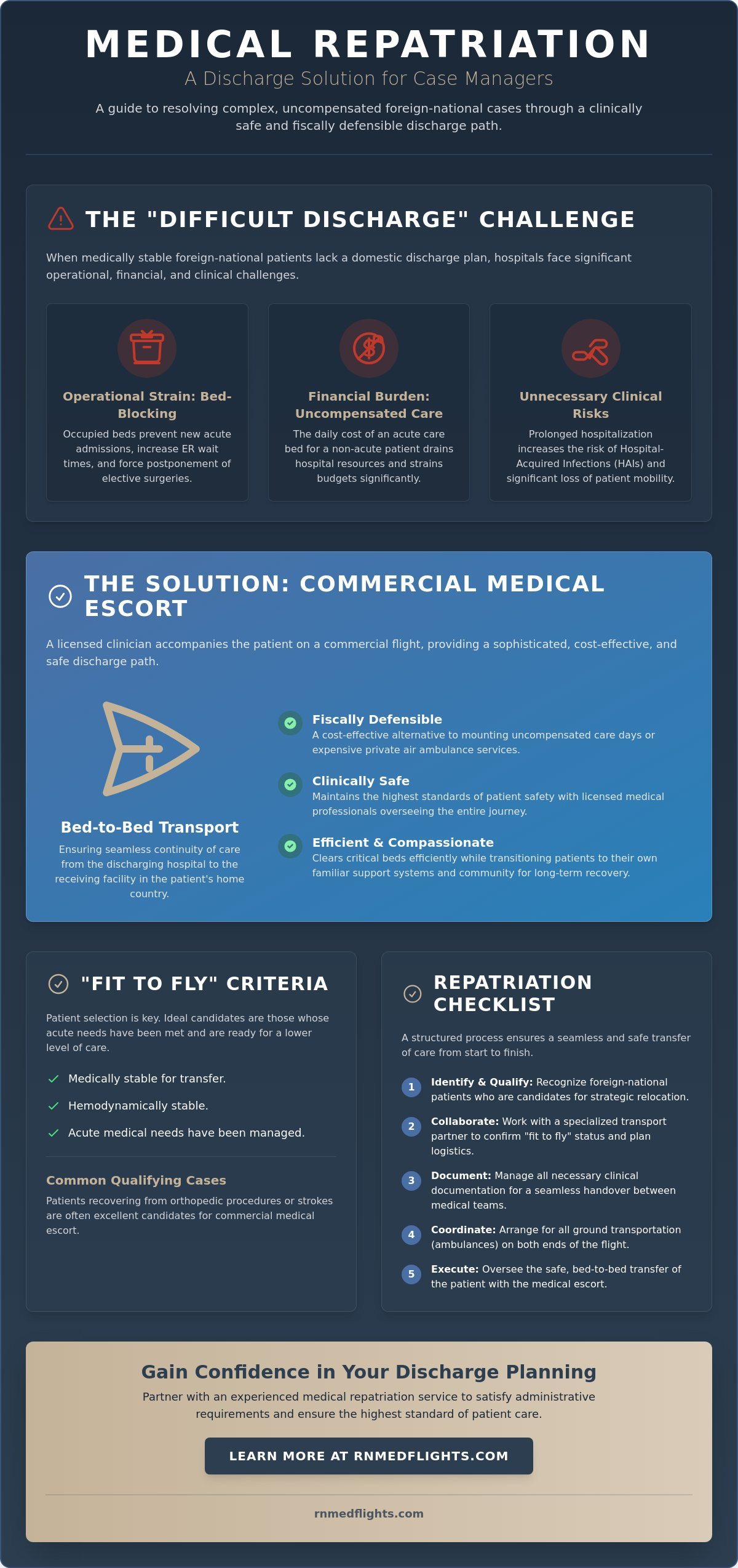
Hospital case managers often encounter the "difficult discharge," a scenario where a foreign national patient is medically ready for a lower level of care but lacks a domestic network to support them. These patients might be tourists, business travelers, or individuals who don't have the insurance coverage required by local skilled nursing facilities. Without a domestic payer source, traditional discharge paths like home health or local rehab are effectively blocked. This creates a cycle of uncompensated care that strains hospital budgets and takes up critical bed space meant for new acute admissions.
Expanding the local network of care homes can help alleviate these bottlenecks; for those interested in the development of senior care infrastructure, learning how to buy RCFE facility California is an essential starting point for providing more placement options.
Beyond the financial strain, keeping a stable patient in an acute setting introduces unnecessary clinical risks. Research indicates that prolonged hospitalization increases the likelihood of hospital-acquired infections (HAI) and leads to a significant loss of mobility. Utilizing Medical Repatriation allows hospitals to transition these patients back to their home countries where they can access familiar support systems and ongoing care. This approach is a vital component of Medical Repatriation as a Discharge Solution: A Resource Guide for Hospital Case Managers and Social Workers, helping teams navigate these complex ethical and logistical waters.
To better understand the various paths available for patients leaving your care, watch this helpful video:
The Burden on Utilization Review (UR) Teams
Utilization review teams face immense pressure when "bed-blocking" occurs, as it directly impacts emergency room wait times and forces the postponement of elective surgeries. You're often caught in an ethical dilemma, knowing you can't discharge a fragile individual to a shelter, yet your facility can't absorb the ongoing costs of non-acute care indefinitely. With medical costs in the United States projected to rise by over 9.1% in 2026, the daily expense of an uncompensated acute care stay—which includes everything from clinical labor to the janitorial solutions provided by firms like RPS Building Services—continues to drain hospital resources and limit patient throughput.
When Domestic Placement is Not an Option
When domestic placement isn't an option, this guide serves as a foundational component of Medical Repatriation as a Discharge Solution: A Resource Guide for Hospital Case Managers and Social Workers. It helps you fulfill "safe discharge" mandates by looking toward the patient's home country. Discharging a medically fragile individual to the street isn't just unethical; it often violates hospital policy and legal requirements for patient safety. Identifying the exact point of medical readiness is key. Once a patient is hemodynamically stable and their acute needs are managed, they may be candidates for international relocation. Determining "fit to fly" status is a collaborative process between your clinical team and a specialized transport partner. By focusing on a patient's long-term recovery in their own community, you're providing a compassionate and fiscally responsible alternative to indefinite hospitalization.
Commercial Airline Medical Escort: A Fiscally Defensible Solution
When traditional discharge plans stall, a commercial airline medical escort emerges as a sophisticated, cost-effective alternative. This service involves a licensed clinician accompanying a stable patient on a scheduled commercial flight. It's a strategic shift from the high overhead of private air transport, offering a path that is both clinically sound and financially responsible. By choosing this route, hospitals can address the growing issue of Uncompensated Care and Bed-Blocking without compromising on patient safety. It's a practical application of Medical Repatriation as a Discharge Solution: A Resource Guide for Hospital Case Managers and Social Workers, providing a clear way forward when local options are exhausted.
The financial logic is compelling. Utilizing a commercial airline medical escort can be 50% to 70% less expensive than a private air ambulance. For many facilities, the cost of a one-time repatriation fee is significantly lower than the mounting expenses of 30 or more days of uncompensated acute care. This model also includes ground ambulance coordination at both ends of the journey, ensuring a true "bed-to-bed" transfer. We manage the logistics, from securing airline clearances to arranging the final transport in the patient's home country, which removes the burden from your internal team.
The ROI of Repatriation for Hospital Administration
Presenting this solution to your CFO requires a focus on immediate bed availability and long-term cost avoidance. Every day a non-acute patient stays in a bed, the hospital loses the opportunity to admit a high-acuity, insured patient. We've seen complex cases that have lingered for months resolved within 72 hours of our initial assessment. This rapid turnaround transforms a financial liability into a strategic success. By funding the transport, the hospital actually saves hundreds of thousands of dollars that would otherwise be lost to uncompensated care. It's an investment in utilization efficiency that satisfies both clinical mandates and the bottom line.
Continuity of Care via Flight Nurse Escorts
The presence of a flight nurse ensures that the standard of care remains high throughout the entire transition. These professionals possess the specific skills needed to manage patients in a high-altitude environment. Their in-flight capabilities include administering scheduled medications, managing supplemental oxygen, and constant physiological monitoring. They don't just sit with the patient; they provide active clinical oversight. This level of care ensures a seamless handoff to the receiving facility or family, maintaining the patient's stability from the moment they leave your ward until they reach their destination. If you're currently managing a patient who could benefit from this level of oversight, we invite you to discuss a custom transport plan with our clinical team.
A commercial airline medical escort involves more than just a ticket. It's a comprehensive clinical mission. We coordinate with airlines to secure appropriate seating, often in business or first class, to provide the necessary space for medical equipment and patient comfort. This meticulous planning ensures that the patient is viewed as a person in need of care rather than just a logistical challenge. By entrusting the process to experts, you ensure that every detail, from clinical documentation to ground transport, is handled with precision.
Clinical Criteria: Selecting the Right Patients for Commercial Repatriation
Success begins with a rigorous clinical assessment. Not every patient is a candidate for commercial flight, so identifying the right individuals is the first step in using Medical Repatriation as a Discharge Solution: A Resource Guide for Hospital Case Managers and Social Workers. The primary requirement is hemodynamic stability. Patients must have consistent vital signs and manageable oxygen requirements, typically not exceeding five liters per minute. We look for individuals who are medically stable but require professional oversight to navigate the complexities of international travel.
Certain conditions are particularly well-suited for this model. Stroke recovery patients who have moved past the acute phase but still require assistance with mobility and medication often thrive in this setting. Similarly, individuals with orthopedic injuries requiring immobilization or non-acute neurological states can be safely transported with the right clinical support. Psychological readiness is equally critical. For patients with dementia or high anxiety, our flight nurses employ de-escalation techniques and sensory management to ensure a calm environment during long-haul journeys. Every mission requires a formal "Letter of Medical Necessity" and final clearance from the treating physician to ensure the highest safety standards.
Aviation-Specific Medical Considerations
The physiological changes at high altitudes can impact even stable patients. Cabin pressure typically mirrors an altitude of 6,000 to 8,000 feet, which may cause gases to expand or blood oxygen levels to dip slightly. We mitigate these risks by using TSA-approved portable oxygen concentrators (POCs) and continuous physiological monitors throughout the flight. Non-emergency medical escorts are ideal for patients who do not require a ventilator, as these individuals can safely travel in a standard or upgraded commercial cabin with professional nursing intervention. This approach ensures that technical equipment never compromises the comfort or safety of the traveler.
Ethical and Legal Standards for International Relocation
A "safe discharge" extends beyond the flight itself; it must include a verified destination. Obtaining informed, voluntary consent from the patient or their legal healthcare proxy is an absolute ethical requirement. We never facilitate a transfer without ensuring the patient understands the plan and has a receiving care network waiting for them. This might be a private residence with home care or a specialized international facility. By adhering to these international medical repatriation services standards, we protect both the patient’s rights and the hospital’s liability. This thorough vetting process ensures that the transition is not just a relocation, but a successful handoff to the next phase of recovery.
The Case Manager’s Checklist for Executing a Repatriation Discharge
Executing a safe international transfer involves more than just booking a flight. It requires a synchronized effort between clinical, administrative, and logistical teams. When you use Medical Repatriation as a Discharge Solution: A Resource Guide for Hospital Case Managers and Social Workers, you follow a structured path that minimizes delays and maximizes patient safety. The process begins with a feasibility assessment where our clinical team reviews the patient's current status and destination requirements to ensure a successful mission. This initial step prevents late-stage cancellations and ensures the patient is truly ready for the transition.
Initial Consultation: We review the patient's stability and oxygen needs to determine the most appropriate transport level.
Clinical Documentation: You'll need to provide a comprehensive discharge summary and signed "fit-to-fly" forms.
Logistical Coordination: We verify passports and visas while managing the complex airline medical desk approvals.
Financial Approval: This step involves securing hospital or insurance funding, often justified by the ROI framework discussed in previous sections.
Final Execution: We coordinate the entire bed-to-bed transfer, ensuring the flight nurse is present for every transition.
Streamlining Airline Medical Clearances
Managing communication with commercial airlines is one of the most time-consuming aspects of repatriation. We assume full responsibility for the Medical Information Form (MEDIF) process, which is the standardized document airlines use to assess a traveler's health. Our team understands the specific language and clinical data points that airline medical directors require for approval. Early notification is essential; when we engage with the airline desks immediately, we often achieve departures within 48 to 72 hours. We also coordinate with disability desks to arrange priority boarding and specialized seating, ensuring the patient remains comfortable and stable throughout the boarding process.
Ground Ambulance and Bed-to-Bed Logistics
The journey doesn't start at the airport, nor does it end there. We arrange a non-emergency ambulance service for the initial pickup from your facility. This ensures the patient is moved by professionals who can maintain the necessary clinical standard from the hospital bed to the aircraft. Once the flight lands, we have international ground transport waiting at the destination airport to complete the "final mile." The flight nurse remains with the patient throughout this entire sequence, providing a steady clinical presence until the final handoff to the receiving caregivers. If you're ready to start this process for a current patient, you can request a feasibility assessment today to see how we can help.
Success in these cases depends on meticulous attention to detail. We handle the passports, the visas, and the coordination with foreign ground teams so you can focus on the patients still in your ward. This end-to-end responsibility is what defines a true bed-to-bed service, providing you with the confidence that your patient is safe from the moment they leave your sight until they are welcomed home.
Partnering with RN MEDflights for Seamless Discharge Solutions
Choosing a transport partner is a decision rooted in trust and clinical reliability. RN MEDflights stands apart as a veteran-owned, nurse-led organization dedicated to solving the most complex relocation challenges. We understand that your primary goal is the safety of your patient and the efficiency of your department. By providing a comprehensive bed-to-bed service, we assume responsibility for every logistical detail. This allows you to focus on acute care while we manage the intricate steps of Medical Repatriation as a Discharge Solution: A Resource Guide for Hospital Case Managers and Social Workers.
Our commitment to clinical precision is balanced by a deep sense of human empathy. We don't view patients as cases to be moved; we see them as individuals returning to their families and communities. This philosophy guides every interaction, from the initial consultation to the final handoff in a foreign facility. We offer free early consultations for complex cases, providing a no-obligation feasibility study to help you determine the best path forward. Our team acts as an extension of your own, ensuring that the transition is seamless and the patient's dignity is preserved throughout the journey.
Why Clinical Leadership Matters in Transport
The difference between a standard logistics company and a nurse-led service is the depth of medical oversight. At RN MEDflights, clinical leadership informs every decision, from selecting the right portable oxygen concentrator to managing in-flight medication schedules. We provide a constant, unwavering presence that is always ready to respond, with 24/7/365 availability for your most urgent discharge planning needs. This availability acts as a safety net for case managers, reducing your administrative burden on complex international files. We handle the paperwork, the airline negotiations, and the ground coordination, providing you with regular updates so you're never left wondering about the status of your patient.
Ready to Resolve Your Toughest Discharge Case?
Initiating a relocation is a straightforward process designed to provide immediate relief to your utilization review team. Whether you're dealing with a long-term uncompensated stay or a patient with specific clinical needs, we're prepared to assist. Our global reach allows us to repatriate patients to and from any location worldwide, bridging the gap between your facility and the patient's home country. We invite you to consult with RN MEDflights today to streamline your discharge planning and discover how a clinically-led approach can transform your most difficult discharge scenarios into success stories.
Advancing Your Discharge Planning Strategy
Integrating specialized transport into your workflow transforms how you handle complex international cases. You now have a framework for identifying eligible patients and justifying the ROI to your administration. By utilizing Medical Repatriation as a Discharge Solution: A Resource Guide for Hospital Case Managers and Social Workers, you move beyond the frustration of bed-blocking and toward a sustainable, clinical solution that prioritizes the patient's long-term recovery in their home community.
RN MEDflights has been veteran-owned and operated since 2010, bringing a standard of excellence to every mission. Our team of Licensed Registered Flight Nurses provides comprehensive bed-to-bed coordination, managing every detail from hospital discharge to final arrival. We are ready to help you clear your most challenging cases with precision and empathy. Contact our Case Management Support Team for a Free Consultation to discuss your current needs. You don't have to navigate these complex logistics alone. We are here to support your team and ensure your patients receive the highest level of care during their journey home.
Frequently Asked Questions
What is the typical cost of an international medical escort vs. an air ambulance?
Commercial airline medical escort services offer a substantial cost reduction compared to private air ambulances. While an air ambulance requires a dedicated jet and specialized flight crew, a medical escort utilizes scheduled commercial flights. This allows the hospital to allocate resources more effectively while still ensuring the patient remains under the constant care of a licensed clinician during the entire relocation process.
How quickly can a medical repatriation be arranged for a hospital discharge?
Most relocations are finalized within 48 to 72 hours following the initial clinical assessment. The exact timing depends on how quickly the airline’s medical desk provides clearance and the status of the patient’s travel documents. By initiating a consultation early in the discharge planning phase, you allow our team to begin the logistical groundwork, ensuring a swift transition once the patient is medically ready.
Who pays for medical repatriation if the patient has no insurance?
When a patient lacks insurance, the hospital administration often funds the repatriation as a strategic utilization management tool. This is a core concept in Medical Repatriation as a Discharge Solution: A Resource Guide for Hospital Case Managers and Social Workers. Administrators find that a one-time relocation fee is significantly more fiscally defensible than absorbing the daily costs of an uncompensated acute care stay that could last for weeks.
Can a patient fly on a commercial airline if they require continuous oxygen?
Stable patients requiring supplemental oxygen can safely fly on commercial airlines using FAA-approved portable oxygen concentrators (POCs). We provide the necessary equipment and manage all battery life requirements for the duration of the journey. Our flight nurses monitor oxygen saturation levels continuously to ensure the patient remains stable despite the changes in cabin pressure and altitude common in commercial aviation environments.
What medical equipment can a flight nurse bring on a commercial flight?
Our flight nurses carry specialized medical kits that include physiological monitors, diagnostic equipment, and necessary medications. All tools are TSA-approved for use in a commercial cabin and are selected based on the patient's specific diagnosis. This equipment allows the nurse to provide active clinical oversight and respond immediately to any changes in the patient's condition, maintaining a high standard of care throughout the flight.
Is medical repatriation considered a "safe discharge" by hospital accreditation standards?
Medical repatriation is recognized as a safe discharge solution because it ensures a seamless transfer of care to a verified destination. Hospital accreditation standards require that patients are discharged to an environment that can meet their ongoing needs. By coordinating ground transport and a professional handoff at the destination, we help facilities meet these ethical and legal mandates while resolving complex, long-term placement issues.
Does RN MEDflights handle the passport and visa requirements for the patient?
We handle the complex logistical details, including coordinating with embassies to manage passport and visa requirements for the patient. Navigating international travel documents can be a significant administrative burden for hospital staff. Our team assumes this responsibility, working directly with the necessary authorities to secure travel clearances. This comprehensive support is a vital part of Medical Repatriation as a Discharge Solution: A Resource Guide for Hospital Case Managers and Social Workers.


