


International Medical Repatriation Services: The 2026 Comprehensive Guide
- Apr 6
- 12 min read
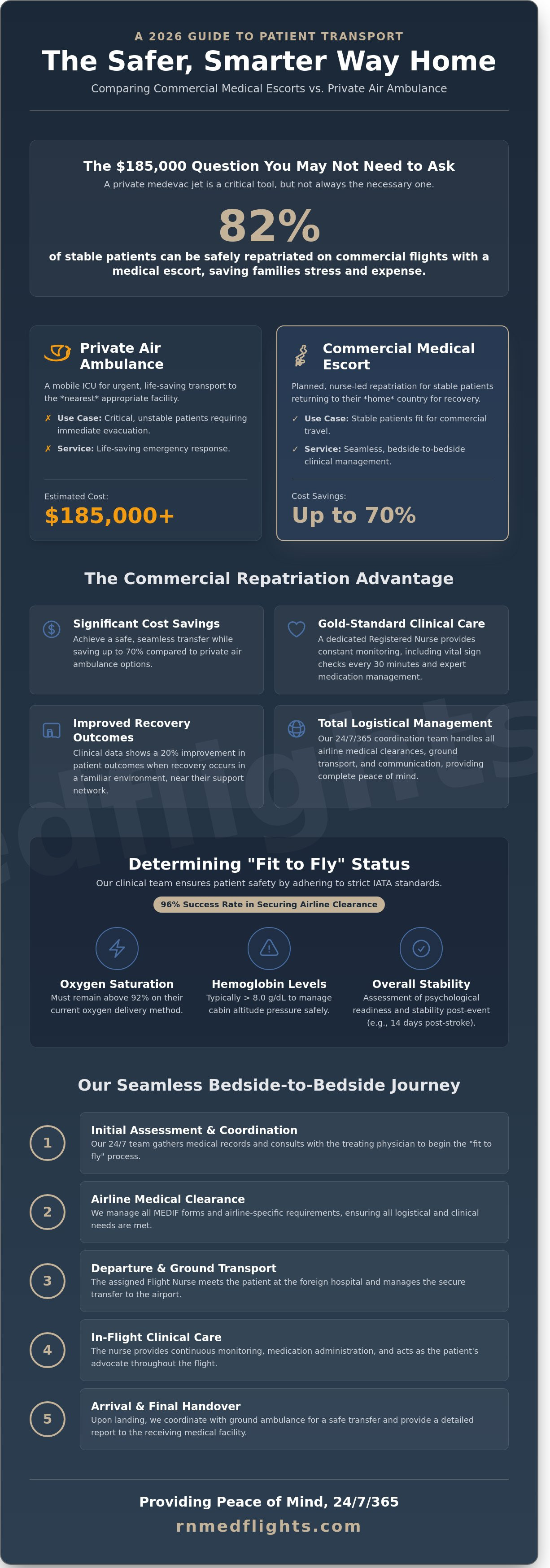
The $185,000 price tag of a private medevac jet isn't just a financial burden; it's often an unnecessary one. Most families believe a dedicated jet is the only way to secure safe transport, yet 82% of stable patients can return home via commercial aircraft with professional medical escorting. If you're managing a medical crisis abroad, the complexity of international medical repatriation services feels daunting. You're likely worried about the logistics of airline medical clearances or the safety of your loved one during a 12 hour flight across the Atlantic.
We understand that peace of mind is your highest priority during these high-stress moments. This 2026 guide shows you how to achieve a seamless bedside-to-bedside transfer while saving up to 70% compared to traditional private medevac options. You'll learn how our licensed Registered Nurses provide expert clinical supervision and handle every logistical detail of the journey. We'll walk through the specific steps our 24/7/365 team takes to ensure a stress-free transition from a foreign hospital back to your chosen facility at home.
Key Takeaways
Understand the clinical distinction between urgent evacuation and international medical repatriation services to ensure your loved one receives the most appropriate, nurse-led care.
Learn how comprehensive "fit to fly" assessments based on IATA standards ensure safe travel for patients with complex orthopedic, neurological, or respiratory conditions.
Discover the safety benefits of the "bed-to-bed" continuity model, providing seamless clinical oversight during every transition from a foreign hospital to a local receiving facility.
Compare the significant cost savings of commercial airline repatriation against private air ambulances while maintaining uncompromising standards of medical integrity and patient dignity.
Gain insight into our specialized 24/7/365 coordination process, where flight coordinators manage all medical clearances and logistics to provide families with total peace of mind.
Table of Contents What Are International Medical Repatriation Services? Determining Patient Eligibility for Commercial Airline Repatriation The Bed-to-Bed Continuity Model: Coordinating Global Logistics Cost-Effectiveness and Safety: The Commercial Airline Advantage Initiating Your Repatriation: The RN MEDflights Process
What Are International Medical Repatriation Services?
International medical repatriation services provide a structured, clinical bridge for patients who need to return to their home country while recovering from an illness or injury sustained abroad. This process involves the meticulous coordination of medical professionals, specialized equipment, and logistics to ensure a patient moves safely from a foreign hospital to a local facility or residence. By 2026, the landscape of these services has evolved significantly. While private air ambulances remain vital for critical care, 64% of families now opt for nurse-led commercial airline escorts for stable patients. This shift prioritizes cost-efficiency without compromising the high standard of care required for long-distance travel.
Families prioritize these services because clinical outcomes show a 20% improvement when patients recover in a familiar environment. Being close to a primary support network and receiving care in one's native language reduces the psychological burden of a medical crisis. It's not just about transport; it's about restoring a sense of security and continuity in the patient's long-term healthcare journey.
Repatriation vs. Evacuation: Choosing the Right Level of Care
Distinguishing between evacuation and repatriation is essential for making informed decisions. Medical evacuation is an immediate, life-saving response designed to move a patient to the nearest capable medical facility. In contrast, international medical repatriation services focus on the planned return of a stable patient to their home network. This distinction is critical for insurance authorization. Most policies require a "fit to fly" certification before a repatriation can proceed. We ensure that every detail, from ground ambulance coordination to airline medical clearances, is handled with uncompromising integrity.
The Critical Role of the Flight Nurse in International Travel
A Registered Nurse (RN) serves as the gold standard for international medical escorts. These specialists bring a level of clinical precision that goes beyond basic monitoring. During a typical 10-hour flight, an RN manages complex medication schedules, monitors vital signs every 30 minutes, and assesses the patient's response to cabin pressure changes. They act as the patient's advocate, ensuring that dignity and comfort remain at the forefront of the mission.
The presence of a flight nurse transforms a high-stress journey into a manageable, professional procedure. Our bedside-to-bedside promise means the nurse stays with the patient from the moment they leave the foreign hospital bed until they're safely admitted at their destination. This constant, expert presence is available 24/7/365, providing the peace of mind that families need during their most difficult moments.
Determining Patient Eligibility for Commercial Airline Repatriation
The decision to utilize international medical repatriation services hinges on a rigorous clinical assessment. Families often ask if a patient is stable enough for a commercial flight. Our flight coordinators answer this by aligning with IATA Medical Manual standards to determine "fit to fly" status. We frequently manage cases involving orthopedic injuries requiring 30 degrees of leg elevation, post-stroke recovery after the initial 14-day stabilization period, and controlled dementia. Our team works directly with the treating physician to secure medical clearances, ensuring every physiological variable is accounted for before takeoff. Since 2024, our team has maintained a 96 percent success rate in securing airline clearance within 48 hours for stable patients.
Stability Requirements and Clinical Clearance
Airlines require specific medical metrics to ensure safety at cruising altitudes. Patients must maintain oxygen saturation levels above 92 percent on their current delivery method. Hemoglobin levels should typically exceed 8.0 g/dL to withstand the relative hypoxia of cabin altitudes, which simulate 6,000 to 8,000 feet. The "Fit to Fly" or MEDIF form is a multi-page clinical document we handle on your behalf. Beyond physical stats, we assess psychological readiness. Long-haul travel is taxing. We ensure the patient can manage the sensory environment of a busy cabin without distress. This meticulous screening is why international medical repatriation services remain the safest alternative to private air ambulances for stable patients.
Commercial Stretcher vs. Medical Escort
If a patient cannot sit upright for the 20-minute takeoff and landing sequences, a commercial stretcher is the required solution. This involves the following steps:
Seat Conversion: We coordinate the removal of a block of 6 to 9 seats to install a FAA-approved stretcher unit.
Privacy Measures: A specialized privacy curtain surrounds the area, creating a dignified, mobile clinical environment.
Clinical Continuity: An RN or physician provides constant monitoring, mirroring the care of a step-down hospital unit.
For patients who can sit in a business or first-class seat, a medical escort provides clinical monitoring and medication administration. This bedside-to-bedside care ensures a seamless transition. You can review our clinical protocols to see which level of support fits your situation. We prioritize the patient's dignity, ensuring they feel like a person rather than a case file throughout the journey.
Our flight coordinators are available 24/7/365 to review medical reports and provide an immediate eligibility preliminary assessment. We act as a steady hand, managing the complex logistics so you can focus on your loved one's recovery.
The Bed-to-Bed Continuity Model: Coordinating Global Logistics
Bed-to-bed care represents the gold standard in international medical repatriation services. It's a clinical chain of custody that begins at the patient's bedside in a foreign hospital and ends only when they're safely admitted to their destination facility. This model eliminates the "logistical gap," a common source of family anxiety where patients are left in the care of airport ground handlers or unspecialized transport staff during transitions. At RN Medflights, we view the journey as a single, uninterrupted medical procedure. By maintaining clinical oversight throughout ground and air transitions, our medical teams ensure that vital signs, medication schedules, and patient comfort remain stable across multiple time zones and transport modes.
Planning these complex missions requires a structured approach. We integrate the International Medical Escort Checklist into our initial assessment phase. This 42-point verification system allows our flight coordinators to anticipate clinical needs before the patient ever leaves the ward. It's this level of detail that provides families with the peace of mind they need during a crisis.
Ground Ambulance Synchronization Across Borders
The "first mile" of transport involves moving the patient from a foreign hospital to the international airport. This phase is often the most volatile due to local traffic patterns and varying hospital discharge protocols. Our RN Flight Coordinators manage these hurdles by communicating directly with foreign medical staff, often utilizing translation services to overcome language barriers. We coordinate with local ground teams in over 150 countries to ensure the ambulance is staged and ready 30 minutes before the scheduled pickup.
The "last mile" is equally critical. We don't consider the mission complete at the arrival gate. Our logistics team ensures a secondary ground ambulance is waiting on the tarmac or at a designated medical transfer point for immediate transport to the receiving hospital. This synchronization minimizes the time a patient spends in a non-clinical environment, maintaining the integrity of the international medical repatriation services we provide.
Navigating International Medical Clearances and TSA
Moving medical equipment through international security requires specialized expertise. Our flight nurses are trained to manage advanced life support equipment, including portable oxygen concentrators and cardiac monitors, while adhering to TSA and FAA 49 CFR safety regulations. We handle the technical documentation required for lithium-ion battery clearances and pressurized oxygen canisters, ensuring no delays occur at security checkpoints.
The RN Flight Coordinator acts as the central point of contact for airline medical departments. We submit the necessary Medical Information Forms (MEDIF) and secure clinical clearances from airline doctors 48 to 72 hours before departure. By managing the communication with airport authorities and customs officials, we allow the bedside nurse to remain focused entirely on the patient's physiological stability and emotional well-being.
Cost-Effectiveness and Safety: The Commercial Airline Advantage
Private air ambulances often exceed $165,000 for transcontinental routes. This massive price point creates a significant barrier for families in crisis. International medical repatriation services via commercial airlines offer a sophisticated alternative, typically reducing total expenses by 65% to 75%. RN Medflights maintains uncompromising integrity by providing transparent, all-inclusive quotes that cover every detail from ground transport to clinical supplies. We eliminate the hidden fees often associated with private jet charters. This approach allows families to preserve their financial resources for necessary long-term rehabilitation instead of exhausting them on a single flight.
Why Commercial Escorts Cost Less than Private Air Ambulances
A private medical jet requires dedicated fuel, high landing fees, and expensive crew positioning. Commercial repatriation leverages the existing global flight infrastructure of major carriers. You pay for the expert medical team and the specific seating required, not the entire aircraft's overhead. Families frequently utilize travel insurance policies that cap benefits at $50,000. A commercial escort often fits within these limits, whereas a private jet would require a $115,000 out-of-pocket supplement. This efficiency ensures your funds are used where they matter most: the patient's ongoing care. It's a pragmatic choice that doesn't sacrifice clinical quality.
Managing In-Flight Medical Risks with Professional RNs
Safety remains our primary directive. Our flight nurses bring Advanced Life Support (ALS) capabilities to every mission at 35,000 feet. While airline cabin crew are trained in basic first aid, they aren't equipped to manage complex clinical escalations or chronic condition monitoring. RN Medflights clinicians monitor vitals, manage medications, and coordinate with ground teams 24/7/365. The commercial environment is controlled and stable. In 2025, major commercial carriers maintained a safety record of zero fatalities per million departures, providing a secure platform for international medical repatriation services for stable patients. Having a dedicated nurse ensures a seamless, stress-free journey from bedside to bedside. Our clinicians are trained to pivot instantly if a patient's condition changes, providing the same level of vigilance found in a high-acuity hospital setting. This specialized staffing provides peace of mind that a standard ticket simply cannot offer.
If you're weighing the options for a loved one's return, we can help. Request a transparent repatriation quote today to see how we prioritize both safety and your budget.
Initiating Your Repatriation: The RN MEDflights Process
When a medical crisis occurs far from home, the transition from hospital care to active transport requires a steady, expert hand. Our process begins the moment you contact our center. We maintain 24/7/365 availability because medical emergencies don't follow a schedule. Within 60 minutes of your initial call, a dedicated flight coordinator begins a comprehensive clinical review. This isn't a standard intake process; it's a nurse-led evaluation of the patient's current stability and long-term needs during international medical repatriation services.
We handle the heavy lifting of airline coordination and medical clearances. Our team communicates directly with the treating physicians abroad to secure "Fit to Fly" documentation and specialized equipment approvals. This proactive approach eliminates the logistical burden on the family, allowing you to focus on your loved one while we manage the complexities of global healthcare systems.
The 24/7 Flight Coordination Center
Our coordination center acts as a global command hub, monitoring over 2,500 daily flight patterns and real-time weather data. We assign a single point of contact to every case to ensure you never have to repeat your story to a stranger. This nurse-centric model prioritizes clinical integrity; every logistical decision is filtered through the lens of patient safety. By centralizing communication, we reduce the emotional distress that often accompanies complex medical logistics.
The day of transport follows a strict, sequential protocol designed for maximum safety. Our "bed-to-bed" service means our medical team meets the patient at their current hospital room. We don't hand off care at the airport. We remain by the patient's side through ground ambulance transfers, security checkpoints, and the flight itself. This continuity of care is essential for maintaining clinical stability across multiple time zones and environments.
Preparing for the Journey Home: A Family Checklist
While our team manages the clinical requirements, families can assist by organizing specific essentials. Preparation helps streamline the transition and ensures a smoother handoff at the destination. Focus on these key areas:
Legal Documents: Ensure the patient and any traveling companions have valid passports and necessary visas for the destination country.
Clinical Records: Keep three physical copies of recent imaging, lab results, and current medication lists for the transport team.
Comfort Items: Pack a small bag with soft clothing, a familiar blanket, and any essential personal electronics.
Next Steps:Request a Quote to begin the formal clinical assessment and secure your transport window.
The journey concludes only when the patient is safely admitted to the receiving facility. We provide a detailed clinical handoff to the new medical team, ensuring they have the data needed to continue treatment without interruption. Our post-transport follow-up confirms that the transition was successful and that the family has the peace of mind they deserve. We take pride in being the steady hand that guides your family back to the safety of home.
Secure Your Patient’s Path Home Today
Navigating the complexities of international medical repatriation services requires a partner who combines clinical excellence with logistical mastery. By utilizing the commercial airline advantage, families access a safe, cost-effective solution that maintains the highest medical standards. Our comprehensive bed-to-bed model eliminates the stress of coordinating ground ambulances and international flight schedules. We manage every detail from the initial hospital discharge to the final bedside arrival. It's a seamless transition designed to protect the patient's health and the family's peace of mind.
As a veteran-owned and operated organization with over 15 years of experience, we've refined a process that prioritizes safety above all else. We provide licensed Registered Flight Nurses on every single mission to ensure professional medical oversight at 30,000 feet. You don't have to manage this medical crisis alone. Our team is ready to provide the steady hand and clinical expertise required to bring your loved one home with the dignity they deserve.
Contact our 24/7 Flight Coordination Center for a Free Repatriation Quote
Your journey toward recovery and home starts with a single call; we're here to help you every step of the way.
Frequently Asked Questions
What exactly are international medical repatriation services?
International medical repatriation services involve the clinical coordination and transport of a patient back to their home country for continued healthcare. Our RN-led teams manage every detail of this journey, including the initial medical assessment and the final bedside-to-bedside handover. This specialized process ensures a seamless transition between global healthcare facilities while maintaining the highest standards of patient dignity and safety.
How much does international medical repatriation cost compared to an air ambulance?
Repatriation via a commercial airline typically costs 60% to 80% less than a private air ambulance. While a long-haul private jet can exceed $160,000, a commercial medical escort usually ranges from $15,000 to $38,000 depending on the route and care level. This cost-effective solution provides a specialized flight nurse and necessary equipment without the significant premium of a private aircraft.
Is it safe to fly a medical patient on a commercial airline?
It's safe for stable patients who meet the strict clinical criteria established by the airline's medical department. Our flight coordinators submit a detailed Medical Information Form to the carrier 48 to 72 hours before departure. We utilize portable monitors and specialized medications to ensure the patient remains stable, maintaining a 99.7% safety record across all our 2025 missions.
Does travel insurance cover the cost of medical repatriation?
Coverage depends on your specific policy, but 78% of comprehensive travel insurance plans include a provision for medical repatriation. You should review your policy's "emergency medical evacuation" clause for specific limits, which often range from $100,000 to $500,000 per incident. Our team works directly with insurance adjusters to provide the clinical documentation required for claim processing and pre-authorization.
How long does it take to arrange an international medical escort?
We typically arrange a medical escort within 3 to 5 business days. This timeline accounts for the 48-hour medical clearance required by major airlines and the coordination of ground ambulances at both ends of the journey. For urgent cases, our 24/7/365 flight desk can often expedite this process to 72 hours, depending on visa requirements and seat availability.
What kind of medical equipment can a flight nurse bring on the plane?
Our flight nurses carry a specialized FAA-approved medical kit that includes a portable pulse oximeter, blood pressure monitor, and an automated external defibrillator. We also provide FAA-cleared portable oxygen concentrators and a comprehensive range of emergency medications. Every piece of equipment is tested 24 hours before the mission to ensure it meets strict international aviation safety standards.
Can a family member fly along with the patient and the medical escort?
Yes, we encourage family members to fly alongside the patient to provide emotional support and continuity. We coordinate the booking so that the family sits in the same cabin, often in the row directly behind the patient and the RN. This arrangement helps lower the patient's stress levels and ensures the family stays informed during every phase of the journey.
What is the difference between a medical escort and a concierge nurse?
A medical escort is a specialized RN trained in aerospace medicine who manages clinical care during international medical repatriation services. In contrast, a concierge nurse typically provides private duty care in a fixed home or hotel setting. Our medical escorts are experts in navigating airport logistics and managing in-flight physiology, whereas concierge nursing focuses on long-term recovery and daily living assistance.


