International Medical Repatriation: Costs and Process
- Jun 10
- 13 min read
Imagine sitting in a quiet hospital room in a foreign country, watching a loved one recover while you struggle to understand the local medical staff. It's a vulnerable position to be in, especially when you realize that getting them back home requires more than just a standard plane ticket. You're likely feeling the weight of high transport costs and the confusing red tape of airline medical clearances. This process, known as medical repatriation, is more than just a flight; it's a clinical bridge between a foreign facility and the continuity of care your family member deserves.
We understand the fear of patient instability during travel and the stress of managing complex logistics. You don't have to manage this alone. This guide explains how to navigate the clinical, logistical, and financial complexities of medical repatriation to ensure a safe, nurse-led journey home. We'll explore the process of securing medical clearance for commercial flights, the role of a private flight nurse, and how bed-to-bed coordination ensures a seamless transition between healthcare providers.
Key Takeaways
Discover the clinical requirements for a "fit to fly" determination and how seamless coordination with foreign medical staff ensures a safe transition.
Evaluate the differences between commercial airline escorts and stretcher services to identify the most appropriate level of care for your loved one's specific needs.
Navigate the complexities of medical repatriation by following a structured five-step process that prioritizes patient stability and logistical clarity.
Learn why a nurse-led, clinically-focused approach provides a superior level of safety and continuity compared to standard travel assistance services.
Understand the end-to-end responsibilities of a medical escort, from initial medical record reviews to final ground ambulance coordination at the destination.
Table of Contents
What is Medical Repatriation? Defining the Path Home
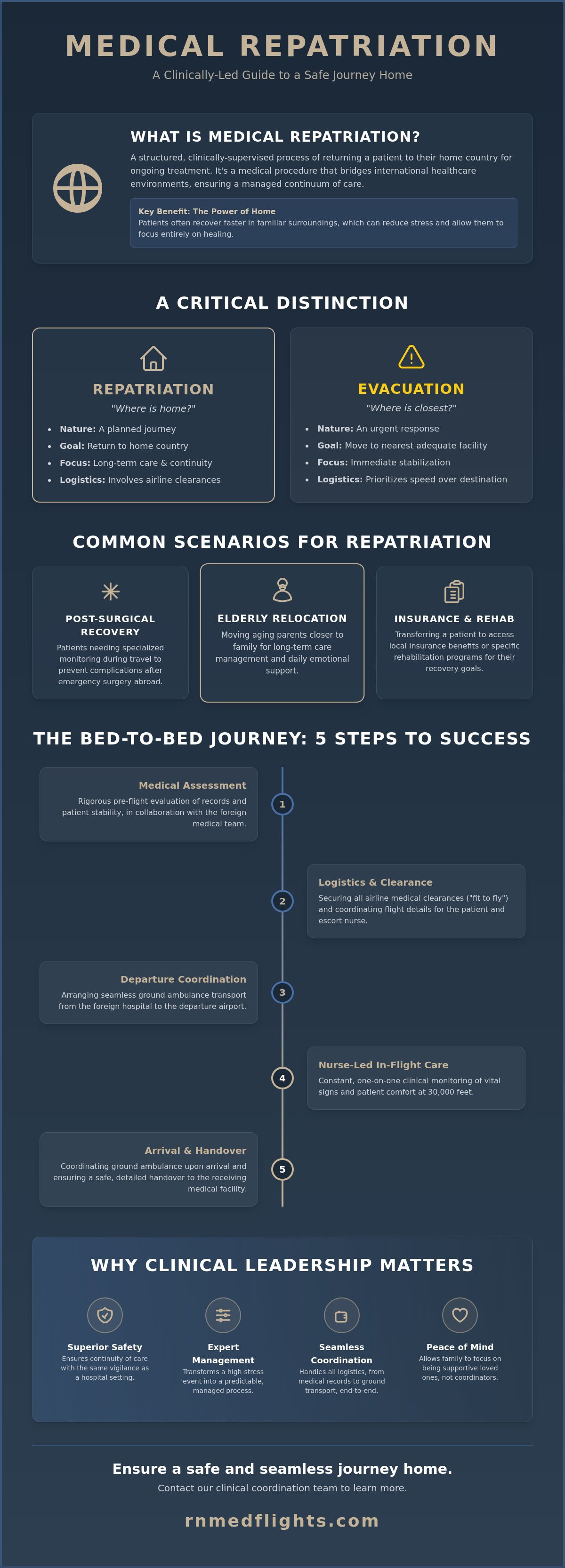
Medical repatriation is the structured, clinically-supervised process of returning a patient to their home country or a local healthcare facility for ongoing treatment. In a 2026 context, this is far more than a logistical arrangement. It's a sophisticated medical procedure that bridges the gap between international clinical environments. For many families, the decision to repatriate isn't just about logistics; it's about the psychological power of home. Clinical studies suggest that patients often recover faster and more effectively when they're surrounded by familiar support networks and can communicate in their native language. Familiarity reduces cortisol levels and helps the patient focus entirely on healing.
This journey requires a steady hand and deep clinical expertise. We view every transfer as a managed continuum of care, where safety is the non-negotiable priority. By utilizing a nurse-led approach, we ensure that the patient's stability is monitored with the same level of vigilance found in a hospital setting. This clinical leadership transforms a potentially high-stress event into a predictable, sequential series of steps. It allows families to step back from the role of coordinator and return to the role of a supportive loved one, knowing the medical details are handled by experts. In the field of medical repatriation, the focus is always on the person, not just the case.
To better understand how this process works in practice, watch this helpful video:
Repatriation vs. Evacuation: A Critical Distinction
It's vital to distinguish between medical evacuation and repatriation. An evacuation is an urgent, life-saving response designed to move a patient to the nearest adequate medical facility. The goal is immediate stabilization. Repatriation, however, is a planned journey back to the patient's home country or a specific long-term care facility. While evacuation focuses on the "where is closest?", repatriation focuses on "where is home?". This change in intent significantly alters the logistical requirements, as repatriation often involves coordinating with two sets of medical teams and securing airline clearances for commercial travel.
Common Scenarios Requiring Repatriation Services
Families seek these specialized services for various reasons, all centered on continuity of care and emotional security. Common situations include:
Post-Surgical Recovery: Patients who underwent emergency surgery while traveling and need specialized monitoring to prevent complications like deep vein thrombosis during the flight home.
Elderly Relocation: Moving parents from overseas to be closer to family members who can manage their long-term health needs and provide daily emotional support.
Insurance and Rehab Alignment: Transferring a patient so they can access their local insurance benefits or specific rehabilitation programs that are better suited to their long-term recovery goals.
Each case is unique, but the goal remains the same: a safe, nurse-led transition that prioritizes the patient's well-being above all else. By managing the clinical and logistical details, we ensure that the path home is as smooth as possible.
The Clinical Process: Ensuring Patient Safety at 30,000 Feet
Every safe journey begins long before the aircraft leaves the tarmac. The foundation of successful medical repatriation is a rigorous pre-flight medical assessment. We don't just look at a hospital chart; we evaluate the patient's physiological readiness for the unique stresses of high-altitude travel. This evaluation includes assessing how cabin pressure changes might affect oxygen saturation and fluid balance. Furthermore, screening for healthcare-associated infections is a vital safety measure; to learn about testing options, read more. We collaborate directly with foreign treating physicians to secure comprehensive medical records, ensuring no detail of the patient's history is overlooked during the transition.
During the flight, clinical monitoring protocols remain constant. We track vital signs in real-time, including pulse oximetry, blood pressure, and heart rate. Managing medication schedules becomes complex when crossing multiple time zones, but our nurses handle these calculations meticulously. They ensure that therapeutic levels remain stable throughout the transit, regardless of the flight duration. If a patient requires oxygen therapy, we manage the logistics of airline-approved concentrators and precise flow rates to maintain respiratory stability at all times.
The Role of the Licensed Flight Nurse
A flight nurse is the clinical heartbeat of the journey. These professionals carry advanced certifications such as ACLS (Advanced Cardiovascular Life Support) and have extensive experience in critical care environments. They understand the nuances of aviation medicine, which is essential when managing a patient in a pressurized cabin. Beyond their technical skills, they serve as the patient's primary advocate. They bridge the communication gap with airline staff and provide the emotional reassurance families need during a high-stakes transfer. If you're concerned about a specific diagnosis, you can consult with our clinical leadership to discuss a tailored care plan.
In-Flight Medical Equipment and Interventions
We transform a standard commercial seat into a mobile care environment using portable, high-precision monitoring devices. These tools allow for continuous assessment of oxygen levels and cardiac rhythm. While we plan for a smooth journey, our nurses are prepared to handle medical emergencies within the cabin using specialized intervention protocols. Every clinical action is documented through precise charting, which provides a seamless record for the receiving medical team at the destination. This level of detail ensures that the continuity of care is never broken during medical repatriation, providing peace of mind for the family and the patient alike.
Comparing Transport Options: Commercial Escort vs. Air Ambulance
Choosing the right mode of transport is a pivotal decision in the medical repatriation process. While private air ambulances are essential for patients requiring ICU-level care or continuous mechanical ventilation, they're often unnecessary for those who've reached clinical stability. For many, a Commercial Airline Medical Escort provides a sophisticated, nurse-led alternative that maintains a high standard of care without the extreme costs of a private jet. This option allows the patient to travel in a standard cabin while under the constant vigilance of a medical professional.
We often encounter a stigma around commercial travel, where families feel that a private jet is inherently safer. However, for stable patients, commercial aircraft offer several clinical advantages. The larger cabins provide superior air filtration and a more stable flight environment, which helps reduce the physical toll of turbulence on a recovering body. Choosing a commercial route isn't about compromising on safety; it's about matching the level of care to the patient's actual medical needs. For patients who are mobility-impaired but stable, a Commercial Airline Stretcher Service serves as a vital middle ground, allowing for a recumbent position throughout the journey.
Financial Realities: Cost Savings of Commercial Repatriation
One of the most significant benefits of this approach is the financial relief it offers families during a crisis. Opting for a commercial escort typically results in a 40-60% cost reduction compared to private medevac services. Our quotes are transparent and comprehensive, covering the medical professional’s fees, airline tickets, and all necessary clinical supplies so there are no surprises. Commercial flights are the gold standard for stable medical relocation because they balance clinical safety with logistical efficiency.
Comfort and Logistics: The Commercial Experience
Comfort is a clinical priority, not just a luxury. We often utilize business class seating because lie-flat beds allow for better circulation and pressure management during long-haul flights. Our team handles the entire MEDIF (Medical Information Form) process to secure airline clearance, ensuring the airline recognizes the patient as a priority for boarding. We also manage layovers with precision, utilizing airport lounges or pre-arranged medical rooms to ensure the patient can rest in a quiet, controlled environment between flight segments. This end-to-end management minimizes the cognitive and physical load on the family, allowing them to focus entirely on the journey home.
The Bed-to-Bed Journey: 5 Steps to a Successful Repatriation
Successful medical repatriation is a sequence of carefully managed clinical and logistical milestones. We manage every detail through a five-step bed-to-bed process, ensuring that the continuity of care is never interrupted. This methodology reduces the cognitive load on families, allowing us to serve as the single point of contact for the entire journey. By following a structured roadmap, we transform a complex international relocation into a predictable and safe transition.
Step 1: Initial Clinical Consultation and Quote Generation. We begin with a comprehensive review of the patient's current condition and your goals for the relocation. This results in a transparent, all-inclusive quote that covers all clinical, logistical, and travel requirements.
Step 2: Medical Records Review and Airline Clearance Coordination. Our clinical leadership reviews foreign medical records to confirm "fit to fly" status. We then manage the complex MEDIF (Medical Information Form) application process with airline medical departments to secure official travel approval.
Step 3: Ground Ambulance Dispatch. We coordinate high-acuity ground transport to move the patient from their current hospital bed to the departure terminal. This includes managing tarmac access or specialized terminal logistics for a smooth transition.
Step 4: The Flight Journey with Continuous Nurse Supervision. Your dedicated flight nurse provides one-on-one care throughout the flight. They manage vital signs, medication titration, and any necessary clinical interventions while maintaining the patient's comfort.
Step 5: Handover to the Receiving Facility or Home Care Team. The journey ends only when the patient is safely settled. We provide a detailed clinical handover to the receiving medical team, ensuring they have all the data needed to continue the recovery process.
Ground Ambulance Coordination
The "first and last mile" of a journey are often the most complex logistical segments. We ensure seamless handoffs between ground and air teams by managing every detail of the ambulance dispatch. This includes coordinating with airport authorities for tarmac access and navigating local traffic patterns to minimize transit time. Our focus remains on maintaining a steady clinical environment during these transitions, ensuring that the patient's stability is never compromised by the move between vehicles. If you are ready to begin this process, you can request a clinical consultation today.
International Logistics and Documentation
Global transfers require more than just medical skill; they require administrative precision. Our team navigates the complexities of customs, immigration, and medical visas to prevent any delays at international borders. We also manage the strict TSA rules for medical equipment and secure necessary permits for in-flight oxygen use. By working within our established international medical repatriation services pillar, we ensure that every administrative requirement is met before the patient even leaves their hospital room. This proactive approach eliminates the friction often associated with international travel, allowing for a calm and focused journey home.
Choosing Your Repatriation Partner: Why Clinical Leadership Matters
Selecting a provider for medical repatriation is one of the most critical decisions a family will make during a medical crisis. It's important to understand that a clinically-led medical transport firm operates differently than a standard travel agency or a general assistance company. While a travel agency focuses on ticket logistics and itinerary management, a clinically-led organization views the journey as a medical mission. We prioritize patient outcomes by integrating clinical assessment into every logistical step, ensuring that the medical needs of the patient dictate the travel plan, not the other way around.
Veteran-owned and nurse-led organizations bring a unique level of discipline and clinical vigilance to the process. This leadership structure ensures that every decision is filtered through the lens of patient safety and operational excellence. We maintain a constant, unwavering presence for our clients, providing 24/7 communication to alleviate the anxiety that naturally accompanies an international transfer. Having a direct line to the clinical team managing your loved one’s care provides a sense of security that the logistics are being handled by experts who view the patient as a person, not just a case number.
Before booking a service, we recommend asking potential providers these essential questions:
Who provides the clinical oversight for the mission?
Are your flight nurses certified in critical care and ACLS?
How do you handle medical emergencies in a commercial cabin?
Do you provide end-to-end, bed-to-bed responsibility, including ground coordination?
What is your process for securing official airline medical clearance?
The RN MEDflights Standards of Care
Our commitment to bed-to-bed medical transport means we take full responsibility for the patient from the moment we arrive at the sending hospital until they're settled at their destination. We assign a dedicated flight nurse to every mission, ensuring continuity of care and a consistent clinical presence. Our clients often share stories of the relief they felt when our team stepped in, transforming a chaotic situation into a managed, peaceful journey home. These testimonials reflect our core belief that clinical precision and human empathy must work in tandem.
Next Steps: Initiating the Repatriation Process
Starting the journey home is a straightforward process when you have the right partner. To provide an accurate quote and clinical plan, we'll need basic medical information, including the patient's current diagnosis, stability, and oxygen requirements. Once we have these details, our team works quickly to coordinate with foreign physicians and airlines. The timeline for launch often depends on airline clearance protocols, but we move with the urgency that your situation demands. If you're ready to bring your loved one home, contact RN MEDflights for a compassionate consultation and quote. We're here to provide the steady hand and medical expertise you need to navigate the path forward.
Securing a Safe Path Home for Your Loved One
Navigating the clinical and logistical hurdles of an international medical crisis is a heavy burden, and it's a vulnerable time for any family. We've explored how medical repatriation serves as a vital bridge, connecting foreign hospital rooms to the familiar comfort of home. Choosing a nurse-led approach ensures that every mile of the journey is managed with technical precision and genuine empathy. By opting for a commercial medical escort, you can access a cost-effective solution that maintains the highest standards of safety and continuity of care.
Since 2010, our veteran-owned and nurse-led team has maintained a 100% safety record for commercial medical escorts. We take full responsibility for the entire bed-to-bed process, from the first medical record review to the final handover at the receiving facility. You don't have to manage these complexities alone. When you're ready to take the next step, Request a Transparent Medical Repatriation Quote from RN MEDflights. We're here to provide the steady presence and medical expertise your family deserves during this transition. Your loved one's safe return is our singular focus.
Frequently Asked Questions
What is the difference between medical evacuation and medical repatriation?
Medical evacuation is the urgent transport of a patient to the nearest hospital capable of providing immediate stabilization during a crisis. In contrast, medical repatriation involves the planned return of a stable patient to their home country for long-term recovery and continuity of care. While evacuation is a reactive measure for immediate safety, repatriation is a proactive step toward
healing in a familiar environment with local support networks.
Does travel insurance cover the cost of medical repatriation?
Travel insurance coverage for medical repatriation depends entirely on the specific terms of your policy. Many standard policies include medical evacuation to the nearest suitable facility but may not automatically include returning the patient to their home country once they are stable. It's essential to review your policy for language regarding medical return or repatriation and consult with your provider to understand their specific criteria for coverage.
Can a patient fly on a commercial airline if they need oxygen?
Yes, patients can fly on commercial airlines with oxygen, provided they use an FAA-approved Portable Oxygen Concentrator (POC). Airlines generally don't allow the use of compressed oxygen tanks in the cabin for safety reasons. Our clinical team manages the entire airline clearance process to ensure the carrier is aware of the medical equipment and that the flow rate is monitored correctly throughout the flight.
How much does international medical repatriation typically cost?
The cost of international medical repatriation is determined by several logistical factors, including the flight distance, the level of seating required, and the specific medical equipment needed. Generally, a commercial medical escort is significantly more cost-effective than a private jet. Because every case is unique, we provide a transparent, all-inclusive quote after reviewing the patient's clinical needs and travel route to ensure there are no unexpected fees.
What are the requirements for a patient to be cleared for a commercial flight?
To be cleared for a commercial flight, a patient must be clinically stable and deemed "fit to fly" by both the sending physician and the airline’s medical department. This process requires a thorough review of medical records and the submission of a Medical Information Form (MEDIF). The airline assesses whether the patient can travel safely, taking into account factors like oxygen needs, mobility, and the ability to tolerate cabin pressure changes.
Who coordinates the ground ambulance transport during repatriation?
Your repatriation provider coordinates all ground ambulance transport as part of a comprehensive bed-to-bed service. This includes managing the dispatch of high-acuity vehicles at the departure city and ensuring a receiving ambulance is waiting at the arrival airport. This seamless coordination ensures that the patient remains in a controlled clinical environment during every transition between the hospital and the aircraft, maintaining the continuity of care throughout.
How long does it take to arrange a medical repatriation from overseas?
Arranging a repatriation from overseas typically takes between 24 and 72 hours. The timeline is largely dependent on how quickly the airline medical department processes the clearance forms and the availability of foreign medical records. Our team works with urgency to minimize delays, managing all communications with the airline and the treating hospital to launch the mission as soon as the patient is clinically cleared for travel.
Can a family member fly with the patient and the medical escort?
Yes, family members can usually fly with the patient and the medical escort on commercial flights. We often encourage family presence as it provides significant emotional support for the patient during the journey. Our team coordinates the booking of adjacent seats in economy or business class to ensure the family stays together while the flight nurse maintains a constant clinical watch over the patient's stability.


